
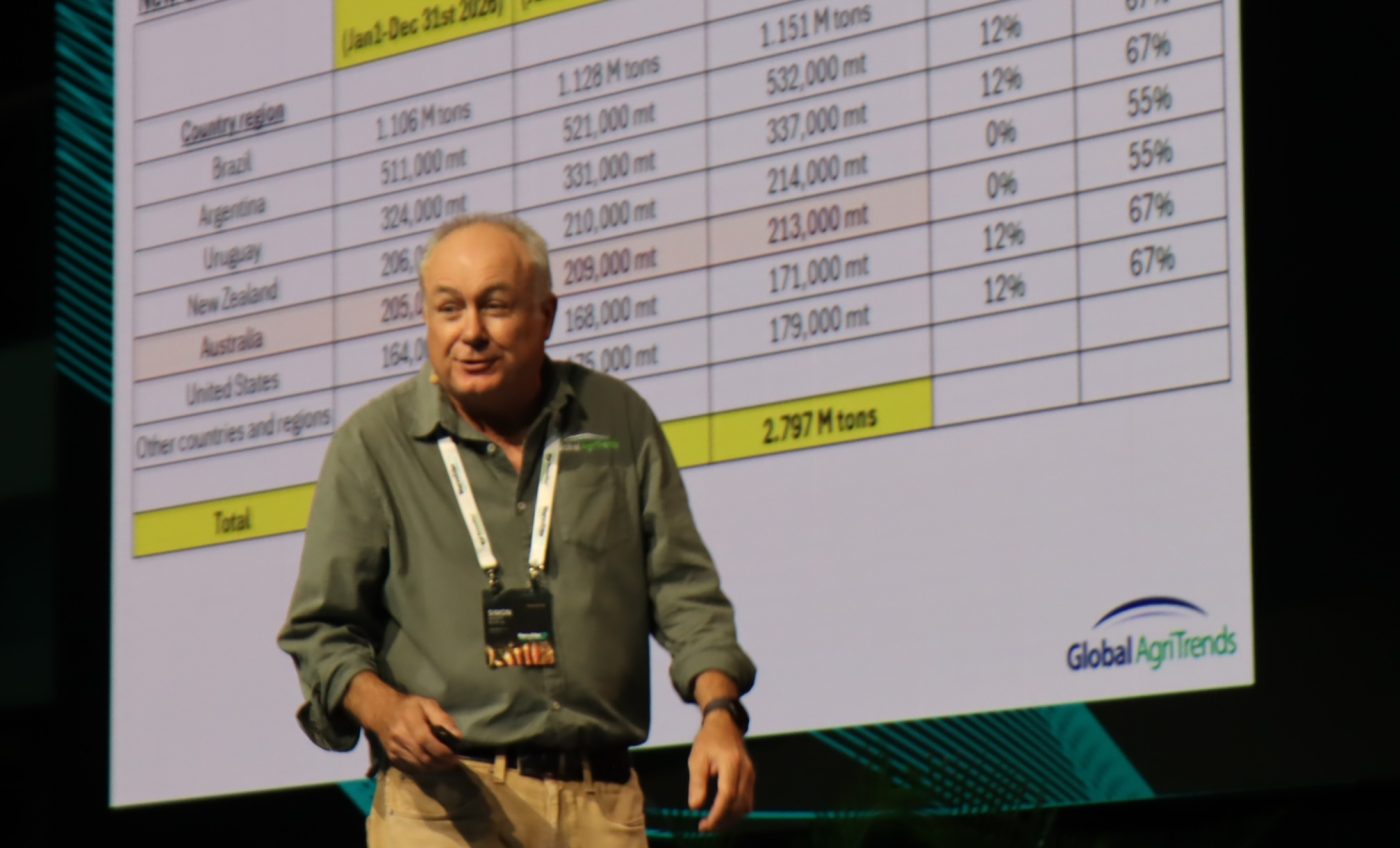
Australian cattle market analyst Simon Quilty believes multiple global beef markets are approaching critical “tipping points”, which is setting the stage for stronger cattle prices into 2026 and beyond.
‘We’re well on the way’
Two years ago Mr Quilty addressed the Australian Wagyu Association’s WagyuEdge conference and made the bold prediction we would see Australian cattle prices double in 2026.
Two years on the forecast has not aligned with current pricing, but, as he told the WagyuEdge 2026 conference in Brisbane this morning, he believes the fundamental drivers remain firmly intact, just delayed.
“And the reason is because we have got to these prices today, because of global demand.
“Because it’s been extraordinary.
 “But next year, it will be rebuilding in North America, rebuilding in Australia, and then the rebuild also in Brazil, that will lift these prices to the next level.”
Mr Quilty said that back in 2024 when he made the forecast, he truly believed the rebuild would have commenced by now.
“But I now am of the opinion that by middle of this year, calf prices have started to lift, one of the early indicators that we will be in a form of rebuild.
“So for what it’s worth, I’ve delayed the doubling till next year. Call it a cop out. But nonetheless, we’re well on the way.”
Mr Quilty offered his assessment of the current state of play in several key markets, including his view on whether a demand or supply “tipping point” has past, is present or about to happen in each market.
(What is a ‘tipping point’? For clarity he offered the following definition – ‘we define tipping point as the critical point in a situation, process or system, beyond which a significant effect or change takes place. So there can be a supply tipping point, there can be a price tipping point, and it can be up or down, but when it happens, it’s significant’.)
Mr Quilty said he believes demand tipping points are either here or emerging in the United States, South Korea, Japan, Europe and South East Asia, and supply tipping points are in play across the US, Japan, South Korea and Australia.
Here is how he summarised each segment in more detail:
Is the US at a tipping point today?
The clear answer was “no”.
In actual fact, there was “enormous upside”, Mr Quilty said.
“I think, for not just Wagyu, but the entire quality end of the market, and it all starts with the consumers’ obsession in America with protein today.”
 One example was the huge take-up weight loss drugs (ie Ozempic). 13.3 percent of Americans today, or the equivalent of 46 million people, are on weight loss drugs. The expectation is that within three years, that will be 92 million.
“An important part of that diet is the requirement of having protein and meat sits right there at the very, very top of that.
“And what’s important is this is not a cheap drug. These are expensive, and the people that are on them that are consuming protein at a higher rate have money to spend.”
The US Government’s 2025 decision to turn the food pyramid “upside down” and elevate the importance of meat in diets while reducing the emphasis of carbohydrates was another example.
The rundown of the US cattle herd to a 74-year-low of 86.2 million head will continue to exert a major influence over Australia’s cattle market.
The US industry has adapted by producing heavier and heavier carcase weights, from an average of 763 pounds in 1997 to 30 percent heavier today.
A net effect is that they have also improved quality. The percentage of US beef production grading prime has increased from 2 percent in the 1990s to 14 percent now. At the same time, ungraded beef has reduced from 13pc to 3pc.
Australia needed to continually focus on driving quality higher in order to compete.
China creates short-term disruption
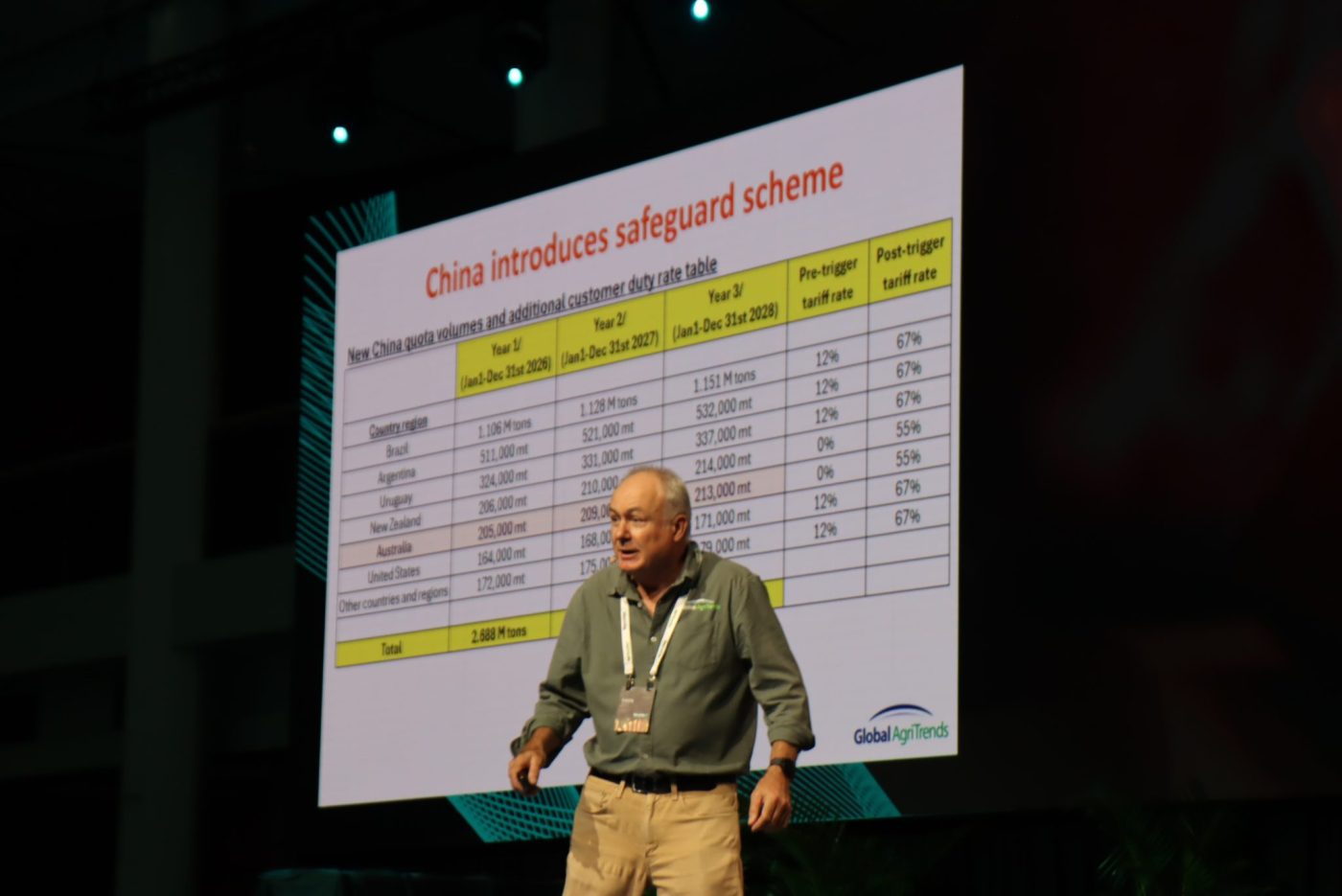
China presents a near-term challenge, with safeguard tariffs limiting Australian exports and creating a potential tipping point.
“We shipped 300,000t last year. So we have a problem here, because a third of our exports to China cannot go there this year, or if it does, it has to pay a 55 percent tariff.”
However, Mr Quilty said the impact is likely to be contained and relatively short-lived.
“So my point to you is, if we are at a tipping point with China, I think it’s very short term.
“Are we likely to see a major correction in price, possibly, but… demand in America is so high, I think on most items, we dodge the bullet.”
Middle East trade adapts despite conflict
Representing only 3pc of Australia’s overall beef exports, it may be tempting to dismiss the Middle East as not a big deal.
But in actual fact, Mr Quilty pointed out, about 23 percent of all grainfed tenderloins end up in the Middle East.
“So it does matter, and what we’ve seen is a remarkable ability for Australia to get product into the Middle East.”
When the war began shipments to the region fell by a third, but over the last month they have recovered.
“To the credit of every exporter in Australia, they have found a way.
“They have shipped through places like Dubai, through Saudi Arabia, they’ve gone across land, they have done everything possible, and they’ve also gone from chilled to frozen to give flexibility.”
Despite that success Mr Quilty warned the region remains exposed to ongoing geopolitical risk.
Japan and Korea tightening on supply
In North Asia, both Japan and South Korea have reached supply tipping points after several years of herd liquidation.
“Overall the expectation is that Japan production will be down 4pc this year, with falling supply as we go forward.
“Japan prices have been problematic for the last two years because of that large production, but my expectation is that we actually start to rise as we move forward.
“… my point on Japan is that they have had a tipping point. It is supply. It’s not price.
“And from here on with Japan, prices move higher and demand gets greater for Australian beef.”
South Korea was on a similar trajectory.
“In Korea, have they reached a tipping point? And the answer is yes as well, but on supply, just like Japan, and the net effect is that the Hanwoo market they have been liquidating the herd now for four years since 2022, and in the last quarter of last year, a whopping 5.1pc fall in terms of their overall production.
“Once again, they are going to be short of high quality beef. And in actual fact, Korea looks like an even bigger opportunity to me than Japan does for the Wagyu sector.”
Domestic market under pressure for now
Australia’s domestic market was fickle and has been temporarily impacted by displaced export product, creating short-term pressure.
“We’ve seen problems in the Middle East and we’ve seen problems with safeguards, in China, and in the short term, we have pivoted product onto our domestic market, and it has suffered as a result,” he said.
“So the net effect is that, I think for the short term, we have reached a tipping point on our domestic market.
“But within two to three months, I think we come out of it as we get into the demand season at the back end of this year.”
Structural shift toward quality beef in Australia continues
“Another thing to keep in mind is also the lack of herd in Australia, just like America,” Mr Quilty said.
“We’ve seen the Wagyu herd here upgrade itself.”
Anecdotal evidence from talks with many processors and suppliers indicated that, where about 80pc of Australia’s Wagyu production was between Marble Scores 3-6 four years ago, today it was the reverse.
“In actual fact, we produce 80 percent of six and above marble scores, just like that enormous improvement of quality across America…
“We too have stepped up to compete, and I don’t think that stops.
“In actual fact, I’m of the opinion that Australia will continue to make huge leaps forward when it comes to the herd and the marble score and in parts of Victoria Tasmania today, F1s are averaging 7.2 marble scores consistently.
Europe: FTA “too little, too late for Australia”
While Europe remains the highest-value beef market globally, limited quota access remains a major constraint after the disappointing conclusion to the recent AU-EU Free Trade Agreement negotiations.
“What’s disappointing is that we only got a very small amount of access for grain fed beef at 13,770t, of which for the first five years, we can only ship half of that.
“And what we need is more grain fed access. 80c of our exports go into Europe as grain fed and yet what we’ve got is really grass fed access, which is not what we need.
“So on many levels, this agreement, the volume is too low. In actual fact, it will become an administrative nightmare, because now there’s six quotas of beef to manage. That requires potentially six health certificates, and the volumes are so small that for any of the 10 processors/exporters that are in this market, you’re talking about 300 metric tons each to ship in the next five years.
“Simply too little, too late, and right now, with all the uncertainty around the world, we needed better access.”
Herd rebuilding to commence this year
The bottom line was that herd rebuilding is likely to commence this year, Mr Quilty said.
“Herd rebuilding is likely to commence this year.
“Trump’s pause on tariffs helps keep customers avoid recession.
“We have a demand driven cattle cycle that is going to turn into a lack of supply driven market soon. ”
Price peak expected in 2027
Mr Quilty said Wagyu prices have been subdued, but he is expecting some premiums to reappear by the end of this year.
“I’m of the opinion that we will see Angus by the end of this year get to 580-$6 and that we’ll see F1s get to a 30 to 40 cents a kilo premium.
“By the middle of next year, or late next year, I’m expecting Angus prices not to get to the 750, but to be at 680 to $7.
“And that the Wagyu premium in the north probably will be on F1 at about a 70 to 80 cents premium, but in the south, $1 a kilo premium. That’s my outlook.”
While short-term disruption remains, Mr Quilty said the broader outlook is underpinned by strong fundamentals.
“Opportunities are there and will present themselves – we just need the Iran war to stop.”