
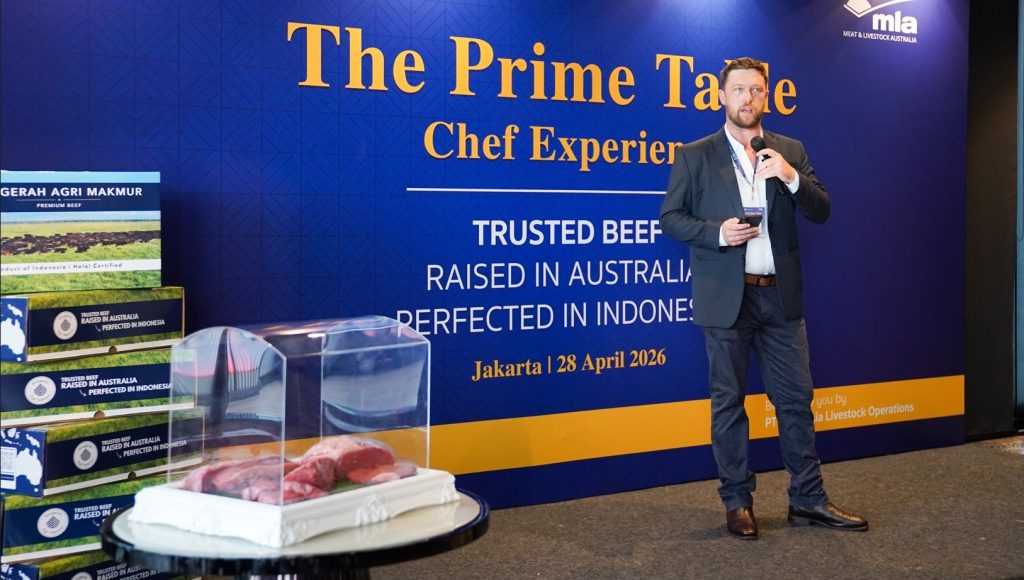
ILO General Manager Jack Webb during the recent launch of AAM’s new beef brand in Indonesia
A RECENTLY launched branded beef program is exploring higher quality beef opportunities in Indonesia, built around northern Australian live export cattle.
The new brand program launched last month by AAM in partnership with its subsidiary PT Indonesia Livestock Operations, is called Anugerah Agri Makmur – Bahasan for ‘Grace, Agriculture, Welfare.’ The brand uses the tag, “Premium boxed beef raised in Australia and perfected in Indonesia.”
Central to the program are composite cattle carrying some Wagyu genetic content bred on AAM’s Northern Territory stations northeast of Kununurra on the WA/NT border, and backgrounded near Daly Waters before live export out of Darwin or Wyndham.
The supply chain brand development move marks a strategic expansion into the high-quality Indonesian protein market.
More than 100 meat industry identities, chefs, social media influencers and Australian beef industry stakeholders took part in an official launch a fortnight ago at Jakarta’s Westin Hotel. With support from Meat & Livestock Australia, the launch featured cooking demonstrations by one of Indonesia’s leading food content creators, Dims the Meat Guy.
The new brand carries no specific claims nor references to the word, ‘Wagyu’, but is simply using the breed’s genetic potential to deliver higher levels of meat quality than that seen in conventional live export cattle.
As reported earlier, there has been a trend among some large northern Australian pastoral operators over the past few years to introduce Wagyu genetics into extensive northern herds. The primary reason has been to lift fertility performance, with meat quality improvement considered more of an ‘added bonus.’
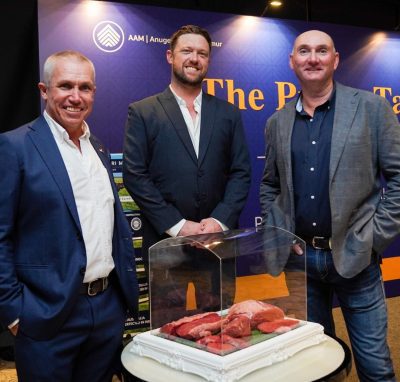
Tim Gallagher, Portfolio Manager, NT and Indonesia, Jack Webb, General Manager, ILO and Cye Travers, Director, Value Added Beef and Lamb Supply Chains, during the recent Jakarta brand launch
AAM, together with other large pastoral operators like Consolidated Pastoral Co, Hughes Grazing and others have moved down the Wagyu genetics path in some of their northern Australian herds – but AAM’s new brand program in Indo is arguably the first to attempt to segment this new genetic direction.
AAM’s portfolio manager for the Northern Territory and Indonesia, Tim Gallagher, told Beef Central the pilot program is currently processing around 50 head per week, with most of the product being sold into selected food service customers including hotels and restaurants.
Most of the composites involved in the program carry 25pc to 50pc Wagyu genetics, using high performance Fullblood bulls internally bred by AAM at Tamworth. Dams are mostly composites carrying Brahman/Droughtmaster/Shorthorn/Belmont Red/ Senepol genetics, some carrying some Wagyu genetics.
AAM has had some cattle custom-fed at the BPS feedlot near Jakarta for a couple of years, before moving into a trial under the new branded program earlier this year.
The cattle are fed for 120-150 days – a relatively long duration by Indonesian lotfeeding standards, but still quite short, by Wagyu feeding conventions – with typical carcase weights around 280-320kg. Rations are typical Indonesian feedlot rations – not a Japanese style Wagyu diet.
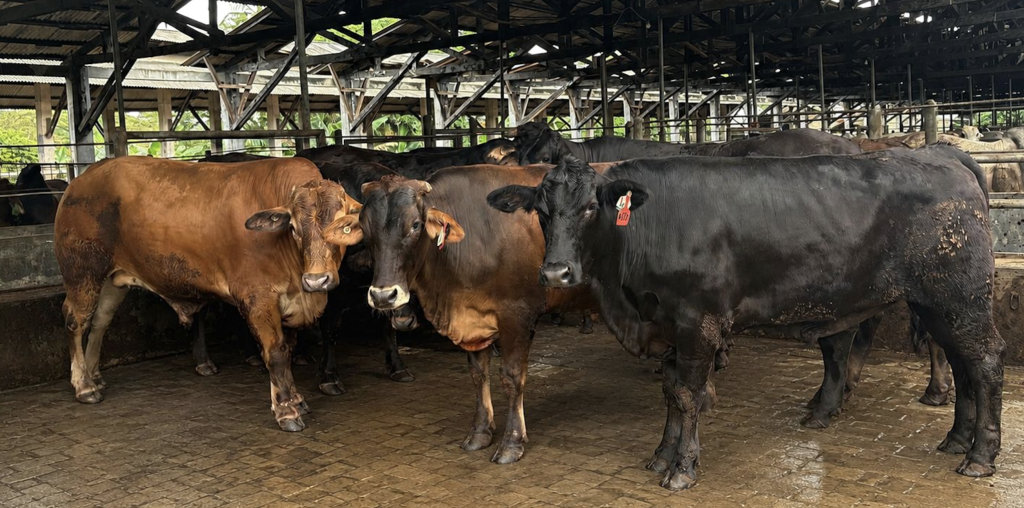
The finished cattle (see sample image above, taken in the Tum feedlot) are processed at what could best be described as a ‘western style’ AusMeat-accredited research abattoir attached to IPB University, Bogor. Principles similar to the Meat Standards Australia grading program are applied, to underpin eating quality consistency.
The key objective is not specifically to produce marbling in the finished beef, but is more about elevated meat quality and consistency, Mr Gallagher said.
“Given the genetics, obviously we are seeing some marbling in the carcases, but that is not the main objective,” he said.
 Marbling scores of 2-3 are not uncommon – something similar to better shortfed flatback type animals in an Australian feedlot.
Separate from AAM’s composite venture, some other Indonesian lotfeeders are already longfeeding some Australian-bred Wagyu feeder cattle, specifically to achieve marbling outcomes. AAM’s high grade Wagyu cattle lines are fed through a separate partnership with the Santori Japfa business in Indonesia, alongside their own Wagyu cattle program, marketed through their Tokusen Wagyu brand sold throughout restaurants, food service, supermarkets and high end meat shops in Indonesia.
During the recent WagyuEdge conference in Brisbane, Santori told Beef Central it had been achieving average marbling scores of 4.6 on F1 cattle fed 350-400 days.
Early reaction
Early reaction from food service customers in Jakarta to AAM’s new Anugerah Agri Makmur brand program has been excellent, Mr Gallagher said.
“It’s really about trying to extract the optimum value from each animal AAM produces,” he said.
“The right cattle will be put through this program, while the straight Brahmans and Brahman crosses fed in Indonesia will go through other channels – the wet market, for example.”
“The customers we’ve already established for the new brand are asking for more volume, but we want to get the brand supply chain process right on these smaller volumes, before we consider expansion,” Mr Gallagher said.
“But the AAM northern herds are getting softer in genetic make-up, and we definitely see growth potential ahead for projects like this. It’s been part of the motivation to start this up,” he said.
New benchmark
During the program launch ILO General Manager Jack Webb said the brand represented a new benchmark for boxed beef bred in Australia and fed and processed in Indonesia to Australian equivalent standards.
“We are not just importing an idea of quality, we are reproducing it, end-to-end. Anugerah Agri Makmur delivers on the strength of Australian production, supported by local expertise on the ground here in Indonesia, with full traceability every time,” Mr Webb said.
“This integrated approach gives us something very powerful: confidence in every box of AAM beef, confidence that it is processed locally to the highest standards, and confidence that we are building a sustainable, long-term solution and strengthening food security in Indonesia.
“Indonesia can benefit from knowing there’s an increase in production locally where quality is not substituted, and our supply chains become more efficient, more transparent, and more resilient.”
Tim Gallagher said AAM saw enormous opportunity in continuing to grow and evolve its close working relationship with Indonesia.
“AAM’s first direct live export shipments to Indonesia started two years ago, and since then we have exported about 31,000 head to supply partners and the feedlots we are managing,” he said.
“We proudly support Indonesian President Prabowo’s Free Nutritious Meals program and AAM is currently supplying four school kitchens with beef to support this program, with the hope of increasing this in the future.
“We are grateful to our customers and business partners who have helped us achieve our goal of supplying trusted beef, raised in Australia and perfected in Indonesia, to chefs, butchers and food service.”
“This is an exciting step for live export into Indonesia – it’s producing a different product than the typical conventional boat trade animal, and by being up there, engaged in the market, it’s given us the opportunity,” he said.
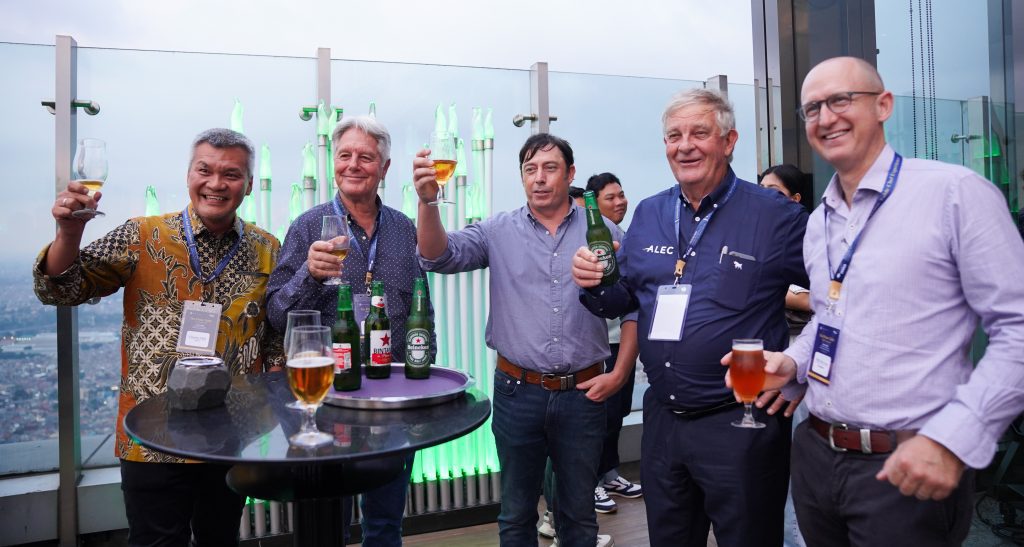
Toasting the success of the new AAM brand program in Jakarta with a cold Bintang were Charles Mok, Ross Ainsworth, Patrick Moran, Chris Back and Will McEwin.
Asked whether any of the Wagyu composites off AAM’s Northern properties had ever been lotfed in Australia, Mr Gallagher said we see value in feeding programs both domestically and internationally to supply into that market.
We also asked about future prospects for ‘re-export’ of premium beef produced under the Anugerah Agri Makmur brand program, into other Southeast Asian countries.
“There may be some potential there, but it is nothing we have explored at this stage,” Mr Gallagher said.