
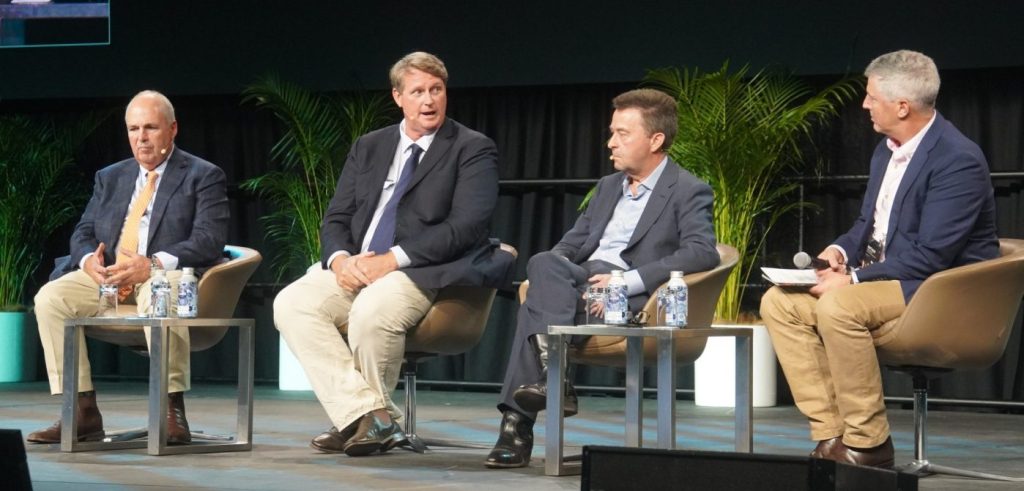
JBS’s Edwin Cooke provides a response during a lotfeeding panel session held at last week’s Wagyu Edge conference
HOW substantial is the Wagyu ‘footprint’ in northern Australia?
The question came up multiple times during last week’s WagyuEdge conference in Brisbane.
Somewhat embarrassingly for the broader industry, nobody knows, with any degree of certainty.
During a lotfeeding panel session at Wagyu Edge last week, JBS’s Edwin Cooke said it was probably under-estimated as to how much impact Wagyu genetics was having in Australia’s northern breeding herd.
“Australia currently has a cattle herd of around 30 million head, and its arguably among the youngest, most fertile breeding herd we’ve ever had,” he said.
“But within that, there’s now a lot of Wagyu influence out there, in the north. There’s guys in this room who swear by the influence they (Wagyu bulls) are having on calving and weaning rate improvements they have seen, since their introduction. It’s real, and we’re seeing it right across from the Kimberleys, the Territory and North Queensland,” Mr Cooke said.
“Yes, those bulls are being used over a Brahman base, but the lift in those progeny is unbelievable, and it’s making a real impact on the Australian herd makeup,” he said.
“We (Australia) can’t run a large lotfeeding sector without a lot of feeder cattle and a lot of fertility in our herds, and in the north, a significant and growing part of that is down to Wagyu genetics that are coming through.”
Mr Cooke said it would be fascinating to establish what percentage of our herd now is Wagyu influenced. “I’d suggest the number is now quite large,” he said.
Producer surveys add little
ABS used to ask a series of census questions about breed content as part of its three-yearly statistical survey, but that stopped years ago.
Meat & Livestock Australia’s annual producer intentions survey includes responses about genetics in use, but it adds little value to the discussion on northern Wagyu impact, because questions relate to female (breeding herd) genetics, not their progeny (ie F1 calves produced by Wagyu bulls).
 MLA says the reason for this is that its survey is primarily focussed on what the breeding herd looks like – not population-scale genetic composition. It’s survey methodology defines ‘breed’ as being 51pc or more of breed content.
Consequently, MLA’s most recent producer intentions survey suggests Wagyu accounts for only 4pc of all breeding females in the Northern Australia region (Queensland, NT and the top third of WA),and just 2pc in southern Australia. A total of 2271 producers across the Northern Australia region provide responses to the survey.
While that 4pc figure may technically be correct in terms of breeder composition, it gives a misleading impression about the impact that Wagyu (via sire genetics) is currently having across the northern half of the continent.
What is known is that the same very large commercial cattle operators in Northern Australia’s Kimberley/Pilbara, Victoria River District, Barkly Tableland and Queensland’s Gulf Country and Northwest have employed Wagyu bulls in recent years.
While the full list is considerably longer, the prominent northern names known to be employing Wagyu genetics include AAM, CPC, Hughes Grazing/Georgina, AA Co, Hancock Agriculture/Kidman and others.
Three strategies
The application appears to fall into three categories, conversations with stakeholders during Wagyu Edge suggests.
- Some are simply using Wagyu to lift fertility and calving performance in their beef herds, with no intention of making any ‘Wagyu’ claim.
- Others are embedding Wagyu genetics more methodically in northern composite programs, typically 50-75pc, to improve meat quality, as well as fertility, Beef Central was told. How these calves are described in future brand claims remains to play out.
- Still more are relying on Wagyu’s strong reputation for hardiness to produce F1s and F2s out of a tropically adapted cow base to feed into Queensland and NSW feedlot Wagyu F1 brand programs.
“Go back a few years, and a Wagyu bull over anything you could get a price for,” one northern stakeholder told Beef Central.
“There’s a fair few cows about now in northern Australia that people might now loosely call ‘Brangus’, that in fact might represent something like Wagyu x Santa genetics. That’s happened either intentionally, or unintentionally, where some F1 heifers that were hard to sell ended up in the breeding herd.”
He said some eastern states lotfeeders had had ‘sub-optimal’ experiences long-feeding those ‘North Queensland or Territory’ Wagyu, failing to produce satisfactory satisfactory marbling performance, by F1 standards.
Many of those type of F1s may now be going into larger ‘generic’ 150-day programs, without any Wagyu identity attached, he thought.
Surprising performance in Indo feedlots
However their performance in other markets has been surprising.
A large Indonesian lotfeeding business attending last week’s WagyuEdge conference in Brisbane told Beef Central it has been averaging marbling scores of 4.6 on Wagyu x tropically-adapted F1 feeders live exported out of Darwin or Broome, and fed in the company’s feedlots in Sumatra for 300-400 days.
Much of the ‘premium’ beef produced from those Wagyu F1 live exports into Indonesia is finding its way into the restaurant and hotel market in Bali or Jakarta, and does not compete directly with traditional Australian bos indicus-based live export cattle. Evidently it is being described in-market as ‘Wagyu.’
At marbling levels like that, the product is competing head-to-head with USDA Prime grade beef, or the better end of Australian grainfed Angus production in the Indo quality food service market.
The extent of retention of F1 heifers in the north remains unknown, but based on MLA surveys built around breeder herd genetics, it is yet to have any signficant impact. Northern Australian Wagyu use in females reported in November was just 4pc, falling even below Ultrablack/Brangus (9pc), Charbray (5pc) and only marginally ahead of Hereford (3pc).
Estimate suggests 400,000 northern cows mated
So how many extensively-managed Northern Australian breeders are being mated to Wagyu bulls each year?
When pressed for an estimate, a well-informed northern pastoral operator told Beef Central his gut feeling was that at least 200,000 northern Bos Indicus-type cows run in harsh semi-arid conditions were now mated annual to Wagyu, and perhaps a similar number of run under composite breeding principles had introduced Wagyu into their composite programs.
However many will not carry any Wagyu identity when the beef sold, he thought.
During a panel session held at WagyuEdge last week, JBS’s Edwin Cooke was asked how the increase in ‘northern’ Wagyu feeders would impact southern Wagyu supply chains.
His response was that his JBS feeder buying team remained “very focussed” on dam lines, and what data was behind the animals the company was buying.
The Week in Beef podcast caught up with Wagyu breeder and TopX agent Tom McLeish from Diamond Cattle Co on Wagyu live exports during the Australian Wagyu Association conference.