
View in new window Click on different breeds to view solo, or make comparisons. Click on expansion icon bottom right to enlarge.
THE past 12 months has proven to be a year of contrasts for Australian bull breeders, with seasonal cycles and market movements having a clear impact on results across the country.
As our 2025 summary of bulls sold at auction shows, there’s been generally fewer bulls sold this year than in 2024 across the ten largest beef breeds in use, while average prices have trended higher. Sale clearance rates, for those breeds that collect such data, have generally trended a little higher.
The impact of this year’s drought across some southern beef producing regions is reflected in sales performance, especially for those breeds most exposed to those regions.
And with a solid kick in the cattle market from September after rain started to arrive in some areas, sales held later in the annual spring cycle tended to deliver better outcomes.
 What’s clearly evident in the 12-year trend graph below is that the price/demand ‘bubble’ that occurred during the post-drought herd rebuilding years 2021 and 2022 has now passed, and statistics are back closer to longer-term trends.
With final sales for the year held only last week, Beef Central’s annual summary of the performance of ten major beef breeds’ sales performance published today includes this item focussing on prices paid for bulls, and a second digging a little deeper into the number of bulls sold, clearance rates (where available), and the reasons why.
Based on our records, in total, the ten beef breeds covered in this report account for around 94pc of all bulls sold at auction this year.
Data on sales Australia-wide is provided for auction sales only – either physical on-property or multi-vendor sales, or online – but does not cover private paddock sales, where statistics are impossible to monitor. Where data is available, results recorded in multi-breed bull sales are included. Both registered and herd bulls are included. Data was provided in some cases by breed societies themselves, while Beef Central collated numbers in others.
As always, direct breed comparisons on bulls in use is impossible, as some breeds (Brahman, Droughtmaster and Wagyu, for example) sell many more paddock bulls than those sold via auction.
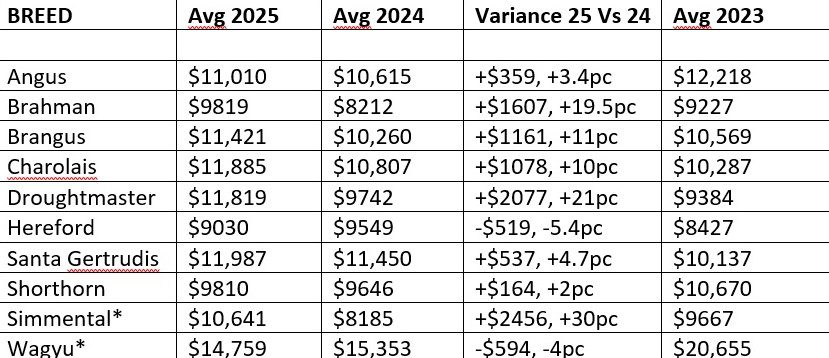
* Data collected by Beef Central (Simm: N=27 sales, Wag N=17 sales)
Longer-term trends
Looking at the longer-term bull price trend over the past 11 years in the graph at the top of this page, it can be seen that most breeds have this year had their third or fourth-best result in history – exceeded only by the unusual 2021-23 period.
Average prices improve
While this report is not intended as a direct breed-to-breed comparison or ‘popularity contest’, it’s worth highlighting some of this year’s achievements.
Most breeds recorded higher average prices for bulls sold in 2025 compared with the previous year, more or less in line with broader cattle market trends.
Wagyu sales, recorded only since the breed started to sell significant numbers of bulls at auction in 2022, have continued to trend down in average value, for reasons explained below.
While Wagyu still topped this year’s price comparison averaging $14,759, that still represents a $5800 or 28pc slide in value on two years earlier, when the average was $20,655.
Among conventional breeds, Santa Gertrudis topped this year’s averages at $11,987, just ahead of Charolais ($11,885) and Droughtmaster ($11,819).
By far the largest breed in numerical terms on the list was Angus, accounting for 11,328 bulls sold this year through 216 sales, up from 196 sales last year. (see today’s separate report on bull numbers sold).
Despite the sheer numbers, and being heavily exposed to drought impacts and herd liquidation in the south earlier in the year, Angus bulls still managed to average $11,010 this year, up another $359 on last year. Like most breeds, Angus prices peaked back in 2022 at $15,770, but that was regarded as somewhat artificial due to distortions caused by the 2019-20 drought.

Scott Wright
Angus Australia chief executive Scott Wright said the rise in the broader cattle market during September, combined with the return of some encouraging storm rain was reflected in this year’s results.
“As the cattle market started to move incrementally, we could see a nice upwards lift in bull sale results, week-on-week,” Mr Wright said.
“It injected a lot of confidence back into buyers’ minds, even among those who had not yet had any rain, but were looking at the forecasts. In contrast, Autumn sales this year in those dry areas had a tougher time. We saw evidence of it in the Angus Australia inventory, with signs of a delay in Victoria, South Australia, southern NSW and Tasmania, as members were pushing their work back. We saw a reduction of about 12pc in female numbers, which had a direct correlation with confidence in the bull market,” Mr Wright said.
“Some of them had cattle away on agistment, and didn’t know at that time what they were going to do with them. As it turned out, they’ve had a good spring break, if somewhat late in some areas. As the spring arrived and Angus sales moved north, that confidence really kicked in.”
“Unfortunately, given the erratic nature of weather in Australia, its always impossible to tell whether it is better to hold a sale earlier or late in the calendar.”
Mr Wright was unable to tell whether the seasonal impact may have seen some traditional Autumn-mated herds swing to Spring mating this year. “But there has been a general trend in the south to move from Autumn to Spring mating,” he said.
He said one Angus Australia southern bull breeder who did not have a satisfactory clearance at their original sale, decided to re-offer those bulls in late spring, attracting a lot of inquiry.
Wagyu trends
While Wagyu bulls sold at auction is still an emerging market segment, it was clear that the market this year for bulls was much tougher than earlier times.
Beef Central’s own calculations on 17 auction sales suggested a clearance rate this year of only 75pc, with bull numbers sold down 20pc to 528. The clearance of 75pc probably flatters the Wagyu result, with several sales cancelled or selling no bulls at all, due to lack of demand this year.
Several factors may be in play, a discussion with a Wagyu specialist stud stock agent suggested.
After some earlier years when virtually any yearling Wagyu bull was worth $10,000, supply and demand this year appear to be in much closer alignment. As Beef Central has written earlier this year, F1 Wagyu x Angus feeders have at times been worth nor more (and in some cases less) than equivalent straight Angus feeders.
Equally, the southern Australian drought that decimated many Angus maternal herds has meant that instead of trying to breed F1 calves, those breeders are now focussed on re-building their Angus breeding herd numbers, requiring a return to Angus bulls for a year or two. In a couple of years time, once those cow numbers are re-established, a Wagyu terminal sire may again come back into play.
Strong Santa growth
Among other breeds on the list, Santa Gertrudis general manager Brad Cooper noted the breed’s strong $11,987 average and statistics-topping 92pc clearance across 38 auction sales this year, saying prices had climbed steadily over the past three years.
He said results reflected both consistent demand and buyers’ confidence in the breed.
“For example, 40pc of members who held auction sales this year cleared 100pc of their bulls, while 80pc achieved clearances of 90pc or higher,” he said. “That’s not a seasonal anomaly — it’s a sustained trend. Since 2021, 72pc of Santa sales have recorded clearance rates of 90pc or higher.”
“In 2025 we sold more bulls across a wider geographical footprint at an increased average and consistent clearance, reinforcing the breed’s position as a reliable performer in both stud and commercial settings,” Mr Cooper said.
- See today’s companion story Numbers of bulls sold at auction for 2025.
2026 Autumn bull selling season call to action for studmasters
Bull breeders wishing to promote their Autumn 2026 bull sales via ads on Beef Central’s genetics pages, daily email alert or home page early next year should contact Matt Hatchard on 0437 870 127 or Nikki Nason at nikki@beefcentral.com or phone on 0448 630 047. Ad spaces are already filling up, so we recommend making contact early to avoid disappointment.
Soon after New Year, work will also start on compiling our full list of 2026 Upcoming Autumn Bull Sales, appearing as a searchable list in Beef Central’s genetics section. We remind studmasters to submit their upcoming autumn sale dates early next year (via this form), if they are not already provided by respective breed societies.
To all our loyal and enthusiastic bull sale advertising clients – many of whom have stuck with Beef Central for a decade or more – we thank you for your ongoing support and wish you, and all readers a Merry Christmas and Happy New Year.
- A number of beef breeds have re-set their record prices for bulls and registered females during 2025. Click this link to access Beef Central’s comprehensive list of breed records.