
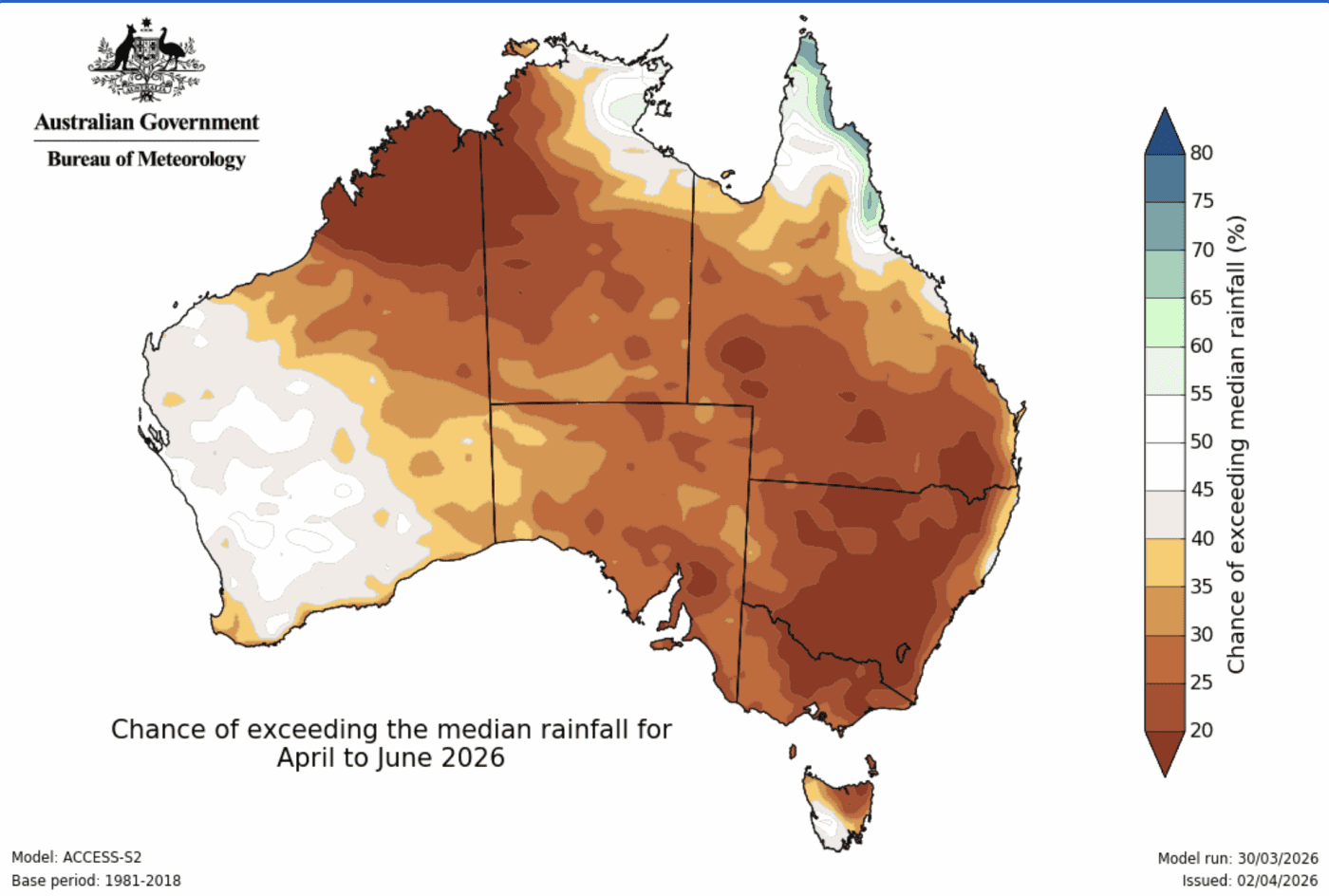
Below average April to June rainfall likely for most of Australia
Rainfall for the three-month period from April to June is likely to be below average (60 percent to more than 80pc chance) for most of Australia.
Parts of far northern Queensland are likely to have above average April to June rainfall (60pc to 80pc chance), with the highest chances occurring in April.
Elsewhere, including parts of western and central Western Australia and south-western Tasmania, there is no clear signal for either wetter or drier conditions, meaning there are roughly equal chances of above or below average rainfall.
There is an increased chance of unusually low rainfall *(1) (over 50pc chance) for large parts of the Murray Darling Basin, eastern Tasmania, and north-west Australia.
May marks the beginning of the northern Australian dry season, when most of the tropical north typically receives very little rainfall. Over these areas, average monthly rainfall totals for May and June are usually less than 5 mm.
*(1) Unusually low rainfall is that in the driest 20% of April to June records between 1981 and 2018.
El Nino watch
In the below video, the Bureau notes that models suggest a possible shift in the Tropical Pacific to El Niño by late winter.
“However, there’s still uncertainty around its timing and strength, with a clearer picture expected as autumn unfolds. We regularly update our long‑range forecasts as ocean and atmospheric conditions change, with the El Niño–Southern Oscillation being just one part of the bigger climate picture.”
Outlook video
TEMPERATURE
Warmer than average days and nights across much of Australia
Maximum temperatures for April to June are very likely to be above average (more than 80pc chance) across much of Australia.
The southern two thirds of Australia have an increased chance of unusually high maximum temperatures *(2) (over 50pc chance), with the highest chances (over 80pc chance) across New South Wales and neighbouring border regions, north-east Tasmania, and western parts of Western Australia.
Minimum temperatures are likely (60pc to greater than 80pc chance) to be above average across much of Australia.
For parts of inland eastern and southern Australia, there is no clear signal for either warmer or cooler than average minimum temperatures.
There is an increased chance of unusually high minimum temperatures2 (over 50pc chance) for much of Western Australia, parts of the eastern and central Northern Territory, and a coastal strip extending from southern Queensland to eastern Victoria, and much of Tasmania.
*(2) Unusually high maximum and minimum temperatures are those in the warmest 20% of April to June days and nights, respectively, between 1981 and 2018.
COMPARISON
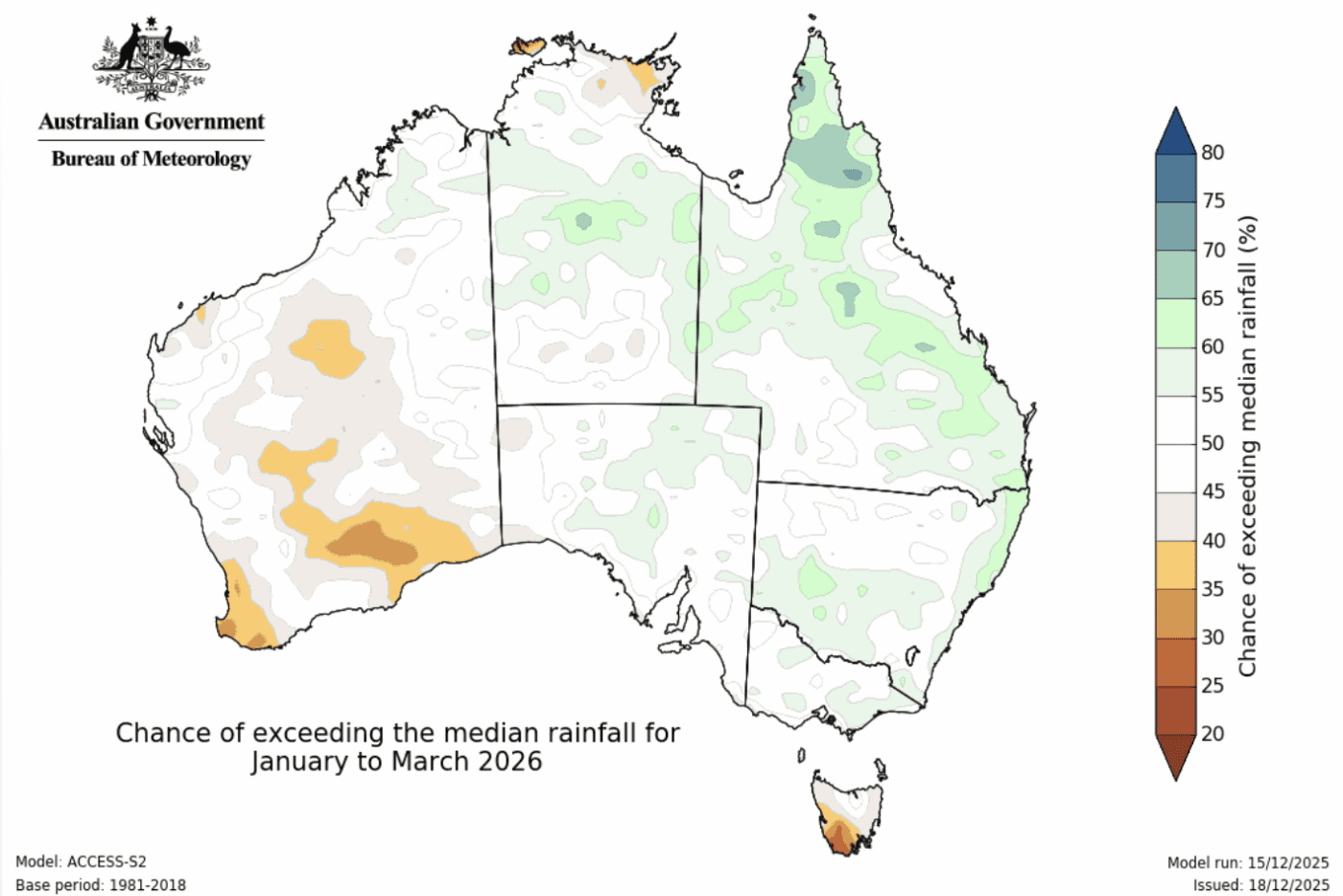
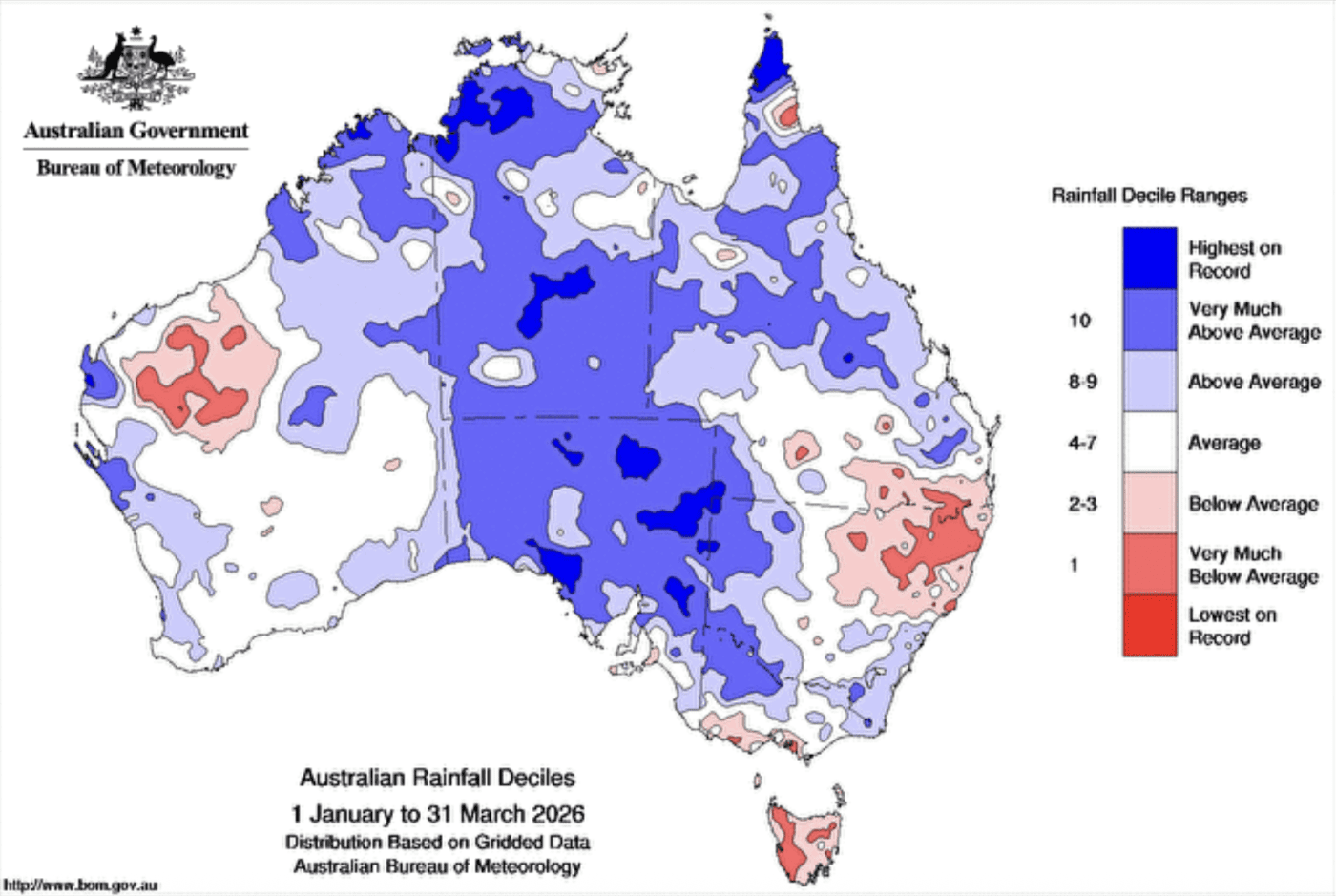
Previous three-month outlook versus actual rainfall received
Jan to March 2026 rainfall outlook (issued 18 December 2025):
January to March 2026 rainfall deciles:
Source: BOM
HAVE YOUR SAY