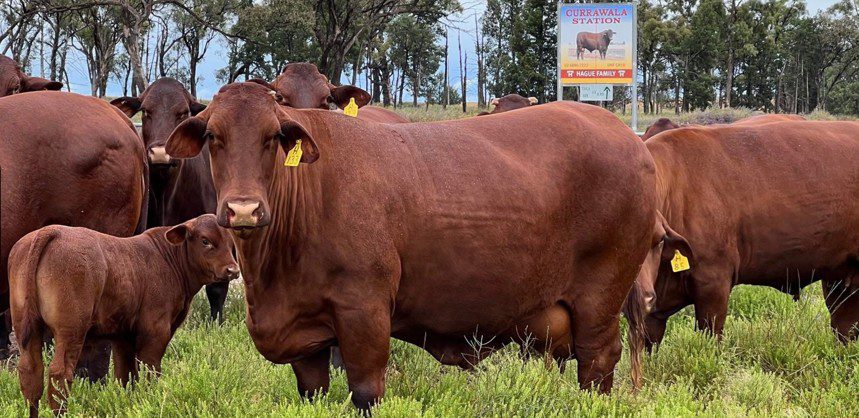
A Santa Gertrudis breeding group at Tara Station, Lake Cargelligo, NSW, exhibiting the productive capacity and structure that’s attracting “real premiums”, according to beef producer, Dean Hague.
THERE are long-held assumptions about cattle breed premiums and profitability in the beef supply chain, but are the people commenting on this topic best positioned to advise?
Livestock agents are a critical link in the livestock marketing chain, but they are paid commission on gross sales, and beef producers know that price received does not necessarily translate to profitability.
In an era where agent influence is heavily pushing producers to “go black”, perhaps the Santa Gertrudis breed is an undervalued performer in Australia’s beef production system.
Many producers try alternative breeds – often on the advice of their agents – only to later switch back to Santa Gertrudis, in search of a beef animal that better suits their landscape, is lower maintenance, and excels for growth – especially in crossbreeding systems where hybrid vigour can account for up to 20 per cent additional weight gain.
Valuing the wrong traits?
Are we currently valuing the wrong traits in our beef supply chain?
Rockingham Santa Gertrudis stud principal, Dean Hague, Tara Station, Lake Cargelligo, NSW, says his family has tried several different cattle breeds over the years, and for them, Santa Gertrudis stayed out on top.
“The breed’s improved out of sight over the past 50 years or so,” he said.
“Our straight Santa steers are coming out in front – they’re being sold mostly grass-fed over-the-hook, and they’re hitting MSA grading every time, with great fat cover.
“Our straight Santa steers are coming out in front – they’re being sold mostly grass-fed over-the-hook, and they’re hitting MSA grading every time, with great fat cover. They have a great ability to lay down fat on lower quality grass, and they are also a low maintenance animal too.”
“The doing-ability of Santas in this climate is excellent, and the lack of inputs required to achieve those good results – they’re bloat resistant, you don’t have to worry about pinkeye – and these costs all add up.
“Even if they only achieved the same weights as other breeds, you haven’t spent on labour to chase pinkeye or bloat, or the $400 on grain when you can finish them well off grass.”
Bulls that last lower costs
Mr Hague said not enough people valued the cost saving from bulls with good longevity.
“I put the longevity of Santa bulls down to the climate they’re bred in, and probably the classification system that the breed’s had in place for decades,” he said.
“We’ve got clients out here that still have bulls going after six to eight seasons, which is a massive saving compared to other breeds that have bulls breaking down within one or two seasons.
“When you’re paying $11,000 for a bull and allowing for 35 calves per year and a $2000 salvage value, if he only lasts two seasons, that works out at $129/calf.
“If a Santa bull with the same purchase price lasts for four seasons, each one of his progeny costs just $64/calf.
“So, you’re $65 per calf in front by having a bull that lasts, and that’s not to mention the impact that a bull that breaks down at a young age has on the longevity of his daughters.
“For a 400kg vealer, that puts you 16c/kg in front from the start, before factoring in any advantages from reduced labour due to bloat and pinkeye resistance, and in our country the doing ability on low value grass.”
Mr Hague said with his British-bred cattle, he often had to supplementary feed them from 300kg to 400kg to get sufficient fat cover on them for processing.
“So that costs me at 10.5kg fodder intake per day to gain 1.5kg of weight gain,” he said. “That works out at 66.6 days to gain 100kg to hit the 400kg target.
“This costs me $244 in grain to take them from 300kg to 400kg, plus all the work involved, machinery, fuel, and so on.
“All of a sudden, without putting a health and labour cost on our animals my British-bred steer would need to sell for $5/kg compared to my Santa at $4/kg because it has cost me an extra $401 to produce the same product.”
Mr Hague referred to the Santa Gertrudis Breeders Association of Australia Inaugural Feedlot Trial held at Pakaderinga Feedlot, Kingaroy, Qld, last year, where 148-head in the trial achieved an impressive average daily gain (ADG) of 2.3kg/day.
The highest weight gain was 3.46kg ADG, achieved by a steer entered in the 100-day export class by Kayleen Bochmann and Robyn Sawtell of Bellbird Pastoral Company, Nanango, Qld.
Renowned Santa Gertrudis stud, Yulgibar, Baryulgil, NSW, took a clean sweep of the top three prizes for the 70-day domestic class, with their best-performing steer recording an ADG of 3.32kg/day.
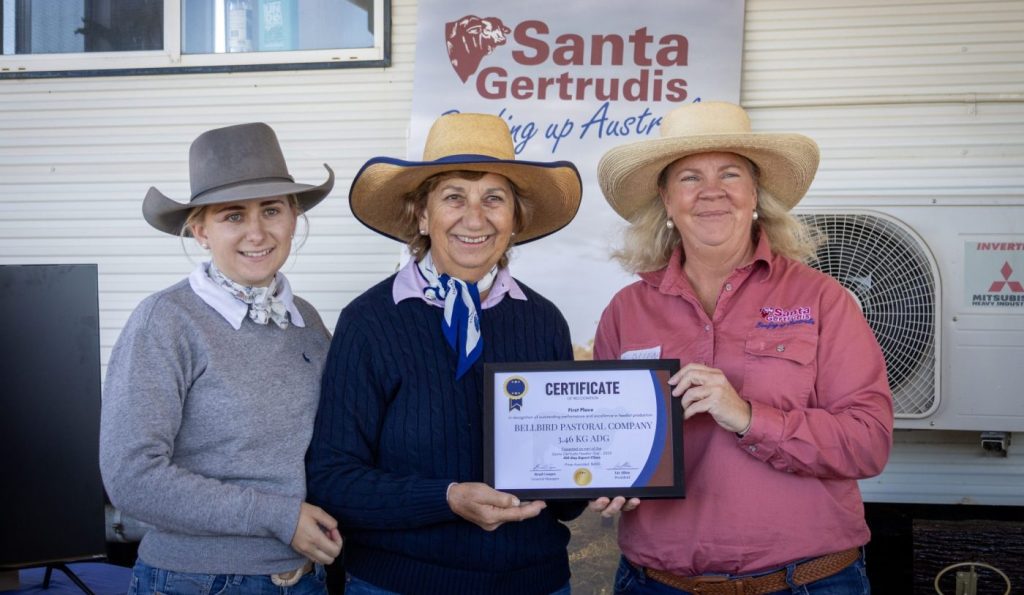
Kayleen Bochmann and Robyn Sawtell of Bellbird Pastoral Co, Nanango, Qld receiving their award from Santa Gertrudis President Liz Allen.
Mr Hague said a southern NSW cattle producer – who did not wish to be named – recently shared insights from a feedlot operator who supplies 250 head of cattle weekly to Woolworths. He said when factoring in purchase price, feed conversion, and weight gain, Santa Gertrudis steers outperformed Angus by up to $200 per head — a potential $2.6 million annual difference for a 3500-head feedlot.
In addition to superior growth rates on grass or in a feedlot, Mr Hague said there was a “real premium” for runs of Santa Gertrudis females.
“They can go anywhere and people can put any bull over them, so they’re very popular, and often top multi-breed sales,” he said.
“Quality will beat coat colour every time, and so it should.”
Hassle-free cattle pay at Uabba Station
One producer who highly values a low maintenance cattle breeding operation is Derek Davis, Uabba Station, west of Lake Cargelligo, NSW.
Traditionally a wheat/sheep operation, spanning nearly 15,000 hectares and including both dryland and irrigation cropping, the Davis family’s property incorporated cattle breeding in 2021 to utilise non-arable country, and to reduce the labour requirement of managing flystrike and shearing in sheep.
They now run about 400 breeding females, and they selected Santa Gertrudis bulls to use over Hereford heifers for calving ease, and bloat resistance on lucerne and clover country.
“We cut back from 7000 sheep to about 4000 and brought in the cattle because we haven’t got a lot of spare time and needed a low maintenance animal,” Mr Davis said.
“We lost a number of black steers to bloat in this country, and pinkeye gave us problems too, but we haven’t had any issues with the Santas,” Mr Davis said.
“I liked the Hereford/Santa-cross to get that ease of maintenance, which is so important to us.
“I believe I am going to be a lot further in front in growth rates and weight to overcome any discount I may get on cents a kilogram. I also haven’t had near as much trouble using Santas over heifers.”
From black to red at White Cliffs
After 40 years of trialling different breeds, and a lotfeeding background in South Australia previously, Leon Zanker, from Laurel Vale near White Cliffs in the NSW Western Division,has concluded that the most important factor in breed selection is suitability to one’s environment.
“We need to try and find what cattle best suit our country, and for us we keep coming back to that Santa/Hereford-cross,” said Mr Zanker, whose property traverses the Paroo River system, between White Cliffs, Wanaaring and Tilpa.
“We’ve always liked the Santa cattle, and our favourite crossbred is that Santa/Hereford-cross – excellent weight gains, and good for temperament.
“We tried a third cross of putting Angus bulls over our Santa/Herefords, back before Angus really took off.
“That was a good cross but up here, we can grow a lot of wild rice flower, which can at times be toxic to cattle.
“The first animals to be impacted by the wild rice flower were our Angus bulls, so we had to give them away.
“We then tried South Devon, with tremendous feedlot results, however we ended up with a very motley-coloured herd, and the South Devon didn’t handle the wild rice flower either.”
Mr Zanker said he had to completely destock their property during the 2017-19 drought, and coming out of that period, they purchased a run of Hereford heifers out of the Northern Territory.
“As our season came good in 2021, we couldn’t find Santa or Hereford females, so we bought in quite a few Droughtmaster heifers,” he said.
“Angus was all the rage at the time, so we mated all these Droughty heifers with Angus.
“We ended up selling 80 percent of the heifers with their Angus-cross calves at foot.
“At around this time we bought some pregnant Angus heifers, and Angus weaner heifers too. “What we found was the blacks coming into this country didn’t adapt well.
“When the season dried out in early 2024, our black cattle were the first to fall in condition. They were also very susceptible to pinkeye, and in terms of do-ability, they were just average for our country,” Mr Zanker said.
“What we also found was that as soon as numbers became available, there were plenty of Angus breeders on the market and there was no real premium for them anymore, especially from out in the western country.
“We’re on the verge of now getting rid of all our black cattle and going back to our tried-and-true Santa/Hereford cows.”
Mr Zanker said going forward, they would not be chasing what was popular, but rather what best suited their environment.
“We don’t think they (black cattle) do any better out here,” he said.
“They’re a lot more susceptible to illness, and the premium might still be there in the inside country, but it’s largely gone out here in this country.”
Mr Zanker concluded by noting that from his experience in their lotfeeding days in South Australia, the single biggest contributor to feedlot performance was not breed – it was temperament.
“Your very good-tempered animals in every breed will be by far and away your best performers,” he said.
More information? Click here to access the Santa Gertrudis Australia website.