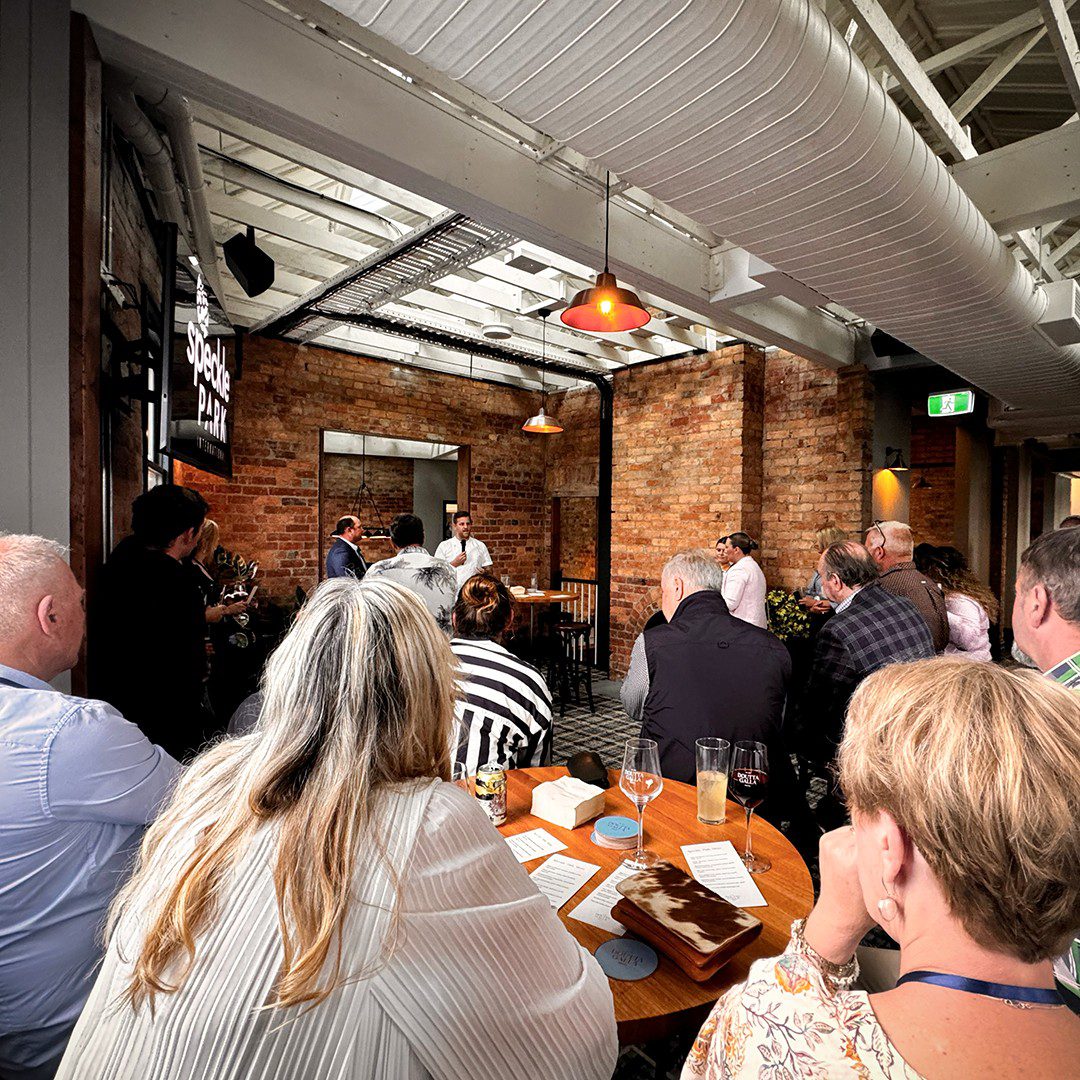
A SERIES of producer-focused events hosted by Speckle Park International across Victoria last weekend brought producers, researchers, supply-chain partners and chefs together to explore how feed efficiency, genetics and eating quality are shaping the next phase of beef production.
The two-day program included a farm tour at Whiteline Speckle Park, a five-star BreedPlan Completeness of Performance herd, a Net Feed Intake (NFI) presentation at HTR Speckle Park & Meade Agri, an industry workshop and AGM in Melbourne and a producer dinner featuring an eight-course grassfed Speckle Park menu.
Consumer trends: Australians turning back to beef
Fresh results from MLA’s 2025 Community Sentiment Research presented at the MLA AGM show a clear shift back to red meat, as highlighted in Beef Central’s recent coverage.
For the first time in 15 years, more Australians are eating more beef than less. Twenty four percent of surveyed consumers have increased their intake, while 22pc have reduced it. Of those lifting consumption, 87pc say they are doing so for health reasons, including protein and iron. The strongest growth is in 18–34 year olds, particularly young women, who remain highly engaged with provenance, nutrition and sustainability.
Speckle Park International Chair Vaughn Johnston said the trend plays directly into the strengths of data-driven producers.
“Consumers increasing their beef intake are doing so for nutrition and eating quality,” he said. “Breeds that can consistently demonstrate tenderness and performance are well-positioned in this new phase of demand,” he said.
Feed efficiency testing reshaping breeding programs
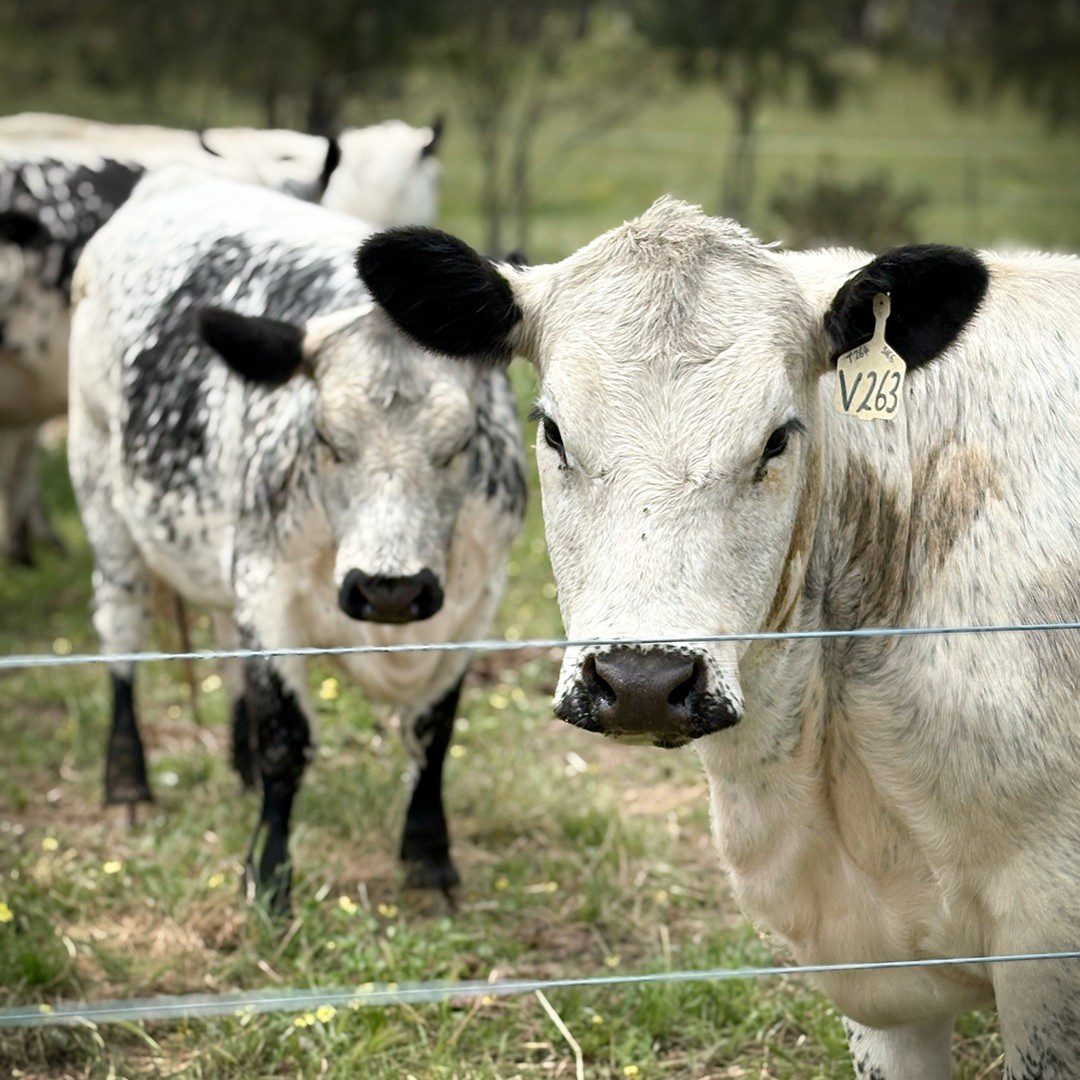
Saturday’s farm visits showed how Speckle Park producers are using data to refine selection decisions. At Beeac, Paul Meade of HTR Speckle Park & Meade Agri shared results from ongoing feed efficiency testing using the Vytelle NFI system.
The work highlights large variation in how much an animal eats relative to the weight it gains, a difference with direct financial impact when feed remains one of the most significant and rising costs.
“NFI data lets us see where the real variation is,” Mr Meade said. “With feed costs not getting any cheaper we need to be more efficient in our approach. Identifying animals that convert better early on is a real cost benefit.”
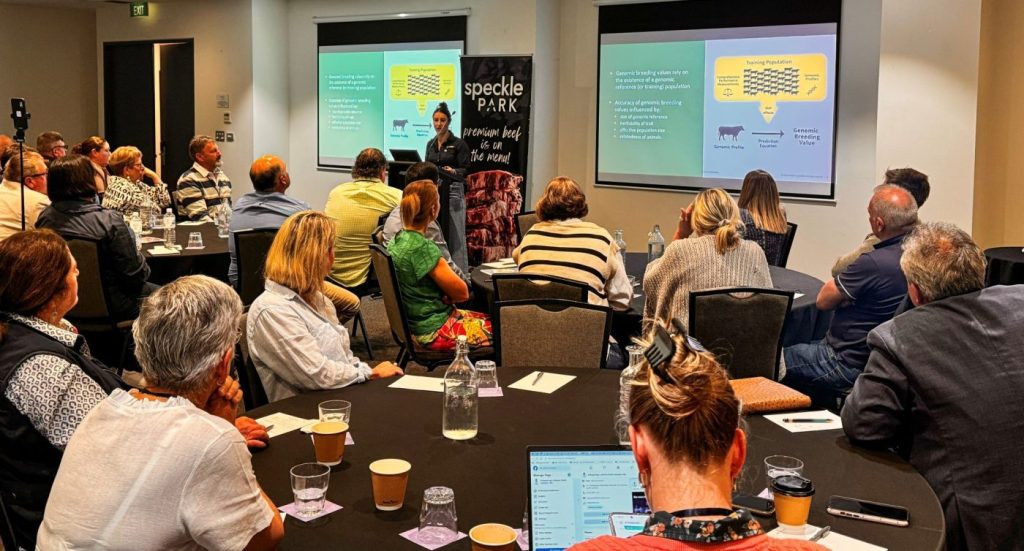
Hannah Powe presenting on tenderness genomics at the Sunday’s Speckle Park International Industry Workshop.
Tenderness was a central focus of the industry workshop with Speckle Park International presenting early findings on the genetic drivers of tenderness and how they influence eating quality.
More than 1500 Speckle Park animals have now been tested, with results available in the SPI database. Genetics play a significant role in tenderness which has moderate heritability, meaning breeders can make measurable progress through selection. This is where genetic testing becomes valuable, as identifying markers associated with tenderness helps inform earlier and more accurate decisions. The tenderness test is now available to Speckle Park members, allowing registered animals to have their tenderness scores included.
Neogen Genomics Sales Specialist Hannah Powe told attendees tenderness is shaped by a combination of genetics, age, handling, slaughter conditions and processing.
“If we can identify animals carrying favourable markers, we can make more informed decisions before they reach the abattoir,” she said.
She outlined emerging opportunities for Speckle Park producers, noting that genomics is becoming increasingly valuable in value-based marketing systems and can be paired with IVF, ET and AI programs to accelerate genetic gain. Genomic information is also helping producers select for traits that lift whole-enterprise efficiency, while feedlots are beginning to use genomic-only tools to refine forecasting and optimise feeding programs.
Hannah said market access and branded program opportunities are expanding as more supply chains recognise and reward genomically tested cattle.
Partnerships with MLA and MSA carcase insights
Speckle Park International has been invited to take part in MLA’s National Genetics Program to design the next generation of national “reference populations” for beef and sheep, which underpin the accuracy and future development of EBVs.
The association is also working with MLA to utilise Meat Standards Australia (MSA) data from processors. Early results show many Speckle Park carcasses sit in the top 25 per cent of MSA Index scores nationally, with a strong representation in the top 10 per cent.
These insights help Speckle Park seedstock and commercial producers see how genetics and management translate to eating quality in commercial supply chains.
Chefs and consumers: aligning genetics with eating experience
The weekend included a producer dinner at the newly reopened Doutta Galla Hotel in Melbourne, where chef and KickOn Group COO Jake Furst crafted an eight-course grass-fed Speckle Park menu using beef supplied by Speckle Park Certified and Benbullen Speckle Park Meats.
Mr Furst, who oversees food operations across venues from Sorrento, Victoria, to Townsville, Queensland, said the flavour, tenderness and texture of the Speckle Park beef immediately struck his chefs.
“The first time our chefs cooked a Speckle Park eye fillet, they said it was one of the best they had ever cooked,” he said. “The flavour was the standout. The fat has a different colour and mouthfeel. Even in the dry-ager, it did not need long. It came out incredible.”
Demand exceeded expectations.
“We thought it would last six weeks,” he said. “It sold out in six days.”
He added that diners wanted provenance, marbling score and whether beef is grass or grainfed with grassfed quality especially important for KickOn customers.
“What matters to our customers is where the product is from and if it is grass or grain fed,” he said.
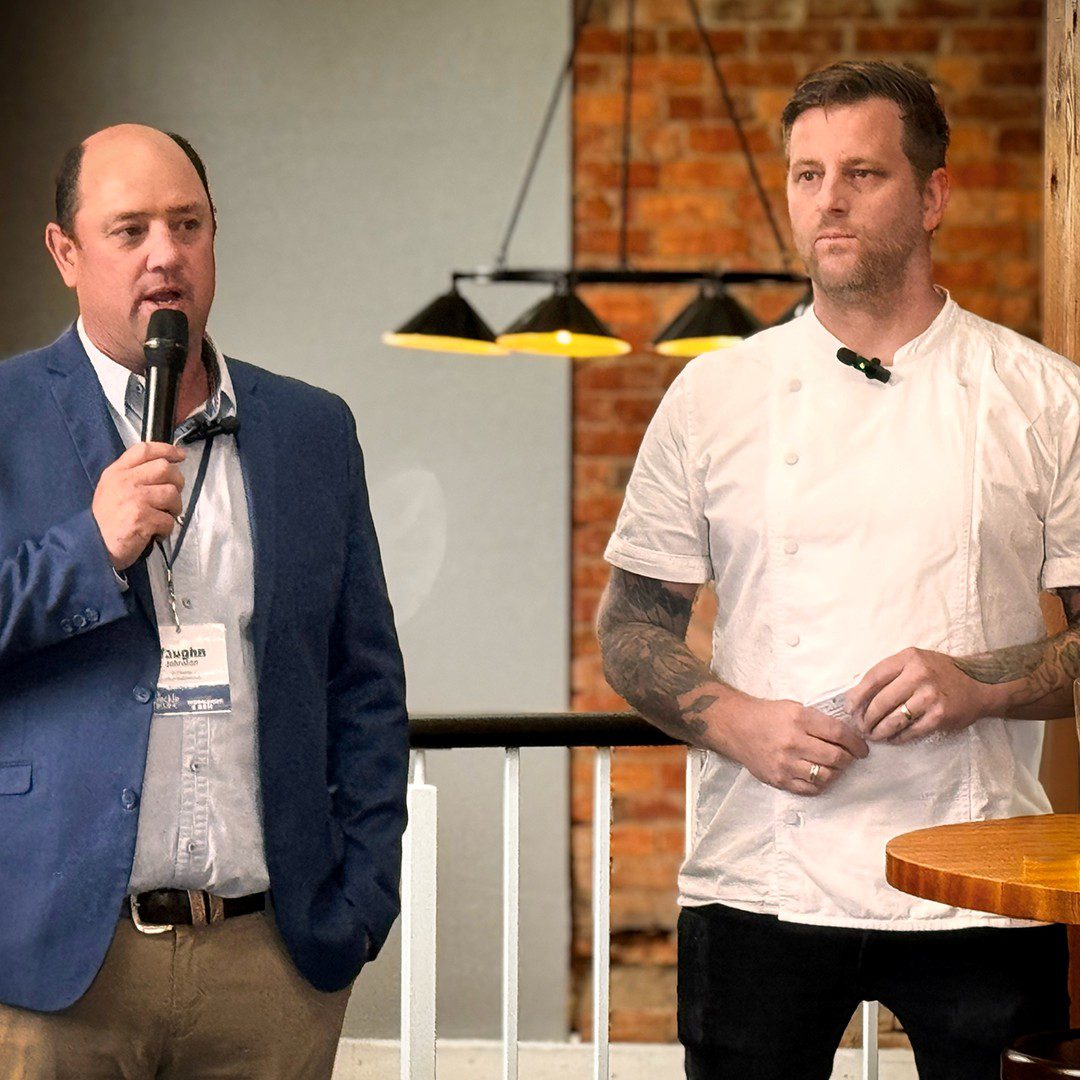
Speckle Park International chairman Vaughn Johnston with award-winning chef Jake Furst, who said Speckle Park beef is a standout for his chefs to work with.
Putting eating quality at the centre
Across the weekend producers, chefs, researchers and supply-chain partners agreed the competitiveness of Australian beef will increasingly rely on measurable eating quality, credible data and strong consumer trust.
For Speckle Park breeders the message was clear: eating quality is now the strongest lever for growth.
“We do not just breed a pattern,” one breeder said. “We breed for tenderness and consistency to deliver the eating experience consumers expect.”