
Click on image to enlarge
WHILE there was a lot of ‘good news stories’ floating around MLA’s Updates and AGM event in Adelaide yesterday, one particular graph stood out.
Amidst all the summaries of record Australian beef production in 2025, record export volume and price, higher per capita beef consumption in Australia and the US (despite rising retail prices) and vibrant export demand for Australian beef heading into 2026, this set of survey data really carried impact.
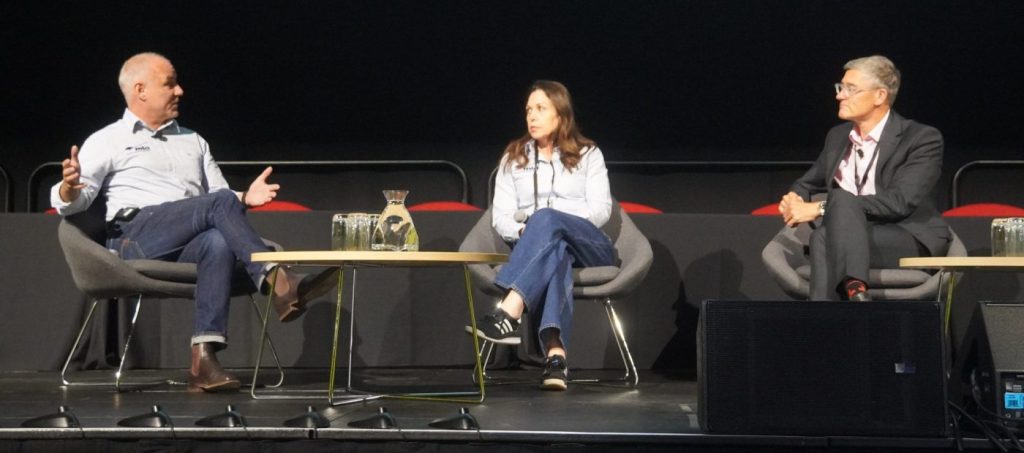
It was presented during a consumer attitudes session featuring consumer analyst Howard Parry-Husbands, sitting alongside MLA’s general manager of marketing and insights, Nathan Low and chief nutritionist, Monique Cashion.
Mr Parry-Husband’s latest extensive Australian consumer and community sentiment research for MLA – part of a sequence stretching back 16 years – was clearly showing the red meat industry’s growing ‘social capital.’
“Consumers clearly think that red meat is really good for the Australian economy,” he said.
“Most people like farmers, and respect the work that farmers do. All that builds up and is reflected in the industry’s social capital. That means that if there is ever a negative story that comes out – and they do – then the industry has all that ‘social capital’ in the bank.
Asked to cover off on the ‘negative’ side of consumer perceptions about red meat – whether it be methane, animal welfare or other factors, Mr Parry Husbands was quizzed about how many Australians felt a degree of ‘guilt’ about eating beef or lamb.
Not very many, his research shows.
“Looking at the actual number, there’s quite a few people – dozens of percent – who say they feel guilty, to some extent. That might be animal welfare concerns, for example, or its bad for sustainability.”
“But when they are asked how much influence that has on their buying behaviour over red meat, it’s one percent. So the likelihood of any ‘guilt’ changing buying behaviour, overall, is very, very low.
But there’s not actually a lot of negativity at all around red meat, among consumers – in fact it as at all time lows, Mr Parry Husband’s research shows.
“Consumers are actually feeling incredibly guilty about most things they buy – whether it be clothes, fashion, or eating this or that. The latest research is that drinking hot tea is really bad for you.”
“But when we bring it right back, there isn’t a lot of negativity about feeling guilty – definitely not.”
“Where we do have room to improve, is in things like being open about what society is concerned about – and changing our management practises, and being seen to change those practises, for the better, in order to conform and deliver to what society is concerned about. They are typically things to do with primary production, which the industry is already doing.”
Much of this is telegraphed through platforms like the Good Meat site featuring Australian producers talking openly, honestly and transparently about their management practises.
Levels of trust at record highs
Mr Parry Husbands said latest Australian community sentiment research suggested levels of trust in red meat “were about the highest we have ever measured.”
“About 70pc of Australians hold Australian farmers at those high levels of trust. The only professions that are considered more trustworthy that farmers are teachers, engineers, doctors and nurses. They are generally people who wear uniforms.
“What’s in common with farmers, of course, is that if you, in your vocation, care about an ‘other’ (in this case a herd of cattle or flock of sheep), or a classroom full of children or a ward of patients – then you are seen to have higher trust.
“The majority of Australians are metropolitans, and they hold farmers in very high regard. We are seeing degree of trust at the highest levels we have seen in a very long time.”
So what are they key drivers of trust – what are the key elements that have helped the red meat industry’s score?
The two big ones were environmental sustainability, representing about 40pc, and the actual product itself – covering issues like transparency and accountability.
“Beyond the way it is produced, Australian beef and lamb – the product itself – is incredibly loved.”
“Our research shows people love eating it. Those drivers really matter. Where we can still improve, in consumers minds, is in those other areas like transparency, accountability, sustainability and those broader ethical type things. That’s not unusual for primary production – and it’s worth stressing those scores on those traits are not bad, and getting better, across the board.”
“But in terms of the current drivers, the product, itself, is becoming the hero.”
So is all this translating into a commercial imperative? Are Australians motivated to eat more red meat?
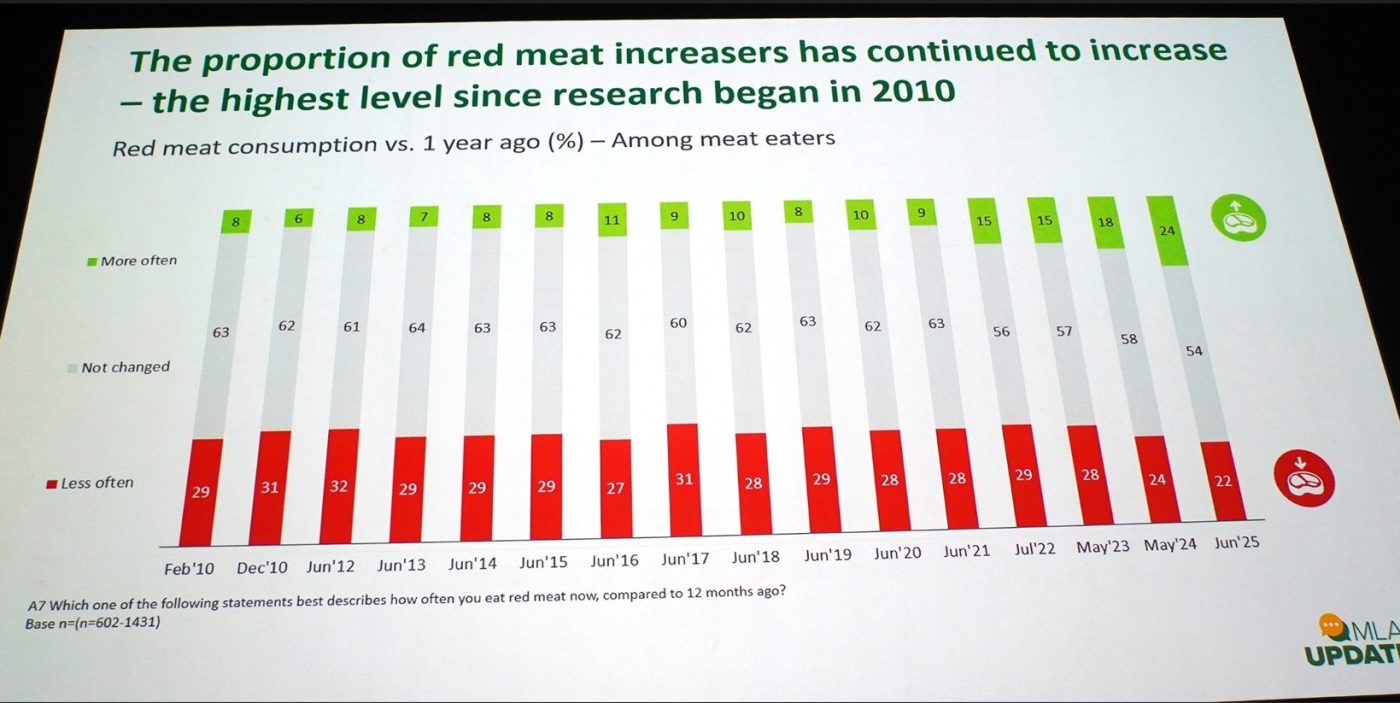
Arguably the most positive story to come out of yesterday’s MLA gathering for the red meat industry was results presented in the bar chart graph present at the top of this page.
The chart covers the period from 2010 to 2025, using 30,000 pieces of data, plotting Australian consumers who are eating red meat more often (green part of each bar), eating less often (red part), or about the same frequency of red meat (white).
Back in 2010, 29pc of people said were eating red meat less often, with only 8pc eating more often, meaning less meat being sold, as a net result. A year later, the ‘eating more often’ column fell further to just 6pc.
This year, 2025, is the first year ever in the 15 year cycle, where more people are eating red meat more often than those saying they are eating less. As the graph shows, there has been a dramatic turnaround over the past four years, with 24pc of consumers this year saying they are eating red meat more often, and a record low 22pc saying they are eating less often.
This supports the claim that overall meat consumption in Australia this year has grown, even against a backdrop of sharply rising retail prices.
“Effectively, the data suggests Australians are saying: You know what? I’m going to start eating more red meat. That’s just fabulous for all in this room,” Mr Parry Husbands said, attracting a round of applause.
Nutrition factor
MLA’s Nathan Low suggested it was driven by a couple of things. Firstly the consumer trust in the industry, referenced above; but there was also a strong nutrition trend factor.
He asked MLA’s nutritionist Monique Cashion (pictured above, with Parry-Husbands and Low) what – from a consumer perspective, health perspective and nutrition perspective – what was driving this demand trend.
“One of the main reasons why people are increasing red meat consumption is health concerns,” she said.
“That definitely aligns with what dieticians and GPs are seeing, as well. When people cut meat out of their diet or start to reduce it, they start to feel unwell, with brain-fog and fatigue setting in.
“They go to the GP or dietician and get their blood tested, and lo and behold, they have an iron deficiency. People are realising the benefit of getting red meat into their diet for high-quality protein,” Ms Cashion said.
“It’s very popular at the moment to eat a lot of protein, but there’s a very good reason for that. Particularly as we get older, protein plays a very important role in overall health, our immune health, but most importantly our muscular health. We need to maintain muscle as we get older for longevity, and quality of life.
“So it’s a really good time for the red meat industry from a health perspective.
Growth in consumption among young women
Another consumer segment driving the increase in red meat consumption frequency was younger people in general, and more specifically young women 18-24 years.
“We know that women historically have had lower intake of red meat than men,” Mr Parry Husbands said.
But in the last five years, consumer research has shown the second fastest growing group in terms of red meat intake is women 18-24.
“It was at this point that I nearly fell off my chair,” he said.
“But the increase has been steady now for four or five years – that’s a trend, not a random movement.”
“That suggests there has been a fundamental shift in their perspective. Obviously as people get older, yes, they might change their eating habits and meat more red meat, nut we are seeing those young women coming off a higher base than they used to. Really, we are creating a healthier long-term society.”
“When we asked young women why they are increasing intake of red meat, 88pc of them said because of health reasons. What are the two things red meat delivers within ‘health?’ Protein and iron.”
“So it’s health, ladies and gentlemen, that’s driving this increase in red meat intake.”
“And a little bit of taste, too,” Ms Cashion volunteered. “They love the taste of red meat.”
Veganism, vegetarianism flexitarianism
The annual consumer research data also looks into trends in veganism, vegetarianism and flexitarianism.
“There was a period of time there, five or six years ago, when people had a ridiculous amount of spare time on their hands (COVID), when the plant-based movement was getting a disproportionate level of noise compared with the amount of people who were actually engaging on a plant based diet,” Nathan Low said.
He asked the panel what the latest data was saying.
“Six or seven years ago we had about 9pc of the population who claimed to be vegetarian,” Mr Parry Husbands said.
“Today, the number is 4pc – the lowest it has ever been, in the 15 years of the research. That means 96pc eat red meat.”
“But here’s where it gets to be fun: when you ask people who claim to be vegetarian what they’ve eaten recently, about half of them have eaten red meat, fish or chicken. What we’re seeing here is that they are not lying – what’s going on is that every now and again they have chosen to include red meat in their diet, for predominantly health reasons.”
“The true number of people who are vegetarians or vegans – people who reject meat, outright – is about two or three percent. The lowest it has ever been, in the survey.”
Ms Cashion said the key things driving the change in behaviour was health reasons – young people understanding and learning about the benefits of protein for themselves.
“A lot of young women are quite sporty now, and they understand they need to have an adequate level of protein, iron and zinc in their diet to be at their best performance.
That then leads into a stage where they want to have a family, and they understand the importance of having a healthy diet throughout pregnancy. The same applies with peri-menopause, where protein and iron intake is beneficial during that stage. And finally as they start to age, more people are understanding the role of protein and exercise in making them feel optimum.”
“People don’t want to feel ‘average’ any more. They want to have performance fuel, so they can perform at their best.”
“Words like ‘strong’ are replacing ‘slim’ or ‘skinny’ in the ideal of beauty,” Mr Parry Husbands said.
A whole generation of young girls are growing up with the idea of ‘strong’ being the idea of beauty, not ‘slim.”
“That is really helping grow this broader area, and they are looking at the providers of the food and saying, Are you aligned with my values as well? Are you aligned with all the things I want to see for society? And what we are seeing with red meat is that it is now really starting to align with that,” he said.