
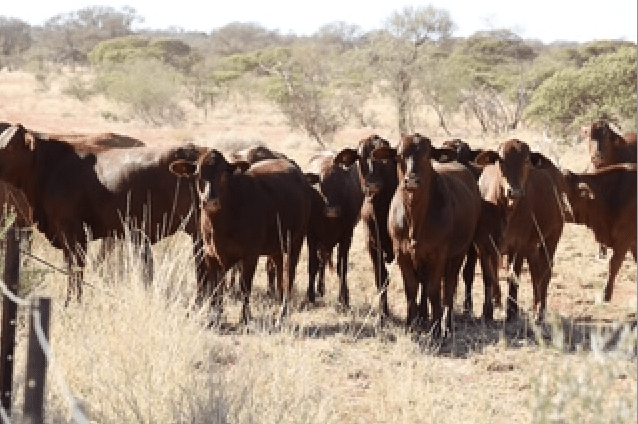
A YOUNG Western Australian cattle producer and helicopter company owner is pushing back on the perception that all cattle in north-western Australia are so-called “pastoral” cattle.
Weldon Percy grew up on a cattle stud property in New Zealand before moving to northern Australia to work in the cattle industry at the age of 17. With his business partner, he has since built a significant helicopter company operating 22 choppers across northern Australia while also running a 5000-head cattle breeding and backgrounding operation on a Pilbara station sub-leased from BHP.
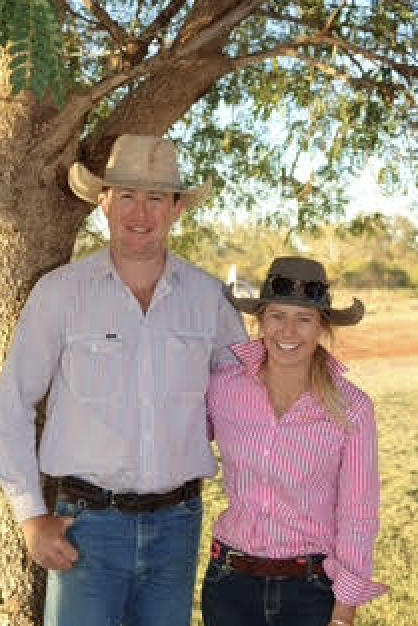
Weldon and Sarah Percy
Beef Central spoke to Mr Percy during a recent trip to Western Australia, where he raised concerns that the stigma attached to northern “pastoral cattle” is outdated, misleading and unfairly used to discount cattle from the region.
“There are a lot of good cattle in the north of WA that go south and go into that feedlot and supermarket and boxed beef job, you just don’t hear about,” he told Beef Central.
“There is a big problem there with this stigma, it is a perception that needs to go away, it is bullshit.
“I’m sure there are still cattle from the north that are far from optimal performers, but they can also come out of the south too, at the end of day they are all just cattle”
“Many cattle from the north of WA grade just as well in MSA across the hooks as southern cattle but the processor’s are paying sometimes up to $1 per kg less for the northern cattle because they say they are “pastoral”, when clearly if they are grading the same this term is irrelevant”
“The stigma and use of the word “pastoral” causes us all sorts of problems and deductions and we don’t get paid as well for our cattle as we should because of it.”
Mr Percy, who is also a WA representative on Cattle Australia’s Regional Consultative Committee, said many producers across the Kimberley and Pilbara had been consistently breeding and producing high-quality cattle for 20 to 30 years.
In their own case, the business is working with Zoetis, DPIRD, AGBU, PIP and MLA to DNA-test cattle and develop benchmarking across their entire herd to improve performance.
 “As a producer with a relatively small place in this part of the world and a small number of cattle compared to everybody else, we need to make sure that every animal that we sell is worth as absolutely much as it can be,” he told Beef Central.
While strongly supportive of the live export trade, Mr Percy said the domestic market presented the greatest opportunity to capture higher margins his business.
“Because you are dealing with a customer buying a scotch fillet off a supermarket shelf in Perth, they can afford to be fussy, so let’s give them something to be fussy about and get a few extra bucks for it.”
The herd has a Santa Gertrudis/Droughtmaster base. Females not aligned with the future breeding direction were culled when the business took over the herd six years ago, with numbers since rebuilt.
“We’re pretty happy with the direction that has taken us,” Weldon said.
Progeny are carried through to 350-400kg feedlot entry weights, with close attention paid in future breeding and management decisions to performance feedback from feedlots and abattoirs.
Mr Percy said the herd was already of reasonable quality when purchased. The best of steers sold following an initial clean-up muster were good enough to be included in the feedlot buyer’s own brand supplying the restaurant trade, while another high percentage went into a major supermarket supply chain.
To further lift performance and increase the proportion of cattle grading well on MSA, the business has undertaken DNA testing with Zoetis using tissue sampling units and stored genomic data to guide future breeding decisions.
“I strongly believe that there are a lot of herds of cattle here in the Pilbara and Kimberly that are a hell of a lot better than ours, that have had better consistency for a longer time, but they just haven’t captured that data so they don’t have the data to back it up. We are excited to use our data to prove going forward that our cattle and the other good cattle from our region are worth more.
“We’re really proud and passionate about what we’re doing with our cattle, I have only been doing this for six years, there are people up here who have been doing consistent breeding and producing top quality cattle for 20 or 30 years, and they’re still suffering from this stigma (of “pastoral” cattle).”
Eastern States lure
Mr Percy said price signals at times made it tempting to consign cattle to eastern markets such as Roma, where prices for equivalent 300-350kg cattle could be $1-$1.50/kg higher — despite the nearly 6000km freight task.
“It probably costs us just under a dollar to get them there, and they’re not going to get called pastoral, they’re just going to be another animal that is there.
“There is a clearly a disrespect and misunderstanding for what is going on and there needs to be circuit breaker on that. It is not representative of the effort people are putting in.”
Kimberley producers lifting quality profile
Kimberley Pilbara Cattlemen’s Association chief executive Bron Christensen said significant change was occurring across northern production systems, with a number of producers now vertically integrated and targeting higher-value markets.
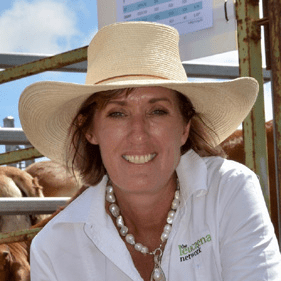
Bron Christensen
“We have got quite a few members who are actually vertically integrated now,” she said.
“You’ve got some that are very large like Harvest Road, but then we’ve got KAPCO, an indigenous owned organisation that grow and process their own beef.
“They started to do it based on getting better quality meat into the communities, but they have ended up with a premium product that they are selling retail plus into restaurants, so they’re doing a fantastic job and the beef is absolutely beautiful, and it is Kimberley grown.”
She said historical perceptions of northern cattle were increasingly out of date.
“The issue of Kimberley beef being scrubbers and tough and just pure protein, it is old days, farming systems have changed, grazing systems have changed, and genetics have changed.”
Ms Christensen said producers were actively diversifying genetics and market pathways in response to evolving demand, including from Indonesia.
“Certainly people are well and truly looking into diversifying markets and even our markets have changed where, you’d be aware Indonesia is looking for a more diversified type of animal as well where traditional cooking styles are changing in Indonesia, they are after better quality beef.”
She pointed to results from the recent Fitzroy Crossing bull sale as evidence of the genetic shift underway. The catalogue featured a wide range of breeds, with about 40 percent Brahman bulls and 60 percent divided between breeds such as Droughtmaster, Charbray, Red Brangus, Queenslanders and Simbrah.
“So people are really looking for that cross breeding because they are looking to diversify their markets and obviously with the changing tastes in our live export as well.”
While live export remained dominant, Ms Christensen said an increasing portion of Kimberley cattle was ultimately entering southern supply chains.