
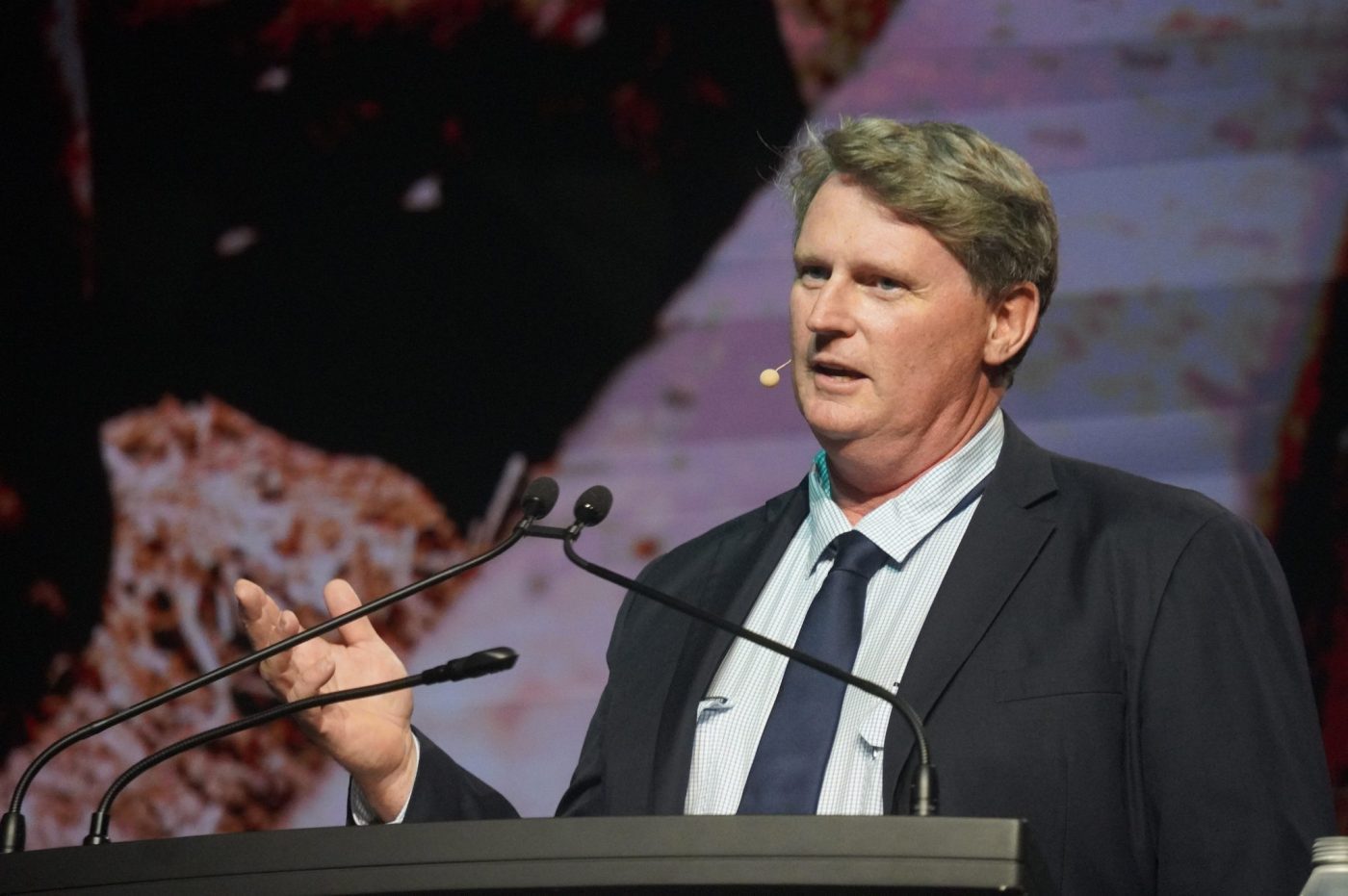
JBS Northern general manager of livestock, Edwin Cooke, addresses last week’s Wagyu conference
JBS Australia’s Wagyu business is the most profitable program run across the company’s entire Australian beef business, delegates attending last week’s WagyuEdge 26 conference in Brisbane were told.
Once regarded as a niche segment too small to attract real attention among the industry’s big players, Wagyu now represent a core part of Australian lotfeeding operations for many commercial yard operators, the audience heard during a session focussed on lotfeeding Wagyu.
The Australian beef industry’s growing focus on lotfeeding is reflected in grainfed throughput at JBS Australia’s Dinmore plant in southern Queensland – the largest beef processing plant in Australia.
Where once JBS’s flagship Dinmore beef plant in southeast Queensland processed few, if any grainfed cattle, the plant now processes almost 7000 grainfed cattle a week – either company-owned or processed for other parties, JBS Northern division livestock general manager Edwin Cooke told the gathering.
The company’s Northern division operates five feedlots, with the southern division operating a sixth, and the past ten years had ‘really pushed the boundaries’ in terms of JBS’s pursuit of producing and selling quality meat, he said.
“Obviously our Wagyu program has been a part of that – especially in the past ten years,” Mr Cooke said.
JBS’s sister company, Andrew’s Meats – a food service specialist based out of Sydney – runs a specialised Wagyu program serviced and supplied via JBS feedlots and processing plants.
JBS/Andrews Meats feeds around 32,000 head of Wagyu at a time, mostly at the Prime City feedlot near Griffith in NSW. Those programs currently produce around 450 bodies a week, with plans to expands to 600/week.
Most of the processing to this point has happened at JBS’s Riverina Beef factory, but up to 300 a week will in future be processed at JBS Beef City near Toowoomba, with the remainder at Riverina.
JBS Australia’s Wagyu business is the most profitable program run across the company’s entire Australian beef business, Mr Cooke told delegates.
“It’s not insignificant – it’s now a big part of the JBS and Andrews Meats businesses – and a big part of our future around providing quality beef,” he said.
Shifting to potential opportunities, he said there had been endless pursuit of marbling scores through genetics – both in the Wagyu and Angus world – producing an ‘amazing’ result.
“Feeding is better than it every has been, but we still see a situation – not just in the Wagyu segment, but also Angus – where we have a lot of high-marbling bodies being downgraded and sold into lower markets, because of buyer resistance around that top end (higher marbling scores, presumably on price).
Shorter days on feed?
“So how do we counteract that?” Mr Cooke asked. “Do we do some shorter feeding programs for Wagyu? I know there are some in this room focussing on shorter days on feed, accepting lower marbling scores.
In JBS’s case, the company is using live-animal MEQ cameras to try to predict whether an animal has the capacity to produce higher or more moderate marbling, allowing the feeder to avoid investing in longfeeding an animal that is not going to produce a high marbling carcase result.
“All this is around fine-tuning the expenditure or the allocation of capital,” Mr Cooke said. Like all large businesses, JBS Australia got measured heavily (by head office) on its cash usage, he said.
 Essentially, JBS Australia beef was fighting for capital and cash among its sister JBS businesses, located across the world.
“It’s pretty cutthroat at the moment,” he said. “We have North America bleeding cash, with record high livestock prices, and Brazil beef has turned pretty bad, pretty quickly. All of a sudden we’re getting calls from the ‘mother-ship’ saying please send us cash; what’s your costs, go back and measure everything again.”
“In fact, that’s a good thing to do. We’re in a period of good margins, and it’s pretty easy to become lazy and let an extra $10-$15 a head just float past. So while we are in this time of continued investment in the industry, we need to keep focussing on how we improve our internal processes for efficiency.”
At the other end, processors needed to be pushing meat customers around how many pieces per bag, or how many pieces per carton.
“If we could standardise our own cartons in our own business, there’s massive savings to be had, but we need to be pushing back to our meat customers on that.
“it’s a hard conversation to have, and it’s no different that trying to buy cattle and changing specs. But if we don’t do it now, we’re going to lose a window of operational excellence, and we very quickly become an industry (gas and mining used as examples) that failed to look at costs.”
“We need to be careful we don’t get too excited by the margins, or the hype in the industry at the moment,” Mr Cooke said. “Go back and focus on the detail, how do we strip $10, $15 out of the system.”
“I know it’s hard to believe when we have already come a long way, genetically and management wise, but there is still some supply chain operational performance fine-tuning to be done, from how the cattle are fed, how they are graded, and how the beef is managed.”

Sandalwood feedlot managing director Geoff Cornford
Low methane Wagyu; managing risk
Another panel session speaker, general manager of Korean giant, Lotte’s Sandalwood grainfed beef business near Dalby, Geoff Cornford, spoke about risk profiles in feeding Wagyu cattle.
Sandalwood, a 17,000 head feedyard located near Dalby, is undergoing a transformation designed to take capacity to around 35,000 head, with the stated objective of being ‘the best feedlot in Australia for Wagyu cattle.’
The yard recently replaced and upgraded its feed milling infrastructure, and will replace the current feedlot pens with a new yard footprint over the next two to three years.
Lotte currently markets Wagyu beef from Sandalwood into dozens of international markets – China and the Middle East principally, with no special focus on Korea, despite the originals of the company’s ownership.
Two commercial brands are used – L’Grow and Sandalwood – highlighting Japanese (Wagyu) genetics, the Australian clean and green environment, and Korean-style management. Each carries crossbred, purebred and Fullblood sub-categories.
South Korea in fact feeds around three million high marbling performance Hanwoo cattle at any one time – roughly twice the size of the Australian grainfed industry – and Lotte has adopted some of the Korean cattle feeding principles in its Sandalwood yard.
Recently, a new sub-brand was introduced under the Sandalwood brand, focussed on low-methane Wagyu. The new brand has already attracted quite a lot of interest in the US market, delegates were told.
There are few, if any significant Wagyu programs making methane claims to this point.
Built around the use of the asparagopsis methane-reducing feed additive, the initial objective in terms of premiums is simply to offset the $200/head feed cost (50c/day over 400 days) using the product.
Mr Cornford said Sandalwood was fortunate in being able to attract and retain relationships with some ‘fantastic’ Wagyu cattle producers, that had served to underpin the performance of the brands.
Managing risk
He said one of the features of the Wagyu industry he still struggled to understand was the “enormous amount of risk” involved, with such long production horizons.
“Most other cattle feedlot businesses now are pretty-much de-risked,” he said.
“Before you put cattle on feed you buy the cattle, fix your ration price, and fix your finished cattle sale price. The only risk after that is the quality of the cattle, and how they are going to feed.”
“That’s the case for shortfed 100-day cattle and every cattle class – other than Wagyu,” he said. “I still struggle with how risky it is – you have to buy the animal, feed it for 400 days, and it’s only in the last month to three months that you actually know whether you’re going to make a profit or not.”
In the Lotte/Sandalwood business, managing risk is considered very important, and it is done in a number of ways – primarily through diversification.
As part of this, the business also maintains a custom-feeding business, with 50pc of cattle on feed at Sandalwood used by four very important customers, Mr Cornford said.
“We also have diversification strategies for our markets, and among our customers – and its been a very important part of our business over the past five years.”
Importantly, part of Lotte’s approach has been to makes sure it has the future meat customers in place, before starting production – although admittedly that could be a hard balancing act, he said.
“Today, we only incrementally increase our volume on feed by about 1500 head/year, so it has been a measured growth in our Wagyu numbers, currently totalling around 9000 head. But we think its sustainable growth,” he said.
Problems with purebred cattle
Referring to challenges, Mr Cornford highlighted problems seen with cattle described by vendors as purebreds, (F4 Wagyu content and higher, as distinct from Fullbloods which are 100pc Japanese Wagyu in their pedigree).
“We’ve had fantastic progress in terms of performance outcomes among our crossbred and Fullblood cattle, but cattle marketed as ‘purebred’ have always been a problem for us,” he said.
Using the graph below, representing one trading quarter last year, comparing purebred versus F1 cattle, it shows that while purebreds on average produced 11pc better marbling scores – they cost more to buy, had lower average daily gains, poorer feed conversion and because they had to be fed longer, are more feed overall.
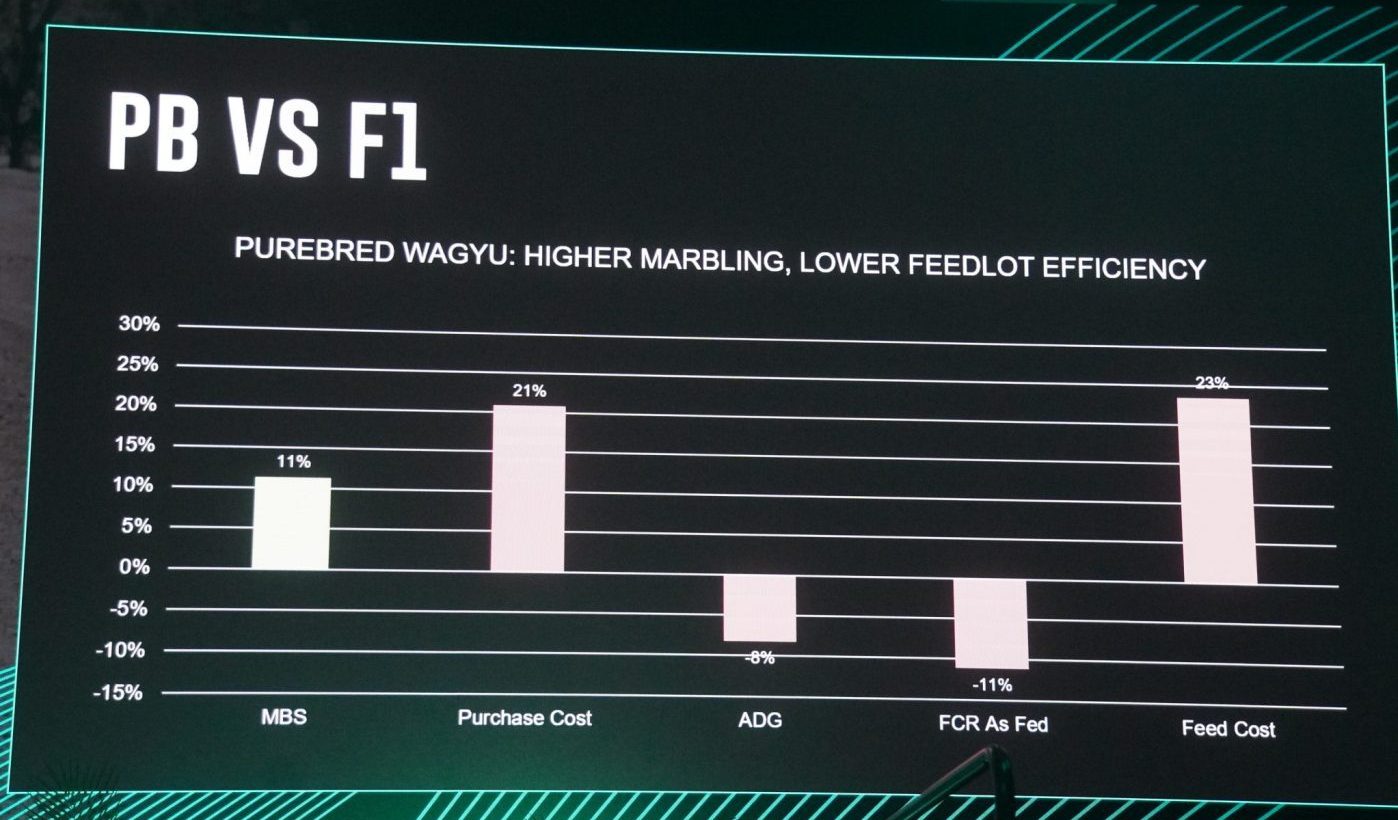
“So for us, that means feeding purebred cattle is a really tough segment, in terms of financial outcome.”
The second graph below shows what was achieved during the same quarter in marbling score for the two classes of cattle. F1s averaged a marbling score of 6, on a breakeven of 5.5. On the purebreds a 6.8 average score was needed to break even, but the cattle achieved only a 6.6 average.
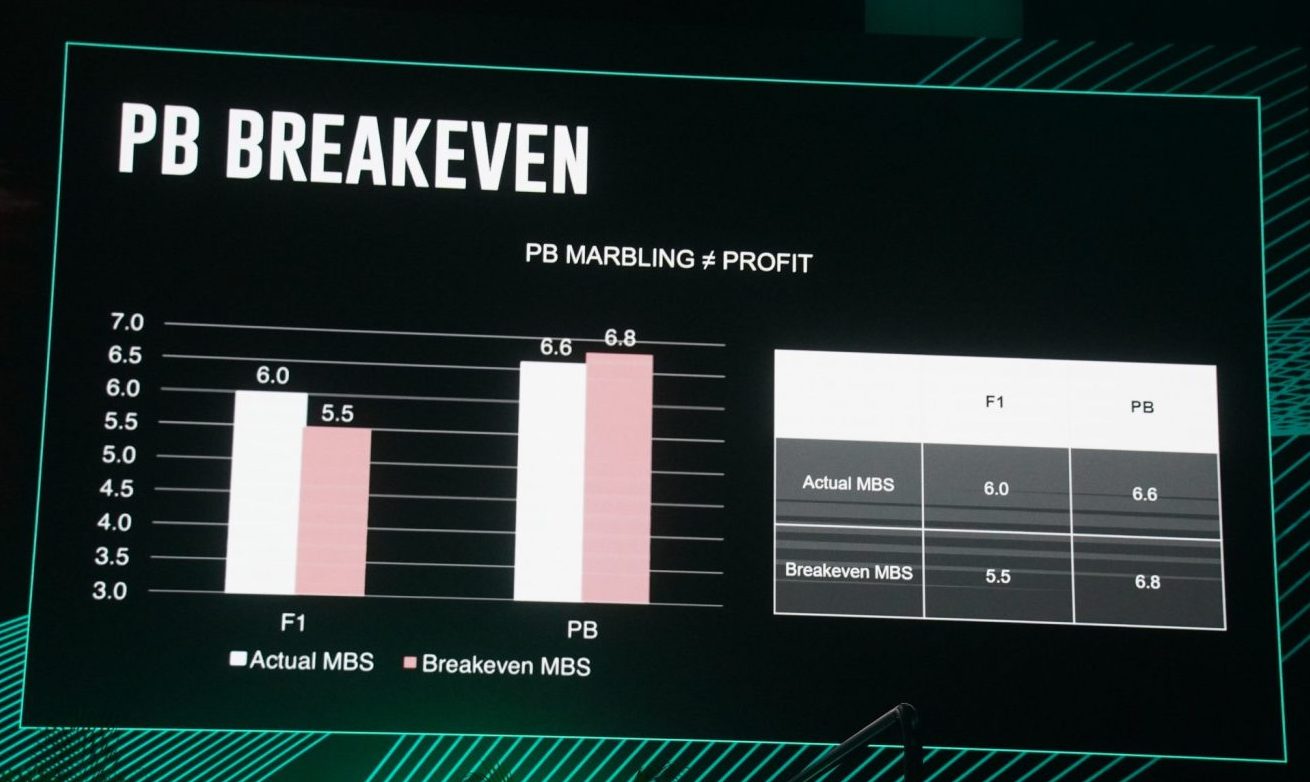
“This result is because of those feeding ineffeciencies and higher production costs on those purebreds,” Mr Cornford said.
“Having said that, we do have some good purebred feeder cattle suppliers, and we are grateful for that relationship – but a large proportion we struggle with, in being able to turn a profit.”
He also issued a plea to Wagyu cattle producers when filling out NVDs.
“In doing so, you are not simply describing the cattle, but making a (legally-binding) claim. For the purebred cattle in our supply chain, if you write that on the NVD, that goes into our system, and when the cattle die in 400 days time, they get a sticker on the carton claiming the beef is from purebred Wagyu cattle.
“It is really important that you are fully aware of the pedigree (or more specifically, breed content) of the cattle you are selling us, and making a legal declaration about that on the NVD.”
“I can’t believe that I’m actually talking about this, but it is an imporrtant issue in our industry.”
As background, genomic tests are now available that can quickly and easily distinguish the amount of Wagyu content present in a carcase.
After five years feeding Wagyu at Sandalwood, Mr Cornford said he was constantly surprised about how resilient demand for Australian Wagyu remained, even during difficult times.
“I think what’s happening – especially in first world countries – is that the middle and lower classes are getting poorer, while the richer classes get richer. The top 10pc of households in the US, for example, account for 50pc of consumer spending. For a societal point of view, that’s probably not a good thing, but from a Wagyu viewpoint, it’s a fantastic thing.”
He said once any new Wagyu feeding business had established the ability to produce highly marbled beef, after that period was over and a customer base had been established, what the customers really wanted was consistency.
“Today, consistency has become more of a focus in our business than outright marbling quality,” he said.
“Turning up with exactly the same high quality beef every week to our customers is critically important, and we’ve implemented a number of strategies in our business to do it – carcase imaging and systems to record that data among them.”
Allied with that, consistency of cattle supply (both quality and volume) was key.
Very interesting story, about Sandalwood Feedlot.