From Pilbara producers reshaping research priorities to grassroots discussion groups forming around local pubs, speakers at the Northern Australia Beef Research Update Conference highlighted the rising influence of peer-to-peer learning. Their message was clear – when producers collaborate, share knowledge and learn from each other’s experience, research adoption is more likely to shift from reports to livestock in a paddock, as Qld agricultural RD&E specialist Lindsey Perry reports.
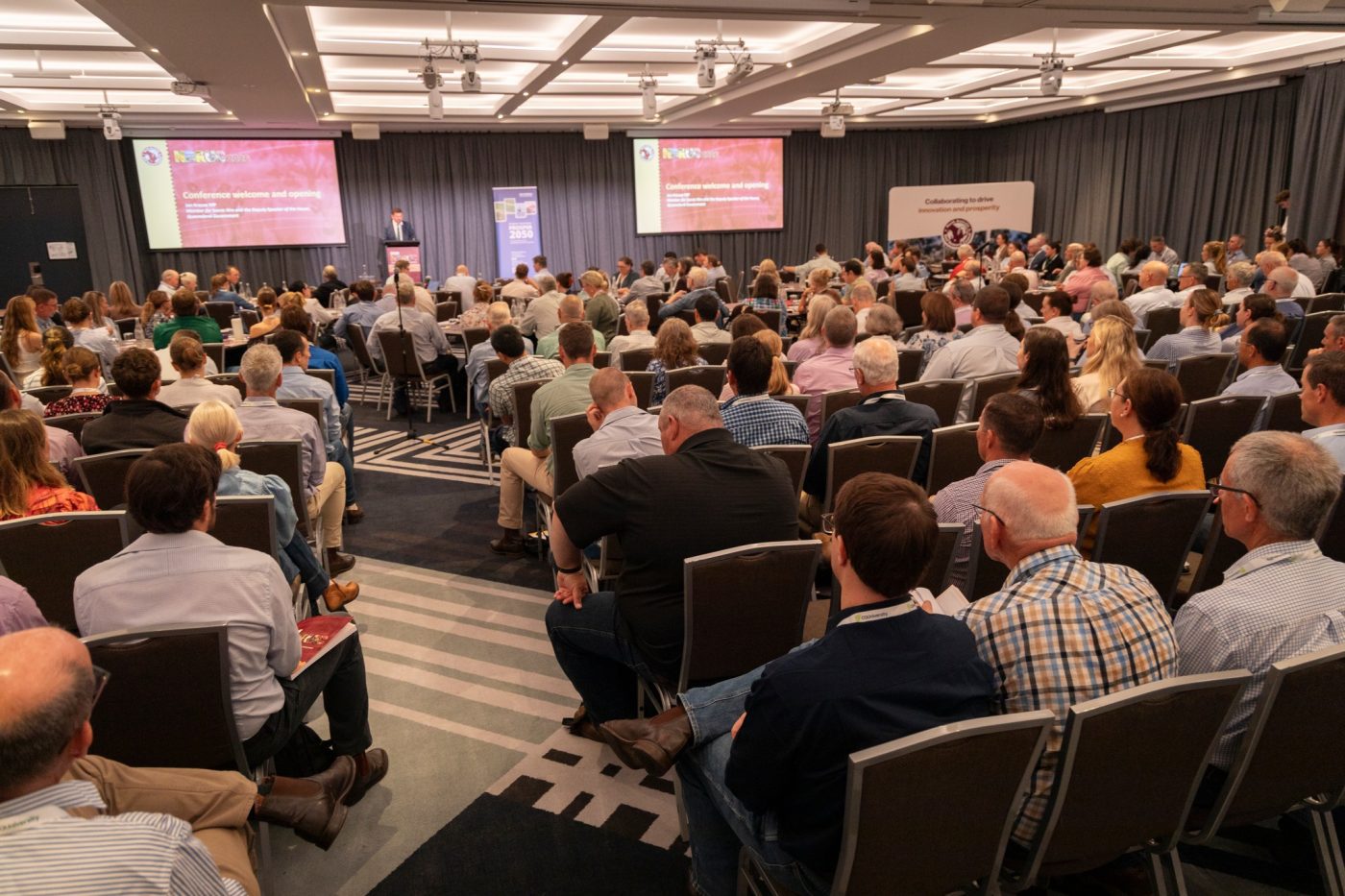
More than 350 people attended the 2026 North Australia Beef Research Update Conference (NBRUC) in Brisbane, including a large contingent of producers from WA, the NT and Qld. Image: NBRAC.
THE final day of the North Australia Beef Research Update Conference brought human connection to the forefront of adoption for innovative research.
Agricultural extension has been a powerful force of change since agriculture emerged from the Fertile crescent 11,000 years ago. Clay tablets unearthed in Mesopotamia (Iraq) around 1800 B.C featured advice on watering crops and getting rid of rats (not much has changed in the technical content it seems; FAO 1997).
Later in the 19th century ‘university extension’ aimed to improve general education for the broader population at a time when knowledge was contained within those walls (FAO 1997).
It is not surprising then, that traditional extension models feature an expert transferring technical knowledge through research findings, data and evidence for primary producers to go home and adopt. As Stacey Holzapfel (NT DITT) noted in her presentation there are many gaps on the lower rungs of ladder that might hinder implementation of a new practice on a station. Bradd Witt, a researcher from the University of Queensland there has been “evolution in extension from a traditional focus on soils, pastures and biophysical things and to see a trend over the last 10 years towards more focus on human capital.”
Peer to peer learning is a collaborative approach where individuals learn from and with their peers. Activities include mentoring, producer discussion groups, knowledge sharing and travel. Claire Mahony pointed out that she was inspired to start the IRDA Foundation by the international capers of School of the Air detective Carmen San Diego. The foundation aims to drive adoption of agricultural innovation at scale through experiential learning in three key programs: internships, innovation study tours and scholarships.
Peer to peer principles have expanded in northern Australia over the last decade due to rapid acceleration in technology obliterating traditional ‘tyranny of distance’ isolation.
Alison Larard, co-founder of Advancing Beef Leaders (ABL) says “we captured a moment of generational change at the same time as technology is wildly moving forward. Zoom made ABL possible. The regular peer connection creates tangible capacity building and real practice change”. To date, ABL has engaged 119 participants since the North Queensland pilot program in 2020, many alumni were in the audience or on the stage at NABRUC. (Applications are now open for the 2026-27 intake of the Advancing Beef Leaders program)
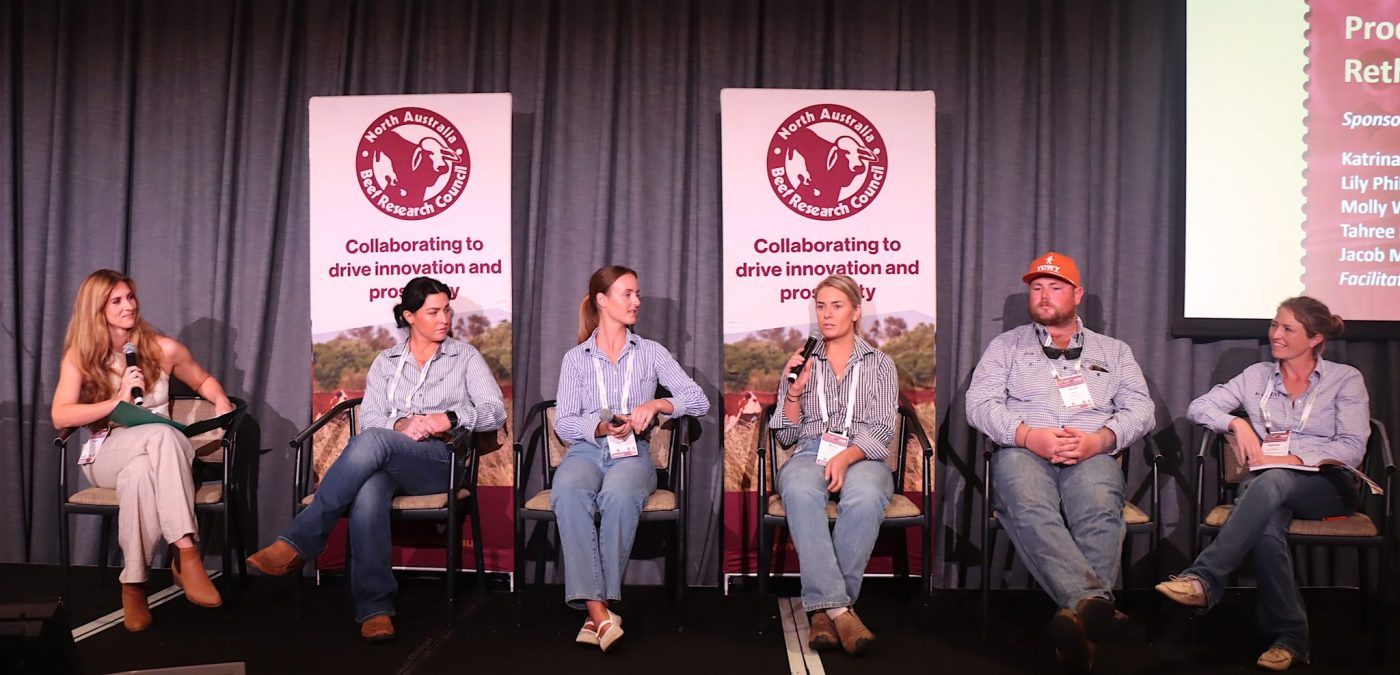
Dr Kelsey Poole, Tahree Kammann, Lily Phillips, Molly Wright, Jacob Morris and Katrina Lee-Warner on a panel at NBRUC discussing how Pilbara producers are reshaping how research happens across northern WA. (Hear more from Katrina in the latest episode of the Week in Beef podcast)
Technology is outplaying the remoteness. That remoteness is nowhere more tyrannical than the “vast space of the Pilbara”, as described by the Pilbara voices panel (pictured above). Stringent regulations in WA add complexity to an already challenging environment for research, development and extension. Combined mining and grazing corporations present challenges for infrastructure improvement and knock on herd management challenges. Under these pressures, peer to peer learning is cracking the foundations of research adoption. The young panel questioned “how do you improve that much area of land?” with the determined follow up “there are people doing it”.
“There has been a lot of research over a long time and we made a start tapping into a bit of old knowledge. There’s plenty there from the 1980s that was done on the property or in the area in filing cabinets and forgotten”.
Session chair Kelsey Poole (UWA) notes that in southern WA, researchers come in, do the work and leave. She opens the question – “does this work in the Pilbara?” A more collaborative approach was favoured by the panel. Tailor to little projects and start small before tacking the bigger landscapes.
“Conferences are great for awareness raising but you still need someone coming on to the place to look at the situation and help you get started – there is more happening now with what Liz Moss is doing with PEN”
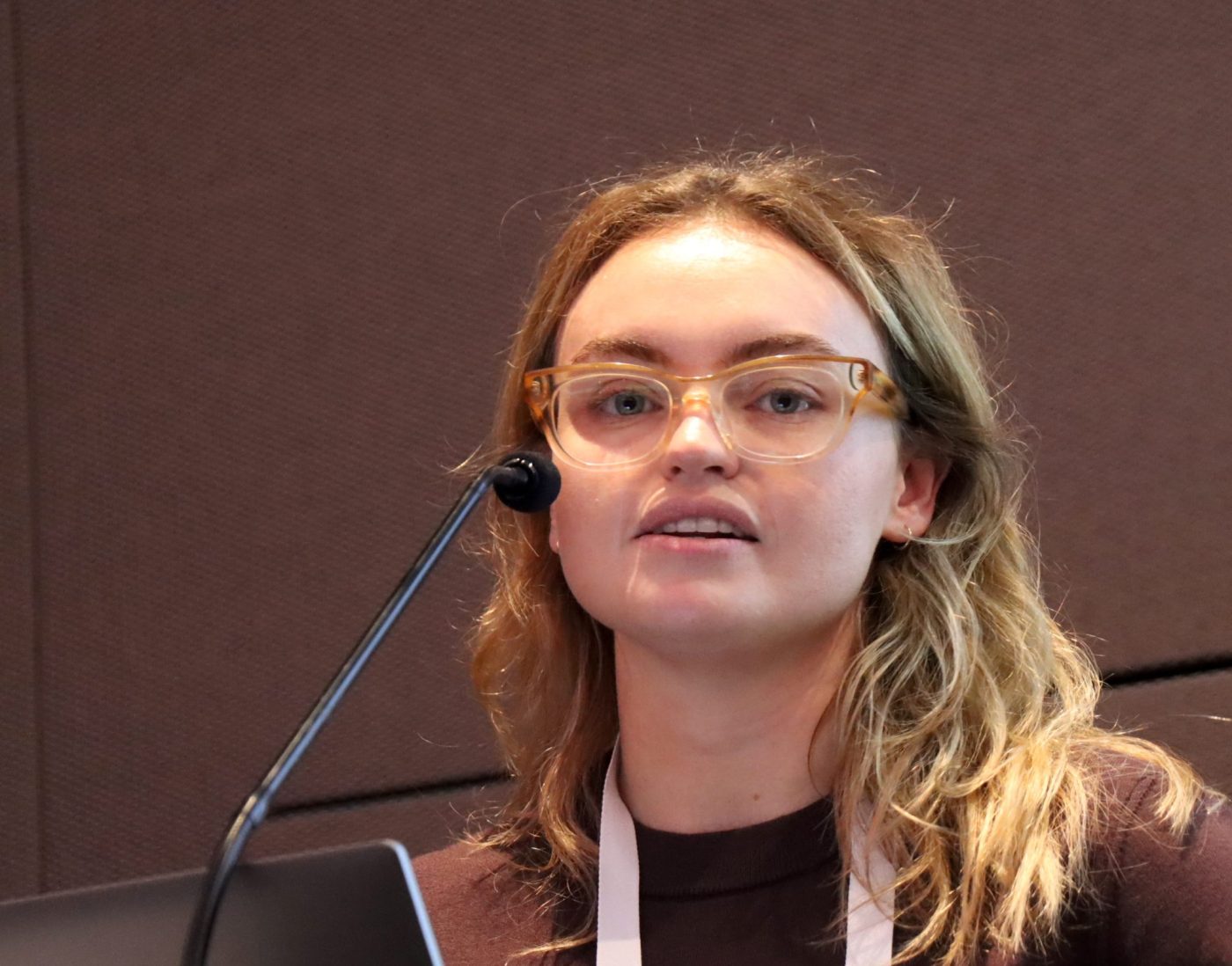
Liz Moss
Liz Moss presented later in the day, describing the Pilbara Extension Network (PEN) that sits under the Pilbara Innovation Partnership (PIP), a co-investment project between MLA, Rio Tinto and DPIRD that provides a framework for community led R&D. Liz said “R&D used to be something that happened to us, now we shape R&D. When a researcher comes out to the area we know what questions to ask.
MLA has invested in peer-to-peer learning through the NB2 program. One of the most successful elements of NB2 is the Indigenous Land and Sea Corporation and Animal Health Australia Indigenous Group. 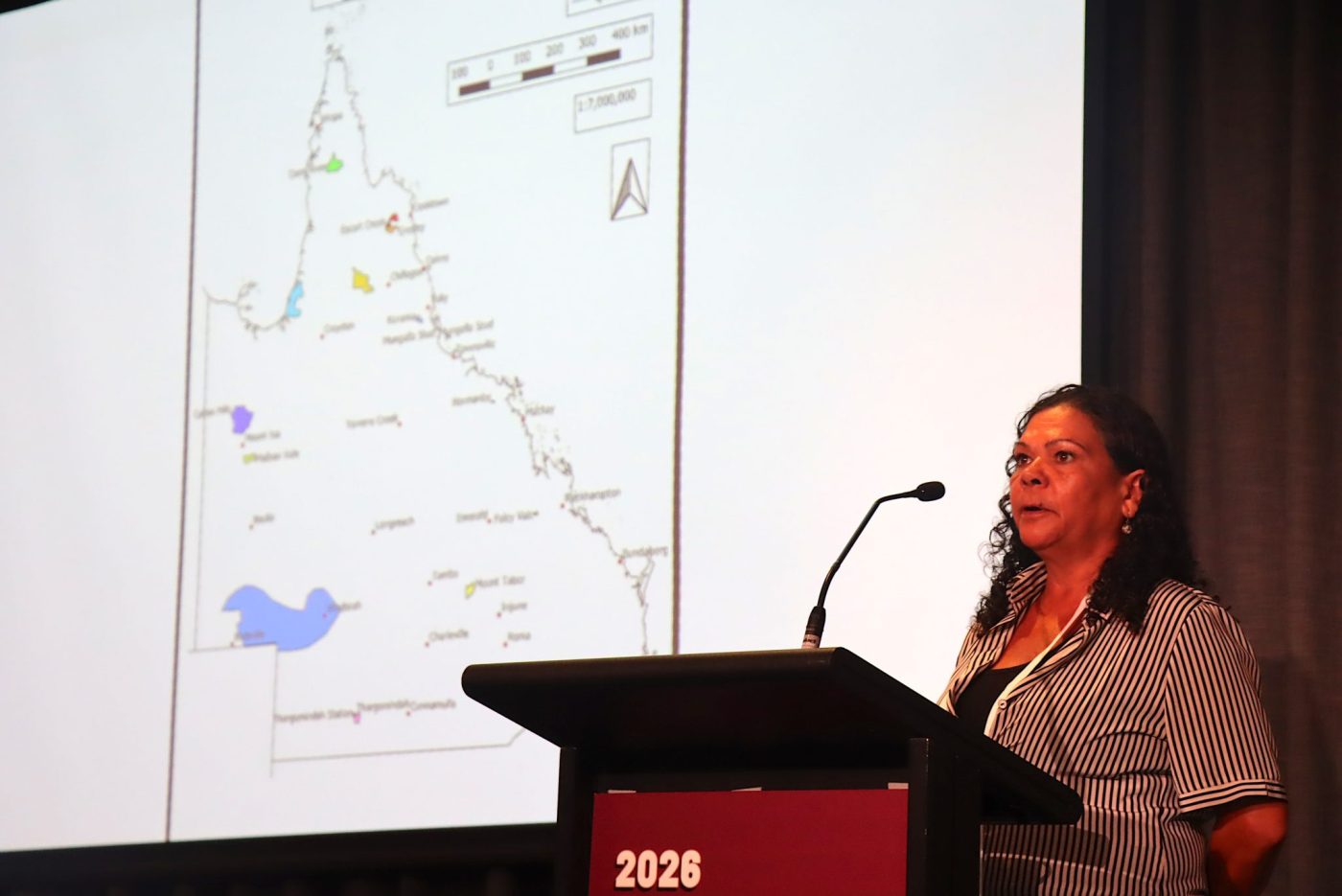 Cassy Stevens is a member of Kulluli Bulloo River Aboriginal Corporation which owns Thargomindah station in western Queensland. Thargomindah is culturally important to the Kulluli mob who are engaged in carbon and cattle agistment. Cassy was enthusiastic about the power of their NB2 peer learning group, as they came into the group knowing very little about cattle and have appreciated the wisdom from more experienced elders on the northern cattle operations in the group. “It wasn’t just about having them in the paddock eating grass and sticking them on the truck to sell them – there’s a lot more to it”. There is a focus on incorporating oral storytelling traditions through ‘Campfire Chat’, a tool for recording, storing and accessing information that can be used remotely through virtual reality or the web. Group facilitator Ian Perkins says “One thing that has worked well is the generous sharing. Herd, land and financial management data are shared from participating properties and the group discuss and share ideas to improve”.
Start small.
Amanda Roughan is a co-ordinator of a grassroots producer group around her own family farm in the Brisbane Valley. It was the drought of 2019 that forced her neighbours to rally around their vet and seek to find better ways to ensure immediate support and intergenerational longevity. This involved gathering after work for dinner at the local pub and listen to a guest speaker and a discussion. Gradually their efforts built up to a Healthy Land and Water Grant to increase sustainability and now field days are a regular occurrence in their neck of the woods, even amongst people who wouldn’t normally put their hand up. There is safety if a few others put their hand up for a field day and it builds confidence to open up the property and generate discussion. Amanda emphasises that it is “people that collaborate, not organisations”.
‘It is people that collaborate, not organisations’
This is a sentiment echoed the length and breadth of the north.
Krystie Bremer, executive officer of the Gascoyne Pilbara Rangelands Initiative (GPRI) offers the advice “start with one, build trust with one and so the rest follow” referring to the beginnings of a successful research partnership with the University of Western Australia. The GPRI showcases an enviably cohesive group spread across 100,000km2. Producers set their own research priorities through turning questions into research projects. Their questions are self-reflective and include the technical “How do I improve nutrition?” to the personal “How do I maintain enthusiasm?”. The GPRI has genuine impact through producers developing their own tools, for example the Rangelands Monitoring tool.
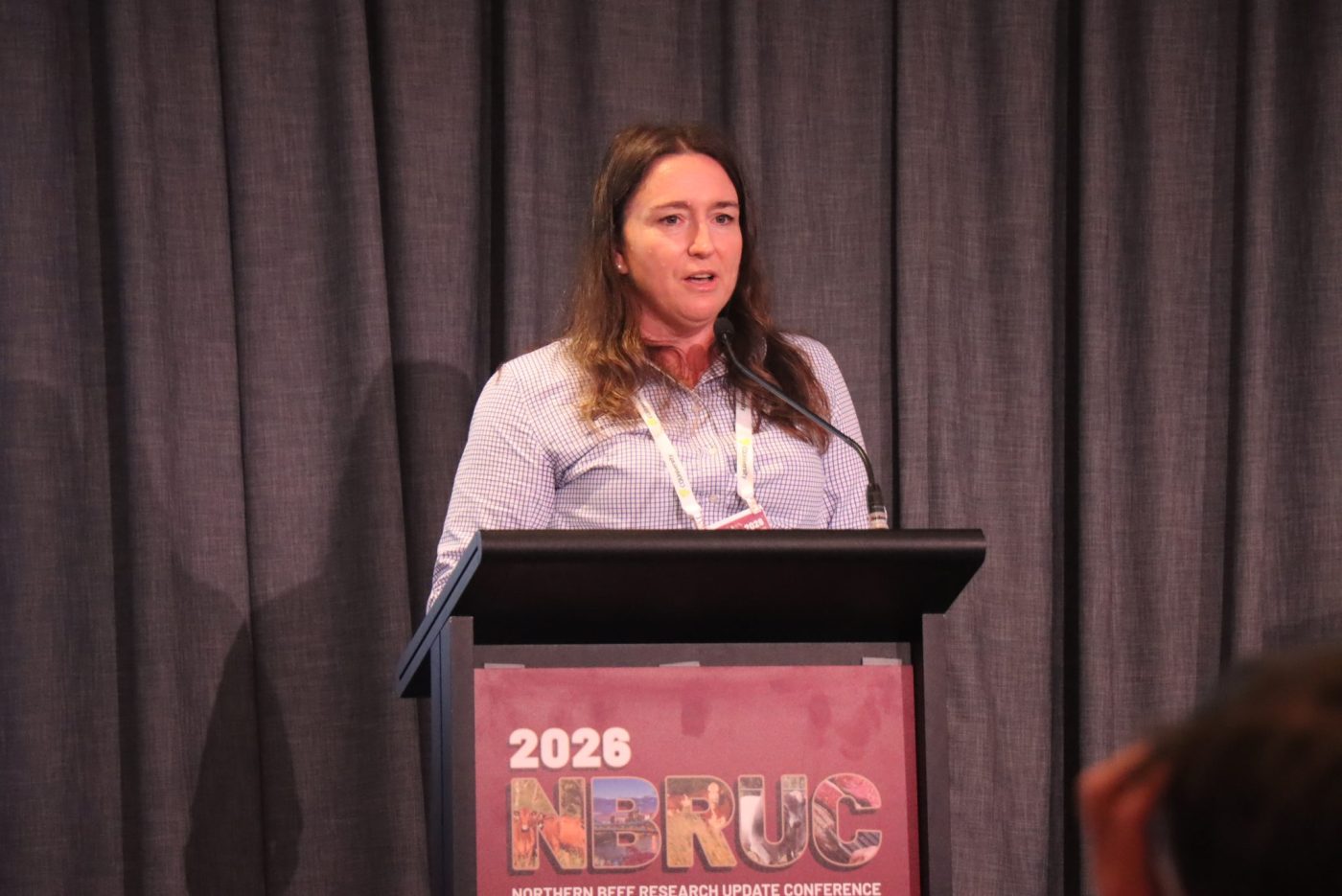
Sally Leigo
These are a few examples of producers up and down the country in the driving seat of improving practices across their own property and their region through human connection and collaboration. If you are a researcher in the north seeking to start solving potential issues on farm, how do you get started? Sally Leigo, Program Manager for Adoption at Meat and Livestock Australia advises to “Reach out to NABRC – put your concept to them and get some feedback”
The challenges of the north are many, but the winds of “practice” change have upgraded the clay tablet to the digital tablet, providing a swathe of new opportunities to connect and share knowledge. It is people that collaborate, not organisations.
Amanda Roughan brimming with enthusiasm as she closed the final panel session says “Start small, grab a couple of people who want to do something and go from there”.
An overview of the history and development of agricultural extension:
FAO 1997 https://www.fao.org/4/w5830e/w5830e00.htm#Contents
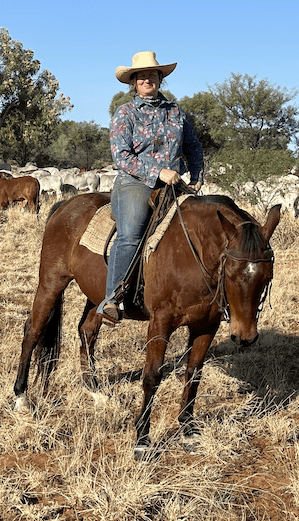 Lindsey Perry holds a PhD from the University of Queensland in pasture quality and emissions interactions in northern beef systems. Her experience includes roles in north Queensland NRM, QDAF and Meat & Livestock Australia’s Grassfed Beef R&D program. Her role as a beef extension officer in Cloncurry, Qld provided an ongoing respect and appreciation for the people, landscapes and challenges of northern Australia. The views expressed in this article are her own.
HAVE YOUR SAY