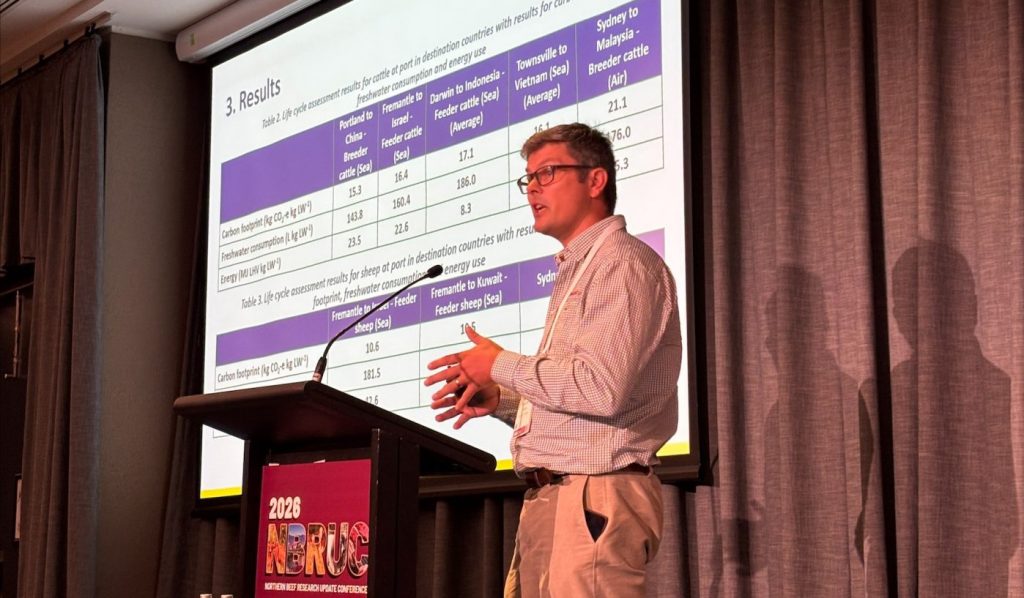
Dr Stephen Wiedemann presenting the findings at the NBRUC conference this morning
A new life cycle assessment of Australia’s live cattle export industry has provided fresh insights into where emissions occur from paddock to overseas port.
The work reinforces the sector’s ongoing commitment to transparency and sustainability, according to Livecorp..
Funded through the industry’s Livestock Export RD&E Program, a collaboration between LiveCorp and Meat & Livestock Australia, the updated assessment offers the live export industry a clear understanding of the carbon footprint of their cattle and sheep from pre-export quarantine yards through to destination market.
Conducted by Integrity Ag, the research builds on a 2011 study and captures the full export journey, from livestock production through shipping and arrival in-market. For the first time, it also includes air freight and a downstream case study of an Indonesian feedlot.
Results from the survey were summarised during the Northern Australian Beef Research Conference in Brisbane this morning.
Dr Stephen Wiedemann, managing director of Integrity Ag, said the results showed measurable improvements in emissions for exported cattle over the past decade.
“Compared with 2010 figures, greenhouse gas emissions per head for cattle have fallen by about 30 percent. Improved herd performance in grazing systems, better methane estimation methods and more efficient fuel use, particularly on ships, have all contributed,” Dr Wiedemann said.
In contrast, average emissions for sheep increased by around ten percent, largely as a result of reduced stocking densities on ships. This highlighted an important trade-off between higher animal welfare expectations and environmental outcomes, the report found.
“The live export stage, from the quarantine yard through to arrival in market, contributed around 25pc of total emissions for sheep,” Dr Wiedemann said.
For cattle, the percentage for sea transport ranged from a low of 3pc for Darwin-Indonesia feeder cattle (4pc for Townsville-Vietnam), to 13pc for Portland-China feeder cattle. Although only limited in volume, Sydney to Malaysia by air accounted for 27pc of total emissions.
Water use
Water use was reassessed using a refined method that excluded seawater and recognised the use of desalination plants on ships, resulting in lower reported consumption during the export process.
While air freight remains a high-emissions transport option for all industries, it represents a small proportion of total livestock exports and serves specific needs such as breeding animals and small consignments to landlocked countries.
Dr Wiedemann said the assessment provided a robust, contemporary evidence base to demonstrate the sector’s progress toward national emissions targets, while reinforcing livestock export as an efficient and responsible pathway to market.
“The updated findings give the livestock export industry a strong, science-based foundation to inform the community of its credentials, guide future improvements and contribute meaningfully to national sustainability targets and Australia’s low-emissions future.”
The livestock export life cycle carbon assessment report can be accessed here.