
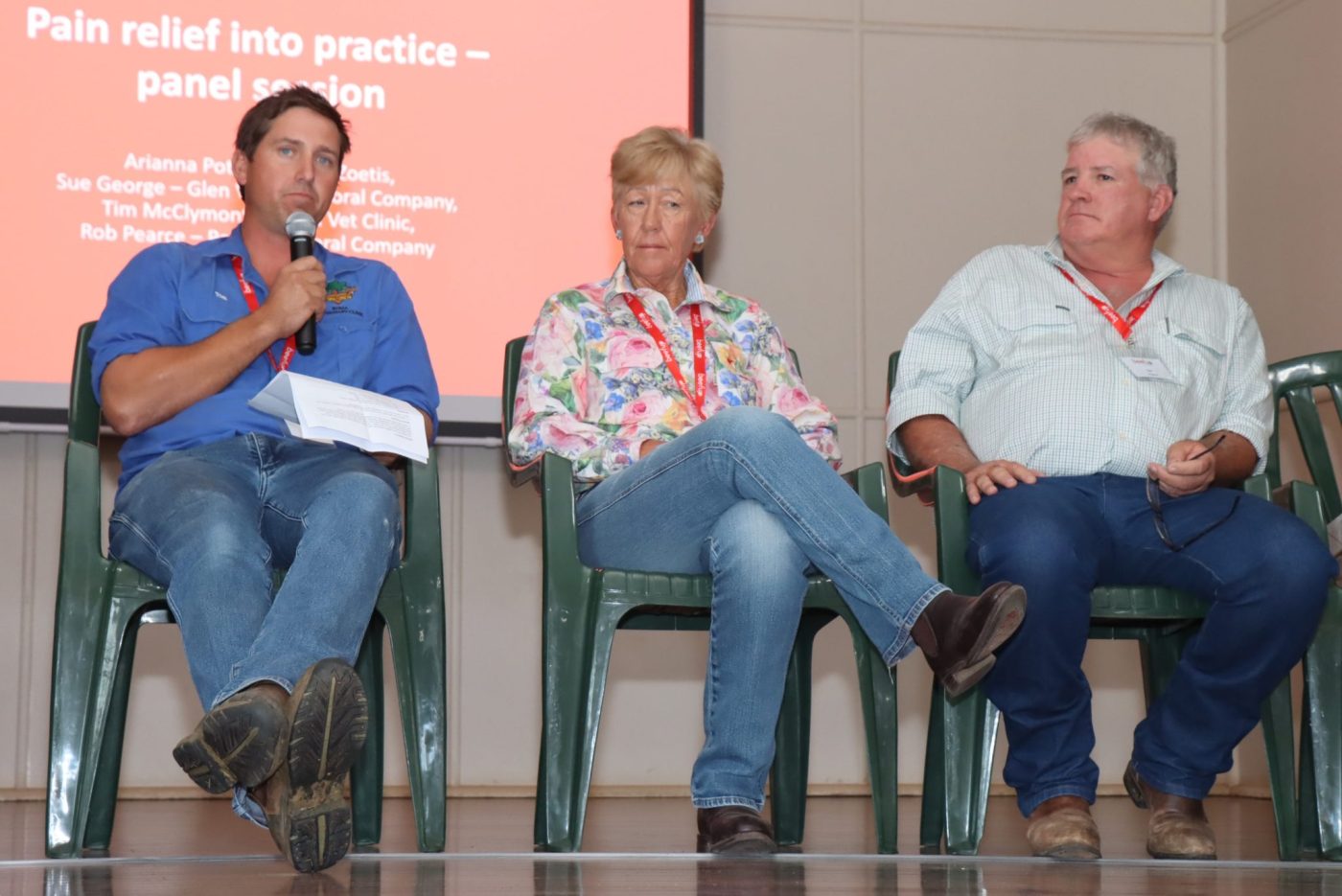
Roma vet Dr Tim McClymont with Sue George from Jundah and Rob Pearce from Ilfracombe.
WHEN he joined the Roma Veterinary Clinic about 15 years ago, servicing a large ‘hoofprint’ of Queensland’s cattle industry from Chinchilla to Blackall, Dr Tim McClymont estimates the percentage of cattle producers using pain relief in surgical procedures was in the single digits.
Today that number has risen to over 40 percent, he estimates.
Over that time pain relief has gone from something that was “somewhat made fun of” to something people were now embracing as they saw and understood the benefits.
“I can’t name any clients who have started using it and who have decided it wasn’t for them and that they didn’t see the benefits of it.”
Tim was speaking during a panel session at Tuesday’s BeefUp forum at Morven which explored on-farm use of pain relief. Joining him on stage were cattle producers Sue George from Jundah and Rob Pearce from Ilfracombe and panel chair Adrianna Pott, South West Qld area manager for Zoetis.
In addition to the observation that most producers do not revert to not using pain relief after trying it, here are several more key messages from Tuesday’s pain relief panel session:
Set up clear systems at the calf race
Asked how to ensure everyone on a property is using pain relief the correct way, Rob Pearce replied that “it’s all about setting up systems at your calf race”.
“Primarily one person is responsible for making sure your calves get the needle, that way we know when they get to the cradle that they have all been done.”
Educate staff on why pain relief matters
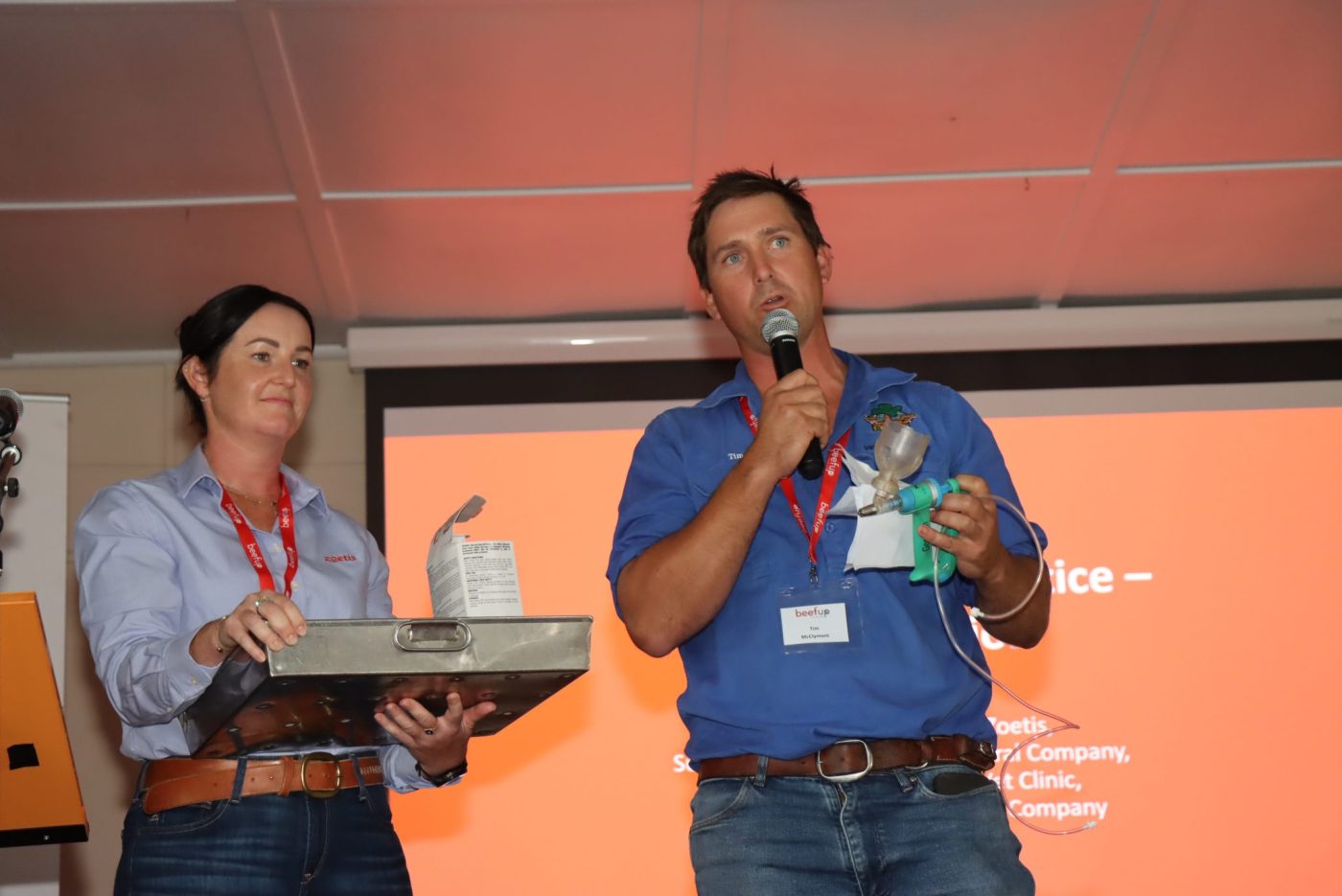
Tim McClymont giving a pain relief demonstration with South West Qld area manager for Zoetis Adrianna Pott.
Correct use comes down to understanding why procedures are being conducted in the first place, Dr McClymont answered.
“Generally it is a five minute crash course on how to use these products,” he said.
“The best way that we have for people to use it properly is to educate them why they need to use it properly.
“And as soon as you understand the product, it’s easy, and then you’re much more likely to use it effectively.”
Products take time to work
It was important to understand that pain relief products take time to work, Dr McClymont said.
“It’s not as soon as you cut the calf and give it the needle, it’s sweet. It takes 15 to 20 minutes.
Programs should be planned so cattle can be needled in the race before reaching the cradle.
“Trying to break pain that is already there is much more difficult than preventing it before you cause it.”
Handling benefits ‘really hit home’
Rob Pearce said that when he first used pain relief on calves, what he really noticed were how calm, content and happy the calves appeared.
 “What really hit home for us with it was when we bought those cattle back in three or four months later for weaning, they just walked through the pound and stood there while we opened the gate, and then walked out the gate, they were like dairy cows, and that is what really sold it for me.
“It was just like there was no association with any trauma associated with those yards.
“For 72 hours of pain relief they had after they left, they were back in the paddock with mum looking after them before they realised something was happening.
“You may not see effects straight away, but when you bring them back in next time, and those cows come in now as old cows, and it is just a whole different lot of cattle to handle. I can’t speak highly enough of it.”
Good operators still benefit from using it
Producers confident in their technique still have reasons to adopt pain relief, the audience was told.
Dr McClymont said pain relief products work across multiple pathways, reducing both pain and inflammation. helping calves recover and move more freely after procedures.
“I’ve got a lot of clients who have got a 10km walk back (for cows and calves).
“You find when you ask them who is at the back of the laneway, at the tail of the mob, it is generally the castrated males which have been dehorned, they not mothering up as well, not walking as well, the animal is under pain. So dealing with that pain is effective, if we can also reduce blood supply to dehorning injuries that is helping as well.”
Organic producers do have pain relief options
Dr McClymont said there was a misconception that no existing pain relief products can be used in certified organic operations.
“That’s not quite correct,” he said. “Depending on which program that you registered with, generally, everyone’s in the USDA (United States Department of Agriculture) and NOP (National Organic Program), we do have pain relief available in the injectable form.”
Organic producers were getting good results with a product called Flunixin, he said.
“So just don’t walk out of here if you’re an organic producer thinking that none of this matters because you can’t use it anyway. That is a really important message we want to get across, there are options for you.”
‘Hidden’ benefit
On Glen Valley at Jundah, Sue and Herb George perform most of their on-farm labour themselves. Sue said the administering pain relief had provided benefits from a safety perspective.
“We find using the pain relief settles them down, it makes it much safer for my husband and I,” she said.
Rob Pearce had the same view.
“I think there’s a bit of a bit of a hidden benefit with using the pain relief in the cradle and in the yard. Is the workplace, health and safety aspect of it all, the calmness and temperament of the cattle.”
Economics stack up
A producer from the audience asked if any effort had been made to measure the cost/benefit of pain relief, or whether the case in favour was based on more subjective and emotive reasoning?
Dr McClymont said was data showing a 650 gram per head per day difference between animals that received pain relief and those that did not. “Whether it could be called weight gain, I don’t think it’s fair,” he said. “That was after 10 days, and after you go further out past a month, you’ll find the other animals actually catch up.
“So it’s not necessarily money in the bank straight away. But I think this would be influenced on things like how far these animals were to walk. Many people in this room here might have a 5 or 10 kilometre walk, and I think that will probably change what we call the setback, the amount of weight that these animals lose after a dehorning or a castration.
“So I think the further west you are, the bigger acres you’ve got, financially I think you’d find, if we could find a way to do the study, I think you would find the financial gain.”
‘Don’t listen to dad’ – the industry is changing
One of the more candid messages came from Rob Pearce to the younger generation of producers present.
“It’s great today to see a lot of lot of young people in the audience out there,” Rob said.
“And if I can just give you some advice, and that’s just don’t listen to dad.
“Things are changing. Animal welfare is so, so important in our industry today.
“We’ve got to be proving that every day that we’re doing the best thing for our animals, and the social license aspect of all of these issues, it’s to too important not to.”