
THE latest Middle Eastern military action that’s unfolded over the past three weeks has added yet another layer to an already complex and confused 2026 global red meat market.
Helping understand and digest the rapidly changing global food trade landscape during a presentation in Brisbane this morning were Rabobank global analysts Jan Lambregts and Cyrille Filott.

The pair used a series of gambling metaphors to illustrate their main points.
Mr Lambregts, head of RaboResearch’s global economics and markets division, stepped through the challenging global trade landscape, being impacted this year by geopolitical, economic and most recently military forces. He outlined the cards that each major geopolitical region had to play, and how they might play them in a rapidly changing world, especially in the light of the US, Chinese and Russian positions.
In the case of the US, President Trump was gambling everything on outcomes in Iran, which was all about access to oil and controlling a key choke-point.
In trying to assess the possible impacts, Rabo had developed a set of scenarios, based on how long the Iran conflict might last:
- The first saw the conflict all over in a month, in which case oil prices sit at about US$90 a barrel
- The second saw the conflict lasting 3-6 months, where oil price sits was estimate to average $110/barrel, and
- The third, where oil production facilities are attacked and the disruptions last for years, where oil prices average $150 a barrel or more.
“And that’s just energy,” Mr Lambregts said.
“From that flows fertiliser, all sorts of other goods, and you also have to consider the demand implications from consumers affected by the fuel price rises and other impacts. There are lots of aspects there.”
If there was one positive to be taken out of the current situation, he said it was that President Trump was ‘not a crusader for christianity, nor was he operating on a principle basis’ in the Middle East.’
“We’ve seen him walk away from things in the past, when normally leaders would not,” Mr Lambregts said.
“I can see a scenario over the Middle East where Trump says, ‘I’ve grown tired of so much winning, we’re done’. If that happens, the question them becomes, who controls the Strait of Hormuz, through which the main sea-freight traffic must pass.”
“Once Trump decides to pull out of the conflict, the only thing Iran needs to do is survive – they will try to calm things down.”
“However it remains a complex part of the world. The latest intel suggests that the Gulf States – now much disrupted by the conflict – would like the Americans to continue, to try to achieve regime change in Iran, because they cannot deal with an Iranian regime that always represents a threat.”
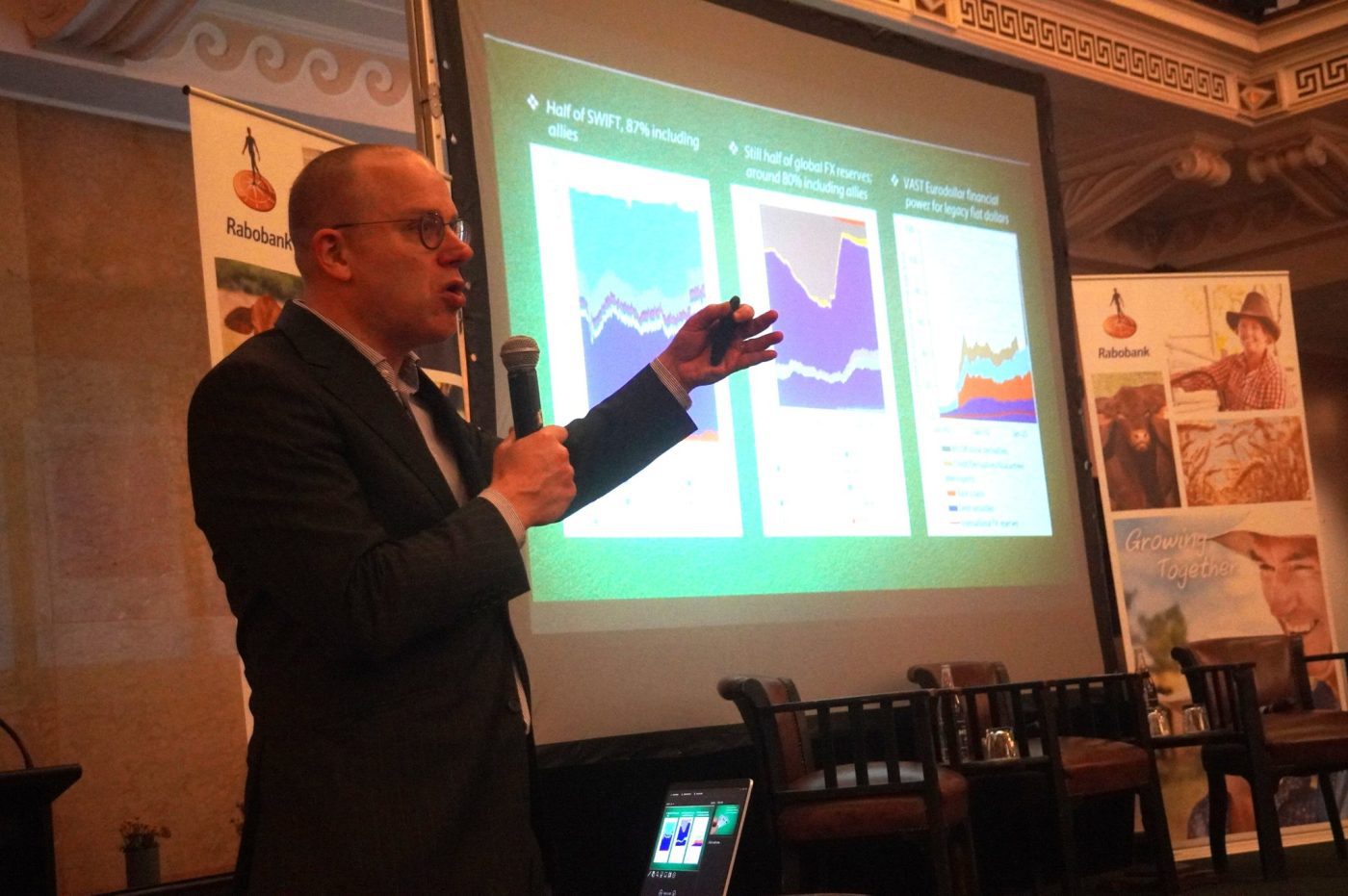
Rabobank global analyst Jan Lambregts addresses this morning’s briefing in Brisbane
In Europe, countries were trying to make sense of all that’s happened this month in the Middle East, in the midst of a lot of turmoil.
“The problem is not that they don’t know what to do, but the EU leaders don’t have the political decision-making powers or leadership to do it,” Mr Lambregts said.
“At the same time they keep getting hit by these geopolitical crises. They have made a deal with Trump; they’re in the US camp, but they don’t enjoy it at the moment – and Greenland, of course, was a part of that.”
Elsewhere, Putin wanted Imperial Russia back, but it wasn’t working well for him at the moment.
“Putin is losing interest and influence everywhere, but he is still stuck in the Ukraine. He now has a new lifeline though, with oil prices higher, and a lot of the weapons are going to the Middle East. He’s betting on the fact that he can outlast the west in the Ukraine conflict – but he too, must be feeling the pressure.”
In China, President Xi still wanted to become the Asian hegemon, building influence all over the world. However he had suffered some setbacks – in Venezuela, and now possibly Iran – but his number-one priority remained reunification of the Chinese motherland, including Taiwan – preferably peacefully, but if not by force.
“This is not about economics,” Mr Lambregts said.
“Taiwan has a semi-conductor industry – that’s why the rest of the world is interested in Taiwan.
“But President Xi hold some key cards – one of them is rare earth, used for many items including lithium batteries – but the other is the simple threat that he may move on Taiwan. He may enforce a simple blockade, and see who comes to Taiwan’s rescue,” he said.
“It doesn’t take great geopolitical expertise to understand that if the US gets stuck, long term, in the Middle East, it may see Xi roll the dice in Taiwan.”
Implications for Australia
So what does the Middle Eastern conflict mean for Australian agriculture?
“I’d say some of the cards are good for Australia – but at the same time some say the rules-based order is disappearing. I disagree: there will still be rules, but they will be different rules, and different blocks of rules,” Mr Lambregts said.
“That is not to the advantage of Australia, but nor is it to countries like Canada or regions like Europe – because the big players, China and the US will set the rules.
“Where previously you were free to trade with anyone, as we’ve found out over the last seven or eight years, that gets more complicated
“That doesn’t mean there won’t be trade opportunities – new opportunities will come up – but it’s now a more complicated world from that perspective.”
Just three days before the US attack on Iran began on 28 February, Mr Lambregts said his own Dutch government had assured its citizens that the country’s natural gas reserves were ‘kind of empty, but luckily we’re out of winter and everything should be fine, unless there is a major disruption like closing the Strait of Hormuz.’
In an outcome that resonates in Australia this month, he said despite being ‘as wealthy as can be,’ the Dutch had neglected to have a proper strategic reserve of gas on hand, because it was ‘too expensive’ to do so.
“It puts us in a difficult spot at the moment – one we can’t just fix by interest rate hikes,” he said.
Is ‘any FTA deal’ better than none?
During question time, Beef Central asked whether the uncertainty surrounding fuel access and other impacts from the Iran action represented a risk in the well-advanced Free Trade Agreement negotiations between Australia and the European Union – in terms of simply ‘getting any deal over the line’ to deliver a trade pact during uncertain times.
“The changing world is definitely propelling this (trade deals) forward, and I share your concern over the potential to take short-cuts,” Mr Lambregts said.
“I would say, however, that this concern is present on both sides – not just from Australia,” he said.
“Obstinacy has been present on both sides of the FTA deal, but we now seem to be cutting through that, because there is a political desire to show that things can be done. But you are right: we need to make sure we (both sides) don’t cut corners for expediency, to simply get a deal over the line during challenging times.”
Mr Lambregts said he got the impression that such negotiations sometimes got stuck on (relatively minor) details for far too long, and the greater benefits don’t come.
“A similar thing is happening between Europe and the Mercosur (South American) countries in trade discussions. There is this political will to make it happen, pushing things through.”
“Within the changing world order, the Europeans may still be a little less stubborn and obstinate.”
Tomorrow: The impact that Ozempic and other weight loss drugs are having on global consumer habits
HAVE YOUR SAY