
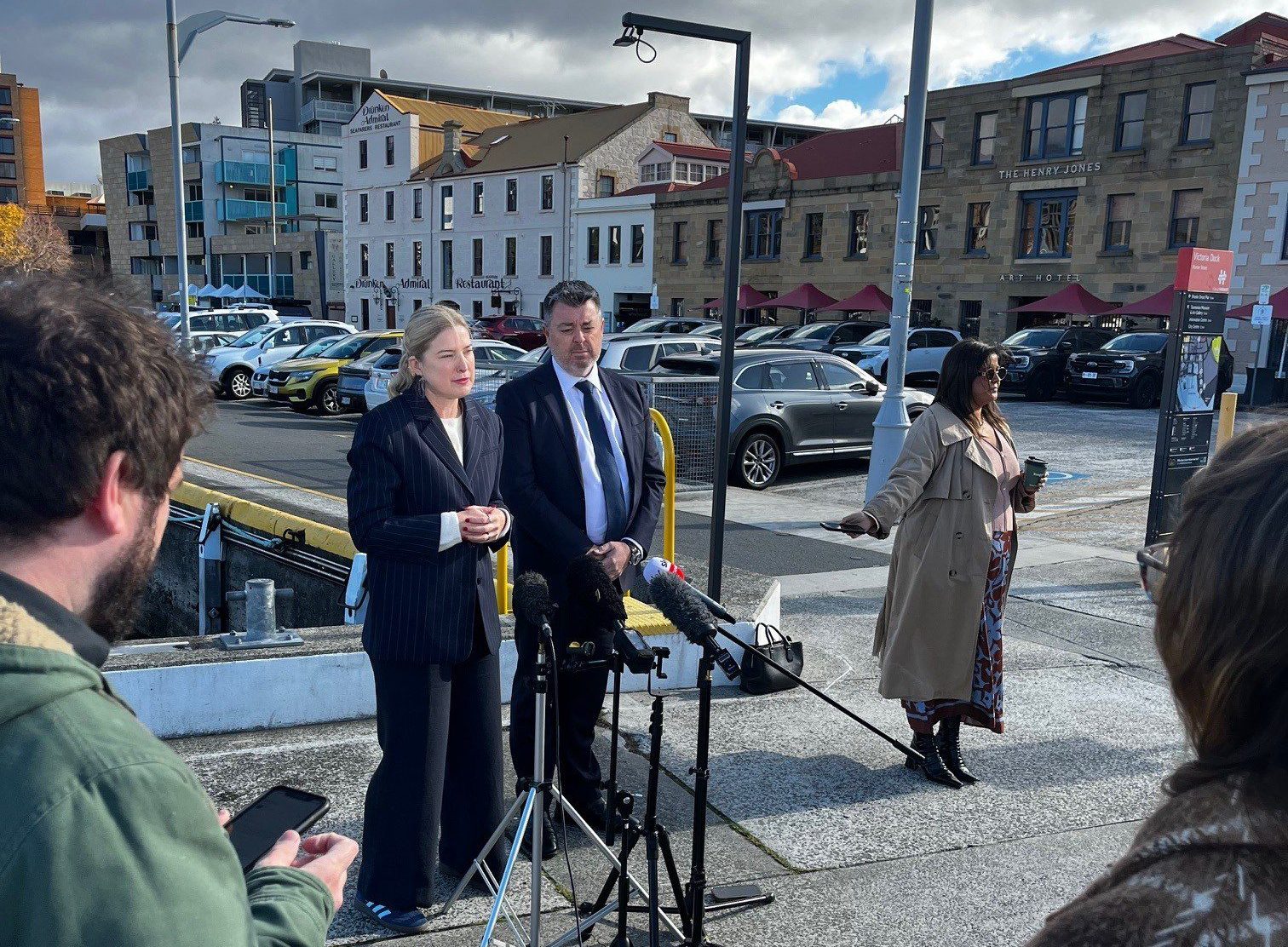
Federal Agriculture Minister Julie Collins and Incitec Pivot chief operating officer Scott Bowman in Hobart this morning announcing the securing of 250,000t of urea from Indonesia Photo: Incitec Pivot
A DEAL between Incitec Pivot Fertilisers and PT Pupuk Indonesia will bring around 250,000 tonnes of additional agricultural-grade urea into Australia for cropping and livestock industry use this year.
It represents around 20 percent of the remaining fertiliser needed for the current season.
The deal has been supported by the Australian and Indonesian governments in the face of limited supplies coming out of the Persian Gulf, normally the origin for around 60pc of Australia’s urea, as conflict rages between Iranian and US-Israeli forces.
Incitec Pivot Limited chief operating officer Scott Bowman said Incitec Pivot’s trading relationship with PT Pupuk Indonesia, supported by the collaboration between the Australian and Indonesian governments, has yielded a positive outcome for Australian farmers.
 “This additional volume for the period May to December, at prevailing market prices, is another critical plank in servicing the needs of Australian farmers,” Mr Bowman said.
“Australian farm output is necessary for regional food security, and this is a crucial contribution to securing inputs via Australia’s largest fertiliser distributor, Incitec Pivot.”
“Whilst there is more work to do to ensure farmers requirements can be fully met this upcoming season, this additional volume will go a long way to shoring up critical supplies to Australian farmers”
The Australian Government said it was working closely with key international partners and domestic industry to secure additional fertiliser supply, which in turn supports food security in Indonesia and across the region.
“I am very grateful for the cooperation and support of the Indonesian Government in finalising this,” Minister for Agriculture, Fisheries and Forestry Julie Collins said.
“While this is a commercial deal, the Australian and Indonesian Governments have been working to support this positive outcome.
“This guarantees supply of fertiliser to Australian farmers at this critical time.”
Biosecurity hurry-up
This week, the Federal Government has also announced changes to biosecurity processes for fertiliser imports aimed at reducing the time and cost of sourcing supply from non-traditional origins such as Nigeria and Oman.
The changes include offshore certification through a simplified entity registration process, streamlined onshore compliance inspections, and a requirement for importers using higher-risk pathways to provide bagged samples for prior biosecurity inspection.
Ms Collins said these measures were introduced following engagement with Fertilizer Australia.
“We have engaged closely with industry to establish these changes, and appreciate Fertilizer Australia’s commitment to practical collaboration and problem solving,” Ms Collins said.
“The Albanese Labor Government will never compromise on biosecurity, but this is a sensible way to streamline the robust systems in place to help get the fertiliser we need faster.”
Fertilizer Australia chief executive Stephen Annells said the changes would help ensure fertiliser was free of contaminants while speeding up supply to growers.
“Fertilizer Australia is committed to working alongside the government, ensuring that our collaborative efforts lead to sound biosecurity systems and timely access to fertiliser for Australian farmers,” Mr Annells said.
“This partnership not only emphasises the importance of practical solutions but also reinforces our shared dedication to maintaining rigorous biosecurity standards, protecting Australia’s farming ecosystems and export markets.”
PM Brunei visit
The changes have come following a visit by Prime Minister Anthony Albanese and Foreign Minister Penny Wong to Brunei on Wednesday to shore up supplies of urea and diesel.
Alongside Indonesia and Malaysia, Brunei is one of the few suppliers of urea outside the Middle East.
Although levels fluctuate, Mr Albanese said Brunei supplies about 11pc of Australia’s fertiliser-grade urea imports.
The visit, including a tour of Brunei Fertilizer Industries, ended with the signing of a joint statement on energy and food security, pledging to keep trade open and ensure continued supply of fuel, fertiliser and agricultural goods.
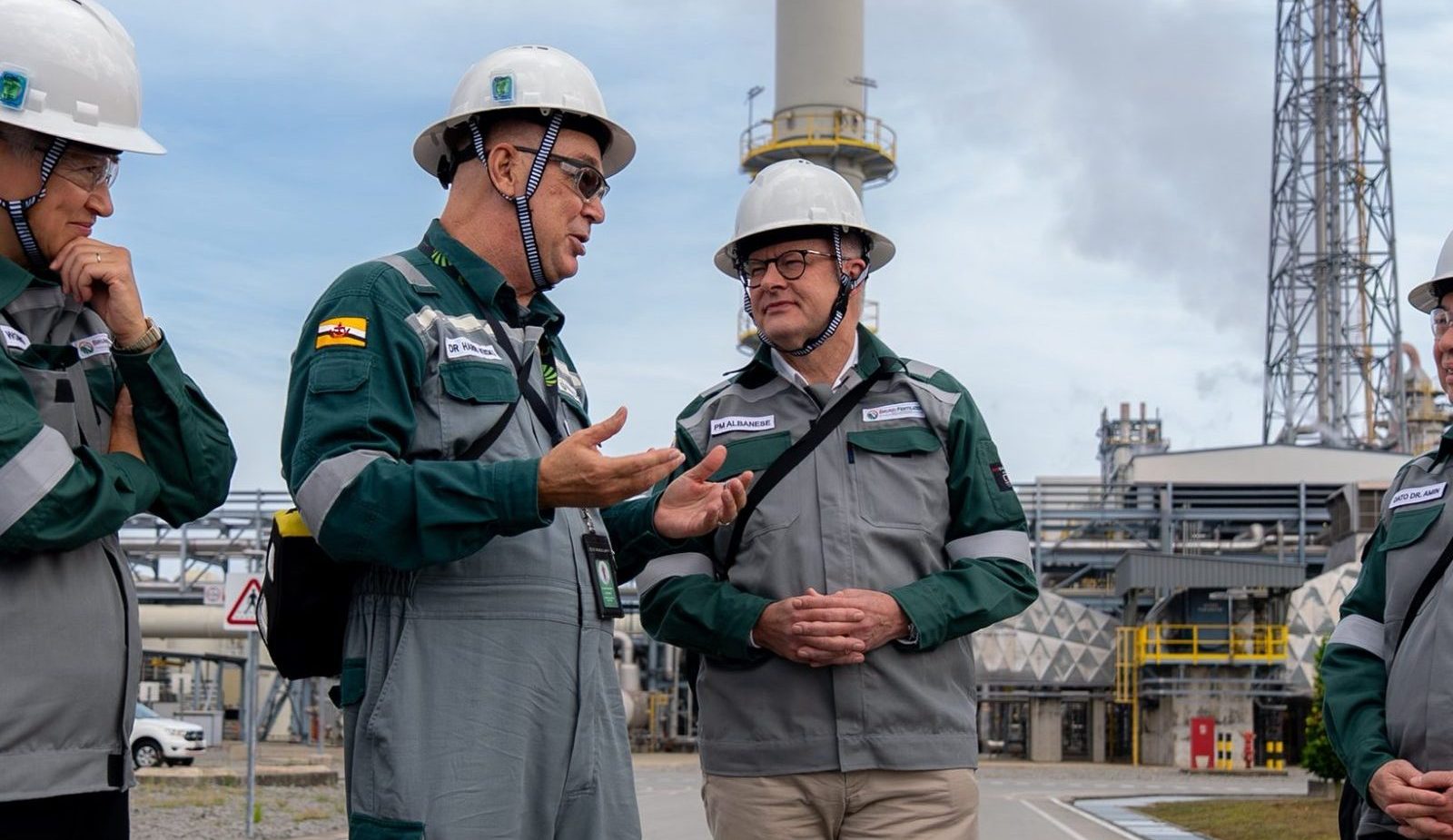
Anthony Albanese tours the Brunei Fertilizer Industries plant on Wednesday. Photo: Anthony Albanese
While no agreement was reached to increase urea imports to Australia, Mr Albanese said talks were positive.
“[A]t the Brunei Fertilizer Industries, we had the opportunity to talk firsthand about the potential that’s there as well for an increase in Australia receiving fertiliser in particular from Brunei and we had very positive discussions and that will continue,” Mr Albanese said.
“As we go forward, of course, in today’s uncertain world, there are pressures on all of the economies in the region.
“Not only did we speak today about existing supplies coming, we spoke about additional supplies as well.”
Mr Albanese then headed to Malaysia for talks with its Prime Minister Dato’ Seri Anwar bin Ibrahim.
Malaysia is Australia’s third-largest source of refined fuel and supplies 10pc of Australian imports of fertiliser-grade urea.
The Prime Minister’s visit was cut short to enable him to return to Australia for a visit to Viva Energy’s oil refinery in Geelong, Victoria, following damage to it from a fire that broke out on Wednesday evening.
The refinery is one of only two left in Australia, the other being in Brisbane, and it supplies around 10pc of Australia’s fuel, and more than half of Victoria’s.
In a statement, Viva Energy said the facility remains operational on reduced production rates.
“We anticipate that the impacts will be predominantly to the production of gasoline and aviation gasoline; however, the damage needs to be assessed and understood.
“There is no immediate impact to fuel supply, and the Company expects to replace any lost production through its fuel import program.”
Supply concerns persist
Speaking on ABC News Breakfast yesterday, Ms Collins acknowledged more work was needed to ensure adequate fertiliser supplies in the months ahead.
“We do know that we’ve got enough fertiliser either in the country or on the water on its way to Australia for the initial planting season.
“We do know that there will be shortage in future months, which is why we have been acting so quickly with the industry and with the sector to get as much into the country as we can, as quickly as we can.
“We want to make sure that we’re covering and getting as much fertiliser as we can for Australian farmers.”
Ms Collins said the government was aware “that some farmers are doing it really tough at the moment and making some really tough decisions because of…prices of diesel and fertiliser as well as availability”.
“[O]ur job as the government obviously is to work to shield Australians as much as possible from the impact of the war in the Middle East that is impacting globally.
“We’ve been working with industry…meeting regularly and dealing with immediate challenges and helping them solve some of those while we work on medium and longer‑term strategies.”
EDITOR’S NOTE: This story updates one published yesterday and entitled Biosecurity changes widen fertiliser avenues; PM visits Brunei.
Grain Central: Get our free news straight to your inbox – Click here
&