
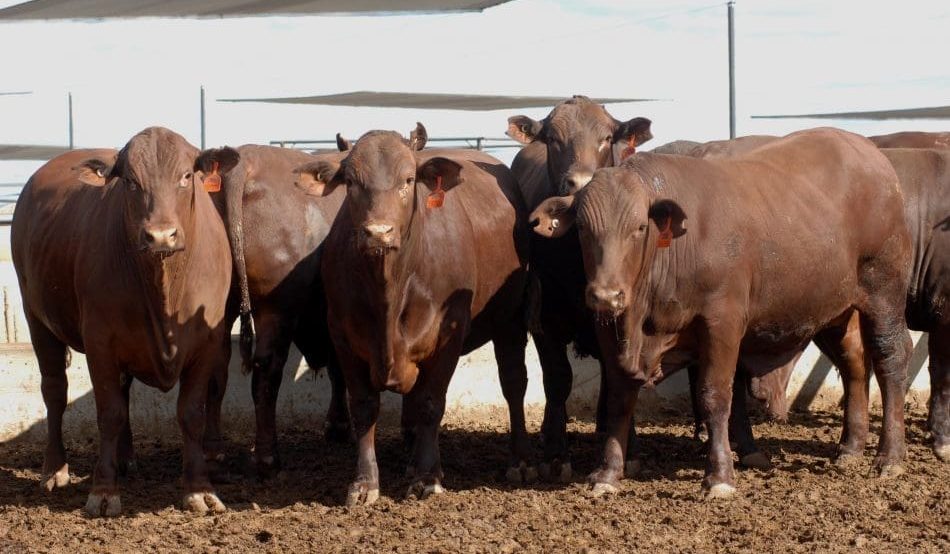
HGP-treated grainfed Santa bullocks in a Queensland feed yard
THERE’S been an uptick in the use of hormonal growth promotants in both grain and grass-finished cattle this year, as the quota for beef exports to the Chinese (HGP-free) export market draws closer to filling.
China is by far Australia’s largest HGP-free beef market, taking 272,000t of Australian beef last year, or 17.6pc of total beef exports. Other HGP-free markets like the UK and the EU are small, in comparison, accounting for just 1pc and 0.5pc of last year’s exports, respectively.
With many anticipating that Australia will fill its 2026 beef quota to China by May or early June, there’s been clear evidence of some grain and grassfed production systems changing tack on HGP use, as a result.
In the grainfed channel that does not include marbling-oriented Angus or Wagyu-type longfed programs, but more generic 100-130 day grainfed beef produced in large quantity.
While the very good 2026 pasture season that’s unfolding in the northern half of Australia is definitely a part of the explanation behind strong implant sales this year, clearly the China access factor is also a part of decision-making for some operators.
Industry body Animal Health Australia compiles data on HGP sales, but collection of data has a long-lag time attached, and was unable to capture the current trend in time for this report.
However discussions this week with product re-sellers and implant manufacturing companies confirmed the stronger trend in implant sales across the northern half of Australia.
Late start to season for many
Beef Central started asking questions on the topic a month or six weeks ago, but was told it was too early to tell at that time, because of the widespread flooding and heavy rain impact across large parts of northern Australia where implants are typically used in grass systems.
Many cattle programs have been pushed back a month or more as a result of the weather, but as country starts to dry out, orders for implants are clearing on the rise, in advance of first-round musters, one large reseller said this week.
‘How much of that is due to the China HGP-free market access issue, versus the general very strong seasonal outlook, is impossible to tell – but both are clearly factors,” he said.
Slaughter cattle, feeder cattle pricing
So are there significant price distinctions for slaughter cattle in the Queensland market, where the majority of HGPs are used? Among the two largest export processors, controlling six export plants between them in the state, JBS Australia makes no price distinction whatsoever on heavy grassfed steer four teeth and less.
Competitor Teys Australia offers a 10c/kg (carcase weight) incentive for HGP-free grass steer – worth around $35 on a 350kg ox.
For feeder cattle, JBS Australia makes no price distinction between implanted and non-implanted steers for its generic 100-day feeding programs, either in its northern or southern yards.
A field sales manager for one large implant manufacturer, who asked not to be identified, said the past two years had been strong for implant sales due to good seasons, but there was a definite uptick this year, and especially in the past month or so, for grass programs.
“Anecdotally, we are seeing people coming back to longer payout grassfed HGPs in Queensland and the NT,” he said. “Off the top of my head, its up perhaps 20pc, compared with the period before 2025.”
“Initially the extra demand has been out of North Queensland and Central Western Queensland, where country has dried out more rapidly and feed has responded quickly. Other areas, like parts of the NT, and Northwest Queensland are still getting started.”
He said many long-standing HGP users in Queensland had in fact changed their business models in recent years, moving from finishing grassfed ox to turning off younger and lighter steers into feedlots.
“They are taking advantage of the seasons, and getting those steers off earlier, at heavier weights, with HGPs playing a role in that,” he said. “Many start with a long-acting oestrodial, then get re-implanted with a shorter-acting TBA-oestrodial combo on entry into the feedlot.”
Manufacturers typically claim weightgain advantage of 15 percent or better over non-implanted cattle, making an outlay of say, $11 on a Compudose 400 implant, look like a very strong return on investment.
“And on top of that, they typically turn off earlier, and save grass,” the manufacturer contact said.
Another sales manager for a popular implant manufacturer said a good season, combined with good commodity prices inevitably stimulated HGP demand in northern regions, but this year had been further boosted by the China developments.
“Demand has built over the past few weeks, as country starts to dry out more,” he said.
Asked for an example on typical implant performance, he said written literature on more than 130 recognised trials on his company’s long-payout product had established 15.8pc weightgain advantage over non-implanted cattle, on average.
“Using a 200kg weaner as an example, over a 400-day period at additional gain of 15.8pc, its adding additional liveweight of 19kg, at even 0.3kg average daily gain per day. Multiply that 19kg by say, $4/kg liveweight adds $76 in value, for an $11 outlay,” he said.
“At a higher sale price of say, $4.50/kg liveweight, the gross goes out to $85.50, or almost $75 after the cost of the implant. Gross profits on the use of implants of $110 a head on grass cattle are not unheard of. That’s not bad ROI.”
“In grass slaughter cattle, for those processors offering a 10c/kg difference between implanted and non-implanted steers, it’s worth about 5c/kg liveweight – so weight always beats rate – more than compensating for any price incentive.”
Some lotfeeders respond to China developments
In grainfed systems, several large feedlot operators responded quickly to the January announcement that Australian beef exports to China this year would be limited by quota, meaning Australian beef would find the market ‘prohibitive’ once the 55pc tariff is applied. In these cases those lotfeeders have discontinued some HGP-free shortfed programs in favour of extracting greater feedlot performance using implants.
In one case, a large Queensland lotfeeder told Beef Central his business had taken the unusual step of implanting cattle already part-way through their mid-fed no-HGP program, originally destined for customers in China, but now heading into other markets.
In the export meat market, HGP-free grassfed and grainfed trimmings attract a small price premium, but not enough to financially incentivise non-use of implants, where appropriate.
HAVE YOUR SAY