
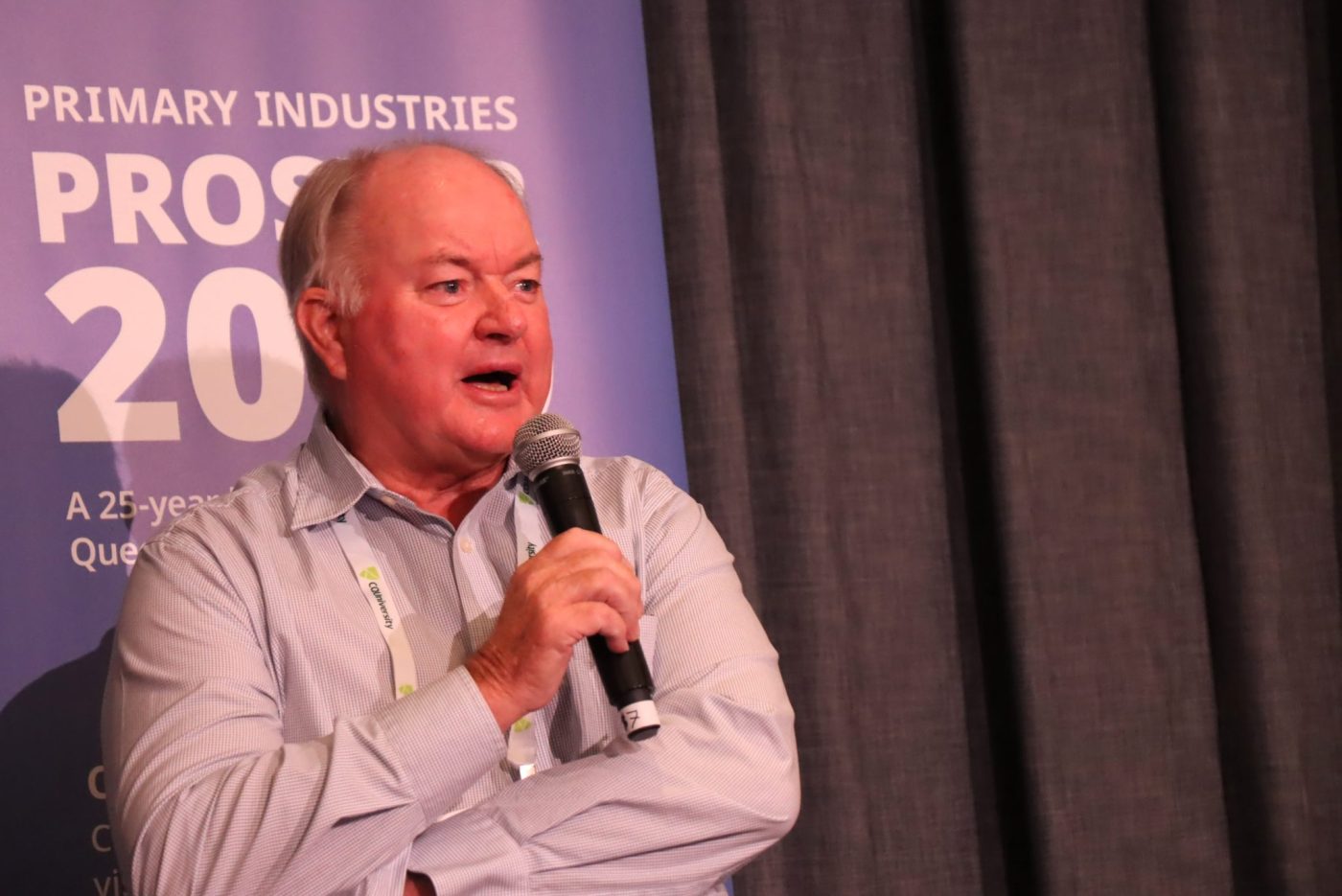
Australian cattle industry leader David Foote opened his keynote presentation at the Northern Beef Research Update Conference in Brisbane on Wednesday with a humourous video demonstrating the skills of American “cat herders” and the deep pride they take in a tradition that they love.
“Herding cats” is a well-known metaphor for tackling tasks that can seem all but impossible. Not only did the video generate plenty of laughs, it also neatly framed the key challenge at the heart of Mr Foote’s presentation: getting proven research knowledge more widely adopted across northern commercial cattle enterprises.
Drawing on the impact of research developed across more than three decades of work conducted through the North Australian Beef Research Council (NABRC) system, including the landmark multi-faceted CashCow project, Mr Foote said one of the industry’s biggest opportunities lies not in new scientific breakthroughs, but applying the knowledge that already exists.
“The industry doesn’t suffer from a lack of knowledge. It suffers from a lack of scale in applying it,” he said.
Profit follows pasture
Mr Foote said northern research over many years had identified clear management principles that consistently improve performance in commercial beef enterprises.
One key message was that “profit follows pasture”.
“Properties that maintain over 70 percent ground cover at the end of each dry season have higher pasture growth across the property, have better breeder condition going into winter, and they have improved conception rates,” he said.
Additionally, profit follows pasture condition. Producers who followed this regime consistently outperformed those who pushed the stocking rates.
“If you adjust your stocking rates early when seasonal conditions tighten, if you prioritise the pasture recovery after rainfall, and if you carry forward feed as insurance, it’s a clear pathway to not having to undertake one of the most expensive and gut wrenching operations, which is destocking.”
“Groundcover drives pasture productivity. Pasture productivity drives body condition. And breeder condition drives conception rate. Not rocket science.
Breeder herd performance was a clear profit lever in northern beef enterprises.
A one percent increase in weaning rate was now worth about $12 to $15 per cow.
“That means a 10pc lift in weaning rate will deliver $80 to $120 a breeder annually.
“So the improvement doesn’t require a new production system. It just comes from better breeder management.
“So how much value is still sitting within our herds for us to extract?”
“What makes up the $120? Three pretty easy principles – improved pregnancy rate, calf survival rate, and cow longevity. Another season, another calf, $120.
So for 5000 breeders – that’s $600,000 revenue extra per year available.
“Breeder performance is the biggest profit lever.”
Mr Foote said the biggest productivity improvements were not coming from new discoveries, but from applying knowledge “that has been available for years.”
Technology was important but should only be used where it solves real problems.
The technologies that were gaining traction in the industry were those that were solving actual operational problems. Examples included remote water sensing, which was saving producers 30 to 50 percent in time spent checking waters, and walk over weighing, because it was genuinely helping to identify underperforming animals early and support better culling and nutrition requirements.
“Technology works when it simplifies management, not when it adds complexity.
“So the key message, the value isn’t the technology, it’s the decisions it enables.”
Adoption the real opportunity
Mr Foote said the industry’s biggest opportunity now lies in embedding proven knowledge more widely across northern production systems.
While some might argue that adoption is all about “preaching to the converted”, he mounted a robust defence of the practrice: “If preaching to the converted wasn’t important, there would be a lot of people that would have a lot more time on Saturdays and Sundays for themselves.”
He described the R&D pathway to success in these simple terms: “Research reveals opportunity. It’s adoption that captures the value.”
The impact of industry research should not be measured in reports, but in calves on the ground.
“The biggest productivity improvements are not coming from new discoveries, they’re coming from applying knowledge that has been available for years,” he said.
“Producers who’ve picked up and adopted these processes…they have 10 to 20pc improvements in weaning rate, significant reductions in calf losses, they’re getting it through stronger breeding condition, they’re getting it through longevity of the cow.
“This isn’t research theory. This actually is happening on commercial properties today. It’s there for the taking.
“So our biggest industry opportunity is not necessarily more research, it’s more adoption. “
He also added that few investments have an ROI that’s consistently as well targeted nutrition.
“But yet, adoption is not as widespread as the science would justify. So the challenge is not knowledge. The challenge is embedding this knowledge across our industry.”
Mr Foote said the challenge was in the next generation of R&D to “design our research for adoption”.
“Focus on the cost of production. Work a production system with scale. Work to translate this knowledge faster.”
“So NBRAC, my words, not the research findings, should only fund projects that can be adopted incrementally, can deliver visible benefits within two production cycles, and do not require ongoing facilitation”
Referring to the industry complexity , he said the existing pipeline for grassfed cattle R&S typically took six to nine months, or 12 months in the case of a big project, to get research projects started.
“And that’s just the bloody paperwork.”
“Are we nimble enough? Are our research extension systems dynamic enough?
Are we translating the knowledge learned quickly enough? And are the programs designed to drive adoption?”
He said the answer to the question of “how can we keep the North winning?” was surprisingly simple.
“Not by chasing the next breakthrough, but by doubling down on the principles that already work.
“Pasture, breeder performance, invest where returns are proven, adapt technology that improves decisions and embed these systems across our industry.
“And if we get that right, if we scale those lessons across the north, then the future of Australian beef production will not just depend on the north, it will be led by it. “