
Dr Derek Bailey address the NBRUC conference in Brisbane
BETTER understanding and managing grazing distribution in semi-arid cattle areas offered opportunity, a US speaker told this week’s Northern Beef Research Update Conference in Brisbane.
Dr Derek Bailey is the director of Research at Deep Well Ranch, Arizona and Emeritus Professor at New Mexico State University.
A significant part of his work has revolved around monitoring livestock behaviour in semi-arid locations, especially surrounding grazing and watering patterns.
He said on-animal sensor technology was one of the keys to better understand grazing animal behaviour. He first started using on-animal tracking sensors as part of this work as far back as 1998 – at the dawn of the digital era.
Part of his research has been carried out on US Government-owned land occupying around 46pc of the land area in the nation’s southwest, where some 20 million US cattle are located, in often rugged, low rainfall environments. Of those, about 40pc graze at least part of the year on public land.
“Grazing on public land is a big part of the western US livestock industry,” he said.
Like parts of Australia, rugged terrain, long distances to water (and in the case of the US) high elevation makes cattle grazing patterns uneven, Dr Bailey said.
The challenges he described are similar to many faced by northern Australian cattle producers in terms of location, connectivity and environmental constraints.
In the public-owned grazing lands in the US, if cattle producers did not take care of the land, they could lose the right to graze it, he said.
“Grazing management on public lands in the western US is a big deal. Local ranchers are set up to use this land, and if they did not have it, their operations in many cases would not be profitable.”
Hence understanding how cattle utilise the available pasture is important.
Opportunity for producers
“The other reason I have been interested in grazing distribution is that its represents a lot of opportunity for beef producers,” he said.
In our environment in the western US, there’s a lot of land that doesn’t get grazed – too far from water, too steep, or whatever – but if things are done, it can be used.
Actions like developing new watering points, strategically placing supplements away from waters to spread grazing pressure, and genetic selection could help better utilise up to a ‘whole third’ of some country that was not currently being grazed.
Smart sensors help understand grazing behaviour
Dr Bailey has been a pioneer in the use of on-animal smart sensors for research purposes, first using GPS collars in 1998. Much of his research still involves tracking cows today.
“For a while, we (Bailey plus grad students) were observing cows on horseback – but nobody is tough enough to survive a winter in Montana, or a summer in New Mexico, 24/7,” he said.
The early work quickly found that by placing a supplement (in this case based on dehydrated molasses) away from water, livestock were attracted to it, drawing cattle up to 600m from watering points.
“So why not attract them into areas that they are not normally grazing?” Dr Bailey said.
Another key observation was the amount of difference in grazing habit between individual animals.
“There were some big differences,” he said. “Some cows in a paddock were walking 5-7 km away, while others only hung out near the water. That kind a variation is a big deal.”
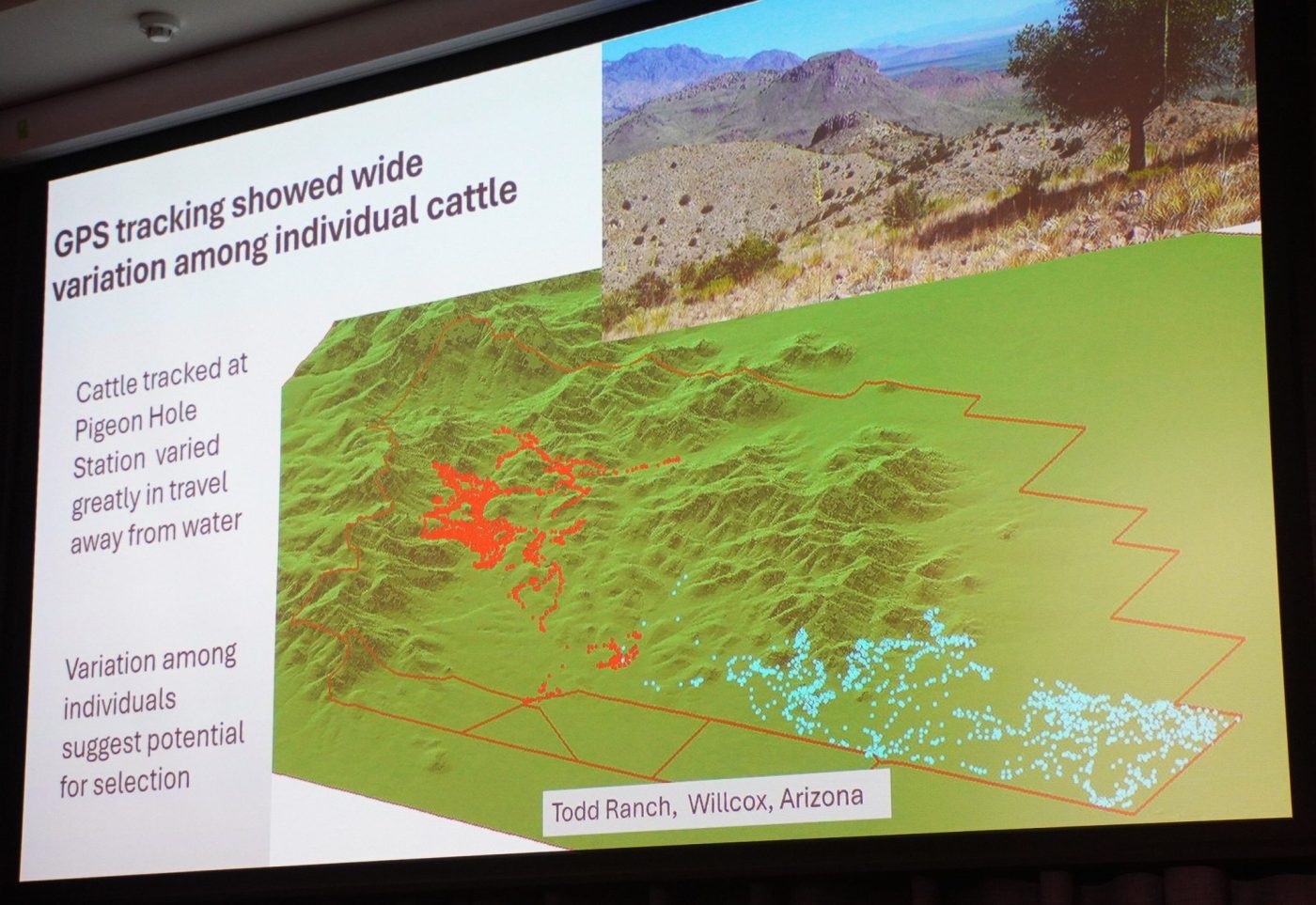
Click on image for a larger view. Click twice to expand further
In the example above, tracking two cows’ movements in the same rugged paddock over a four-month period on Todd Ranch in Arizona (represented by orange and aqua dots at time intervals), the differences were starkly obvious. Similar patterns were observed in large scale GPS tracking trials on Pigeon Hole Station in the Victoria River District in Australia.
This variation among individuals suggested potential for selection, Dr Bailey said.
“The difference was in one of the chromosome locations, which were very different in both heifers,” he said.
In follow-up work, at Florida State University, 29 genes were identified that were associated with these traits, and possibly with differences in traits like feed efficiency, heat tolerance, metabolism and energy.
It looked like these traits for cattle grazing habit may be heritable, and could one day lead to a breeding value.
Real-time data breakthrough
One of the more recent breakthroughs in animal sensors and their application in grazing research was in a moved from stored to real-time data, Dr Bailey said.
“For years, I didn’t think we would ever get to this point of accessing useful real-time data from an animal.
“There’s a lot of cool stuff happening, using sensors for location, activity/movement and body temperature, delivering proprietory predictions from sensors for behavioural states like rumination, oestrus, illness, water intake and calving.
Many commercial suppliers have different dashboards that provide data in useful forms – in some cases including traits like estimated water intake.
This provision of data was now being picked up using artificial intelligence.
“AI ids rte4ally helping in the evaluation of the raw data being provided from these sensors,” Dr Bailey said.
Supervised machine learning is able to detect rumination from a single accelerometer reader.
“Rumination is a very handy, important trait to monitor. But using AI through supervised machine learning isn’t perfect. First of all, you have to do a lot of testing, spending a lot of time watching cows.
“It works pretty dang good for things that occur often, like rumination, feeding and resting. It doesn’t work so well for things that are rare, but very important – like illness, calving, dystochia.”
Pattern mining offers scope in early detection of illness
Dr Bailey’s team got interested in the application of AI and machine learning, using data from a Central Queensland University study last year looking at water intake based on observations from accelerometers attached to seven Brahman heifers near Rockhampton.
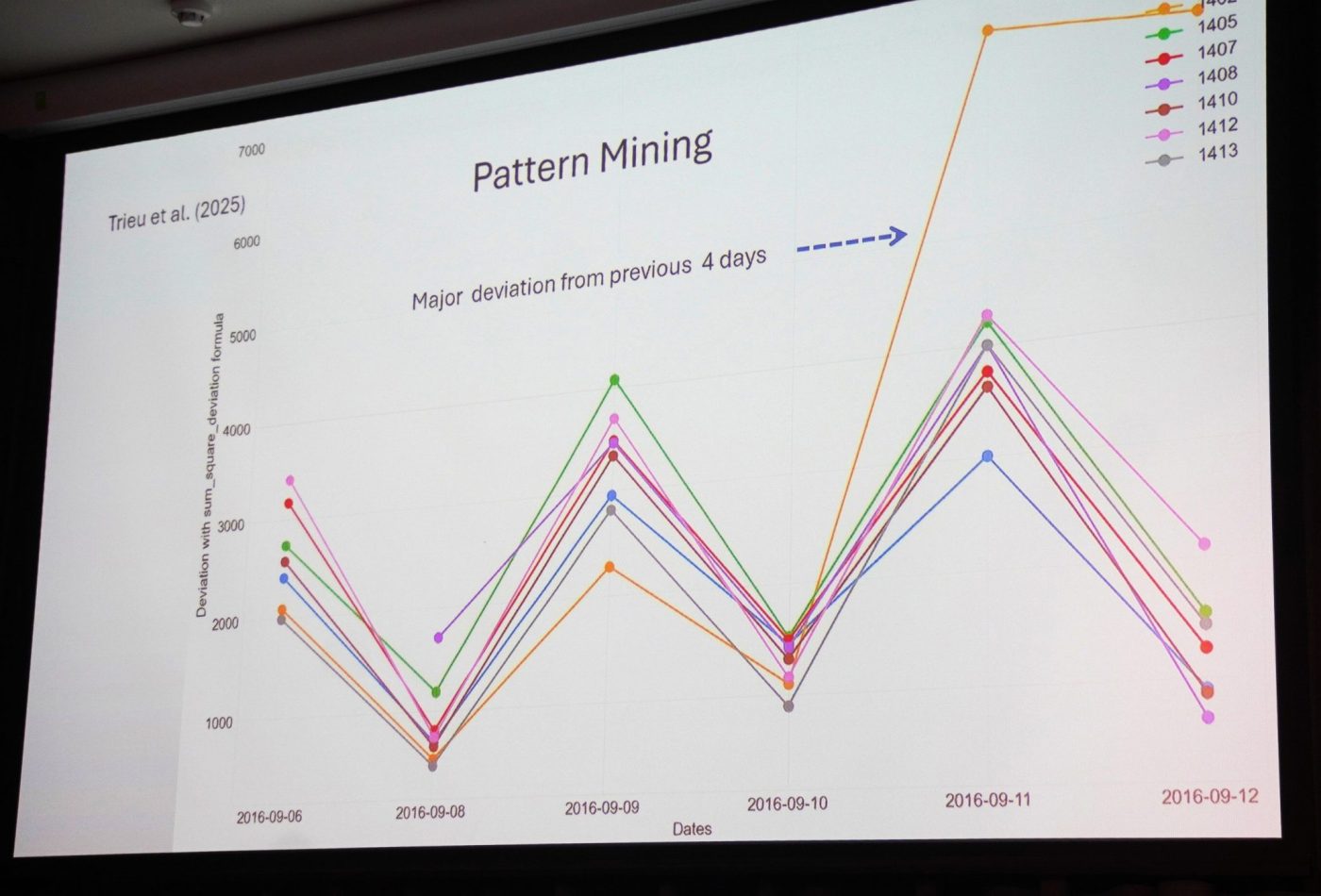
As the graph above shows, normally there were a series of ‘nice even rises and falls’ in an activity index on the heifers over a six day cycle.
But then there was one heifer (orange plot line) which went outside the group range, due to contracting three-day sickness (BEF).
“Just as you might expect, once that heifer got it, it became less active,” Dr Bailey said.
“The best way to detect any anomalies like this, is when normal grazing is happening, and that’s what we focussed on.
The research team used a tool called Pattern Mining, that examines patterns within a data-set, like that produced by a bunch of accelerometers on cattle.
It identified the single heifer whose performance produced a big deviation from the others in the group. And it turns out it identified the problem five or six hours before the herdsman at the university noticed the animal was sick – early detection.
“It turns out the pattern mining tool worked really well in predicting that,” Dr Bailey said.
Real-time animal tracking data could also be valuable in picking up problems like a failed watering point, for example.
“Animals after they drink normally move on. If they can’t access the water they stay nearby. So if you see data showing animals lingering around a watering point because there’s nothing to drink, you’re in trouble – and you need to get out there with some tools,” he said.
Sheep study focus on heat stress
Another line of research Dr Bailey highlighted was a Queensland based study near Longreach looking into sheep and goats fitted with devices, focussed on heat stress.
Plotting distance travelled each day, over six days, the graph published below shows that as temperatures rose, stock movement declined. A similar study on cattle at Deep Well Ranch in Arizona looked at morning and evening grazing, finding correlations between hot days and low rates of movement.
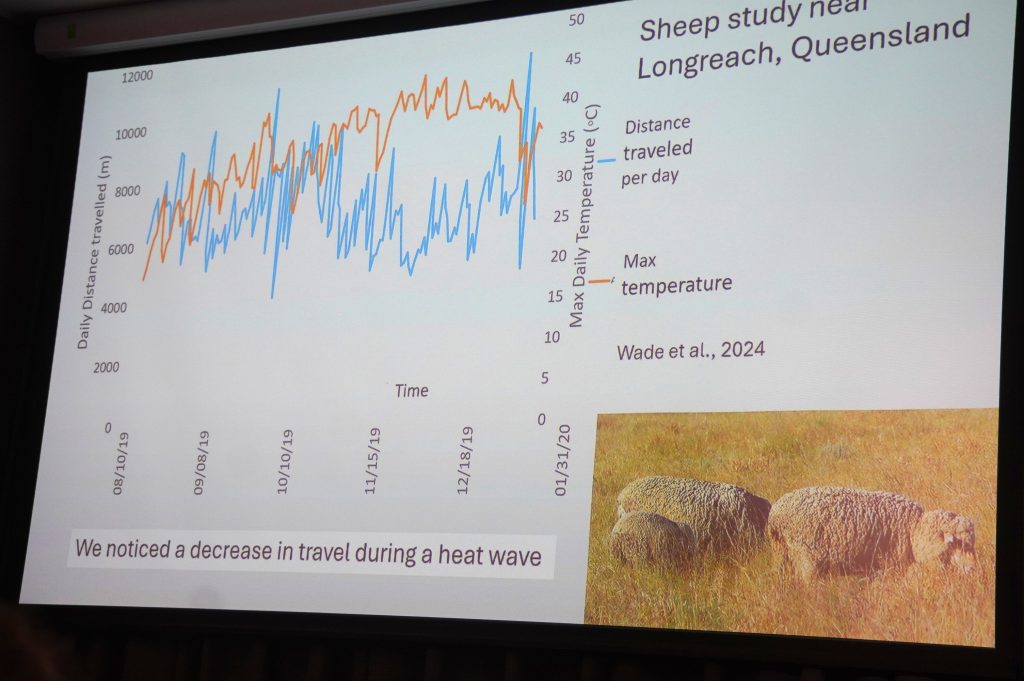
“After three consecutive hot days, they you start to see lower rates of movement. The average measured dropped by 4.7 metres per minute – that’s a lot in grazing terms – they really started slowing down. We think that correlates with observations in feedlots during periods of hot weather, where feed intake goes down dramatically. We think it’s a coping mechanism, due to the internal heat generated through fermentation in the rumen.”
Dr Bailey said artificial intelligence had potential to make on-animal sensors more useful for managers in making more informed decisions.
“But more research is needed,” he said.