
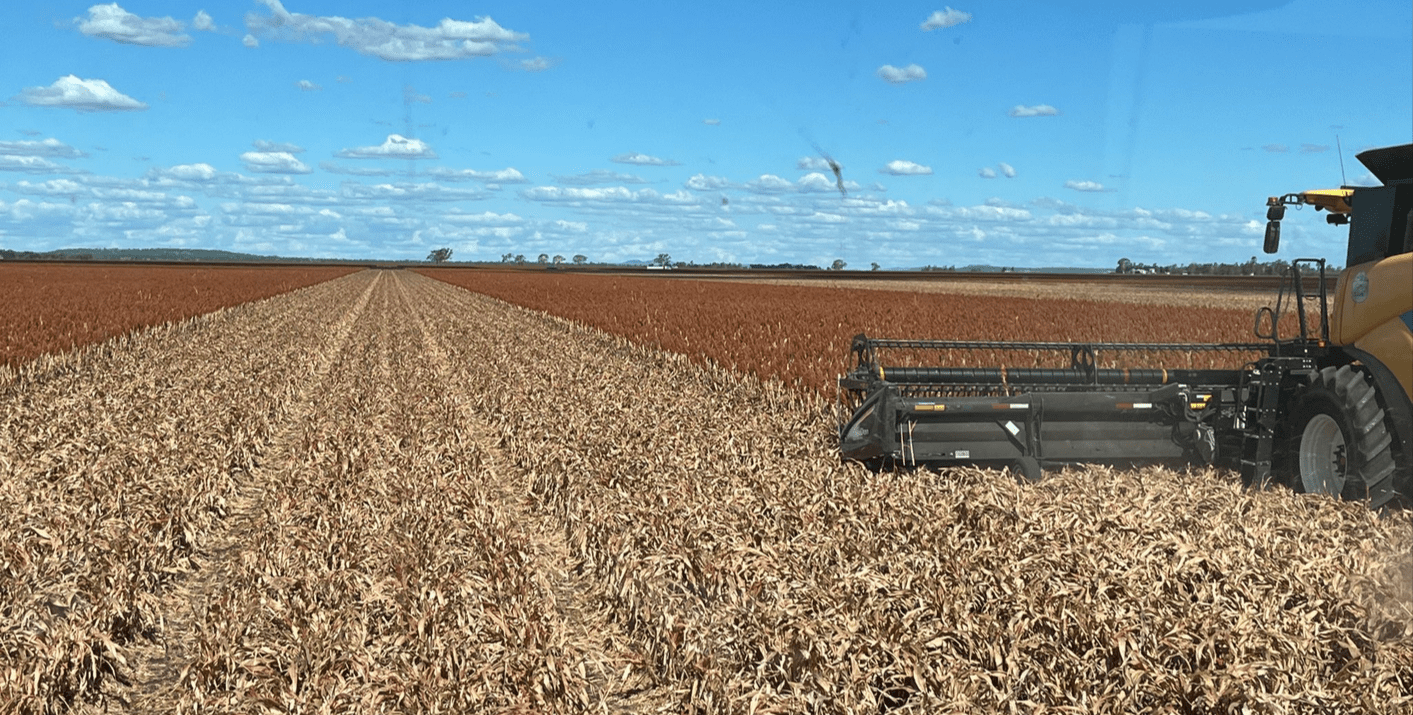
Harvesting sorghum on the Darling Downs, where rain paused activity for a few days. Photo: dburner996
SUBSTANTIAL rain over parts of the Queensland grainbelt has been welcomed, falling at the ideal time for recently planted sorghum in Central Qld, and topping up subsoil ahead of winter-crop planting in autumn.
The rain has interrupted those still harvesting sorghum in southern Qld and on the slopes of north-west New South Wales, but will benefit mungbeans, fodder crops and pasture.
In NSW, falls were generally less than expected, and some with sheep and cattle are buying loads of barley and faba beans to finish their own progeny, or store stock.
| Feb 12 | Today | |
| Downs barley | $340 | $340 |
| Downs SFW | $344 | $345 |
| Downs sorghum | $333 | $330 |
| Mel barley | $328 | $330 |
| Mel ASW | $338 | $345 |
Table 1: Indicative prices in Australian dollars per tonne.
North gets rain
Ahead of new-crop coming on stream when ginning starts, the prompt cottonseed market is trading at $720/t ex Downs gin.
This compares roughly with new-crop available from April-May on, now trading at $515/t delivered Downs, and $475/t in the Gwydir Valley, and $465/t in the Namoi.
“The market is pricing a domestic premium at current levels, and is way above export parity,” Woodside Commodities managing director Hamish Steele-Park said.
“A lack of old-crop seed, hot and dry weather in NSW, and no new-crop supply is keeping values up.
“Old-crop seed is still almost impossible to find.”
Prompt cottonseed is seen as far too expensive to include in feedlot rations, which are finding better value in canola meal and soymeal, while barley and faba beans are the preferred buy for on-farm feeding operations.
Northern growers with warehoused or on-farm wheat and barley are showing little interest in selling at present.
“They’re moving sorghum because they know it’s got a limited flow path,” one trader said.
Accumulation at port is occurring at one facility in Brisbane, with another expected to open the gates to sorghum from next week as bulk exports to China ramp up after chickpea vessels currently on the stem finish loading.
In southern Qld, some growers had to stop harvesting sorghum for a few days after it started raining on Thursday and Friday.
Qld rainfall registrations in the week to 9am today included: Dalby 34mm; Emerald 29mm; Felton 62mm; Roma 103mm, and Springsure 71mm.
In NSW, figures dropped away south of the Qld border, and registrations for the week included: Moree 33mm; Mungindi 55mm, Pallamallawa 24mm, and Walgett 12mm.
Stewarts Grain trader Robert Quinn said trucks are busy carting sorghum, with harvest on the north-west plains now “close to done”, and just starting on the slopes.
Sorghum from northern NSW is selling to container packers, bulk handlers, and poultry and pig feeders.
Piggeries are the market for weather-damaged sorghum when available, while No. 1 sorghum delivered northern NSW packer is making around $340/t.
Consumers, including larger feedlots, are seen as well covered on cereals, and faba beans are trading at around $400/t on-farm into the northern NSW feed gap market, which is also picking up reasonable quantities of barley.
South creeps higher
Some late harvest pressure from big-yielding red wheat crops in south-west Victoria has dissipated, allowing southern market cereal values to drift higher.
“The market’s firmed a dollar or two on the back of grower reluctance to sell at current numbers,” Peters Commodities Wagga Wagga-based trader Peter Gerhardy said.
“That residue from the late Western District harvest has cleared out of the system, and we’re coming back to what’s in storage.
“It’s a typical late summer-early autumn; there’s not a lot of movement on the grain or fertiliser front, and the word on El Niño is starting to get about.”
Those with sheep and cattle to feed a buying a load or two of barley or faba beans.
“As one grower said to me: If we got 20mm tonight, it’s not going to rain grass.
“I think that stockfeed and drought feed market is around for a while; there’s money in lamb and money in beef.”
Feed mills close to port are paying around $440-$450/t for No. 2 faba beans.
“I can’t get a lot of seller interest from the Riverina because that comes back to sub $400 per load on farm.”