
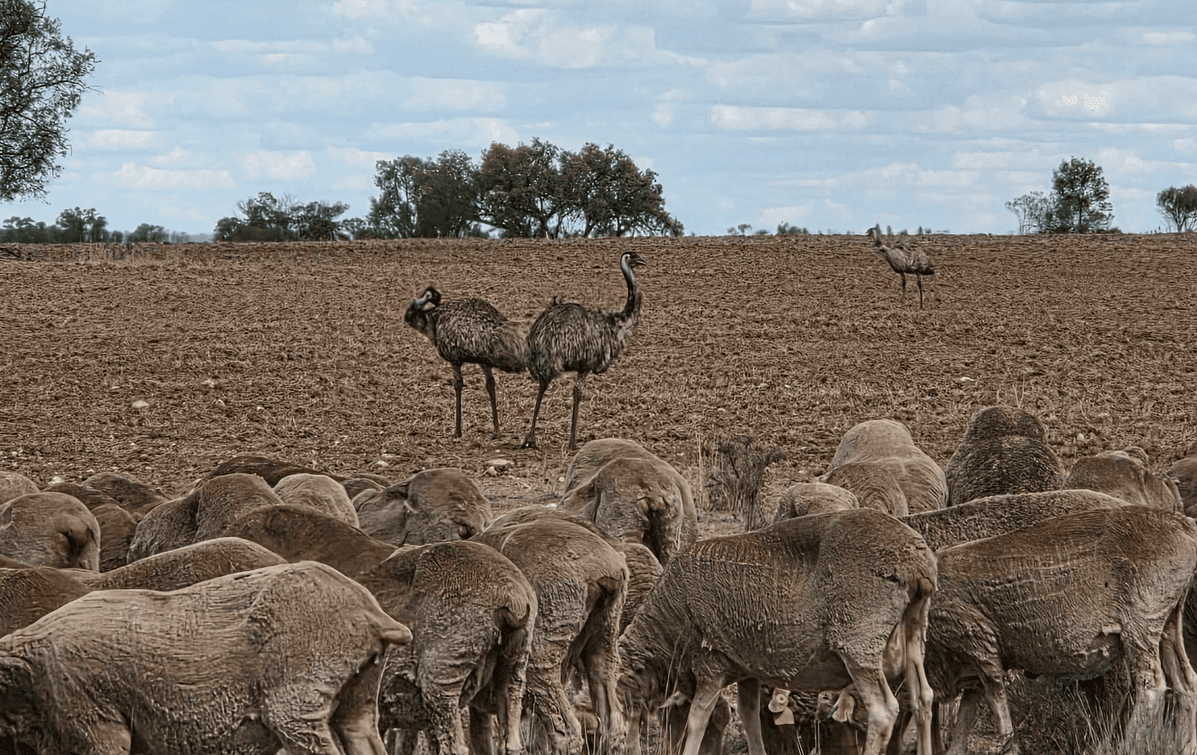
Conditions are desperately dry in many parts of NSW, including Tullamore, where emus are showing interest in barley stored on farm and being fed out to Merino ewes. Photo: Mark Mortimer
DOMESTIC prices for feed wheat and barley have strengthened this week on limited offerings from growers and the trade, while sorghum prices have kicked in anticipation of post Lunar New Year buying from China.
In the northern market, supply of wheat and barley on-farm in Queensland has shortened, and feedlots and others are now eyeing stocks in northern New South Wales.
In the south, a hectic export program for feed barley, and a higher-than-normal amount of barley making malting specifications, has tightened supplies of feed barley available to Victorian, southern NSW, and South Australian consumers.
This has seen the delivered Melbourne market kick $12 per tonne this week.
Much of the rain in Australia in the past week has fallen in the country’s central and tropical grazing regions, but some handy rain has been recorded in a few cropping regions, mostly in the Victorian Mallee and SA’s Upper North.
| Feb 19 | Today | |
| Downs barley | $340 | $345 |
| Downs SFW | $345 | $348 |
| Downs sorghum | $330 | $336 |
| Mel barley | $330 | $342 |
| Mel ASW | $345 | $347 |
Table 1: Indicative prices in Australian dollars per tonne.
North firms
Despite China being in the midst of its Lunar New Year holiday, the China-facing sorghum market is active as exporters advance their accumulation for bulk cargoes ex Brisbane.
Most of the sorghum crops on the north-west plains of NSW, and on Qld’s western Downs, are off, but harvest is still going at pace on the central and inner Downs.
 “It feels like the trade is front-running demand…, with the expectation China will be coming back with a bit of strength,” Sunrise Commodities managing director Scott Merson said.
“The container guys are trying to buy away from bulk and not having much luck.”
The Downs barley market is up $5/t over the week, a reflection of limited available on-farm stocks left in Qld.
“The Downs grower is largely out of white grain; the length sits in northern NSW, and the grower in northern NSW is not that confident in planting the next crop.”
Heavy soils of northern NSW will need considerable rain to prepare them for winter-crop planting, so growers are thinking that wheat and barley from the harvest just gone may have to supplement income into the 2026-27 financial year.
They are also aware of very dry conditions over much of the plains and outer slopes of central and southern NSW, which could translate to increased supplementary feed demand.
On the news front, Elders has today announced the sale of Killara feedlot, a major consumer of feedgrain on the Liverpool Plains near Quirindi.
It has a combined annual throughput of around 62,000 head of cattle and, subject to regulatory approval, will be bought by the Australian Meat Group for approximately $195.8 million.
AMG owns and operates beef abattoirs at Cootamundra, NSW, and Dandenong, Vic.
Barley tightens in south
In Vic’s grain-growing areas, rainfall registrations were generally highest in the Mallee. In the week to 9am today they include: Birchip 32mm, Ouyen 107mm; Swan Hill 43mm, and Ultima 33mm.
Parts of the Wimmera, Western District, and northern and central regions also received some handy rain.
“The Mallee would be absolutely stoked with what they’ve been able to pick up,” Reid Stockfeeds commodity manager Justin Fay said.
In SA, much of the Upper North had more than 30mm for the week, with Orroroo topping the registrations on 101mm.
However, most Bureau of Meteorology gauges in SA’s major grain-growing regions had single-digit figures at best.
In NSW, significant rain was mostly confined to pastoral country in the state’s far west, with some outliers in the state’s south, including: Cootamundra 47mm; Grong Grong 38mm; Temora 28mm, and Quirindi 25mm.
Ahead of winter-crop planting which will start in April, recent rain will help replenish depleted subsoil-moisture reserves, and germinate weeds to enable growers to clean up their paddocks ahead of seeding.
On the trading front, Mr Fay said volume remains modest, despite plenty of sheep, beef and dairy producers across the state taking delivery of prepared feed.
“When it comes to grain, that’s been relatively quiet; everyone’s in the middle of the Mexican stand-off, with growers not wanting to sell at cost-of-production levels,” Mr Fay said.
On the buy side, Mr Fay said the strong Australian dollar was “keeping a lid” on export demand.
“The market down here has also been trading relatively flat into the middle of the year; the trade is basically tipping out into the domestic market what they would have put into the export market.
“Does the consumer need to go out and buy at these prices and add carry? No they don’t.”
Mr Fay said the high malting selection from the harvest just gone has taken a lot of feed barley “out of the pipeline for the domestic consumer”.
“There’s a bit more export demand on barley,”
The opposite is true for wheat; with the spread between ASW and H2 in Vic at little more than $5/t, quality parameters mean little to the market.
Mr Fay said some dairy and beef producers will be in the market for new-crop corn, which will become available in Vic from around Easter.
Vic corn is trading at around $200-$220/t over wheat, well above its normal premium, a reflection of the reduced planted area.
Faba beans are trading at around $420/t delivered Goulburn Valley, roughly $150/t below lupins, which Mr Fay said presented “amazing value” for those not bolted on to lupins in the ration.