
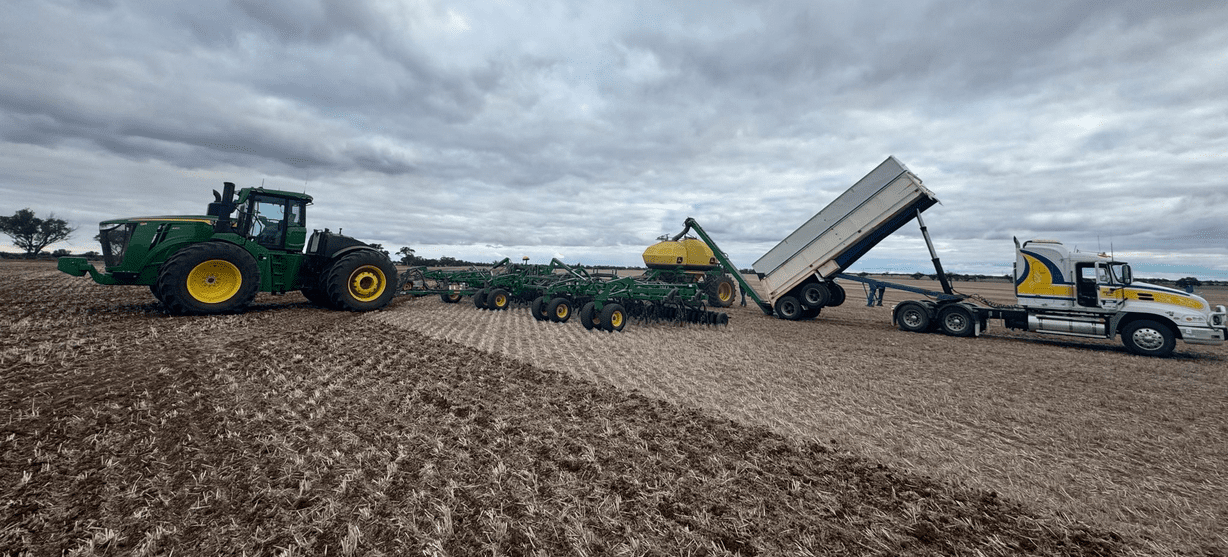
Planting vetch in western Victoria’s Warracknabeal district this week. Photo: Julia Hausler
WHEAT and barley prices have firmed in the past week as local markets respond to the likelihood of a small winter crop in northern New South Wales.
This extends into southern Queensland, and has feedlots and other volume consumers now pulling grain from as far south as central NSW.
Across southern Australia, growers are getting an early start on planting into mostly full subsoil moisture profiles.
They are having reasonable success in sourcing urea, possibly because cargoes pencilled in for Brisbane and Newcastle are being diverted south in response to dry conditions in the north.
| Apr 9 | Today | |
| Downs barley | $420 | $430 |
| Downs SFW | $410 | $420 |
| Downs sorghum | $360 | $360 |
| Mel barley | $342 | $350 |
| Mel ASW | $368 | $380 |
Table 1: Indicative prices in Australian dollars per tonne.
Grain rolls north
In his weekly market report, Clear Grain Exchange managing director Nathan Cattle said drying conditions in north-eastern Australia, on top of export business out of southern states, was underpinning prices.
 “Buyers of grain into the Queensland and northern NSW markets are looking further south down the east coast for grain with prices now factoring in a drought premium to the southern states,” Mr Cattle said in the report out Monday.
“Grain stored in warehouse and on farm through NSW is highly sought-after as buyers look to get more cover to hedge some uncertainty on crop prospects and road freight.”
Diesel remains expensive in response to the Iran-US conflict and its throttling of shipments out of the Persian Gulf, but one source has reported a drop of more than 50 cents per litre this week as opposed to last.
This is helping grain from well into NSW make its way up the Newell Highway, and freight is quoted at around 16c/km, up from 11-12c/km prior to the escalation in Persian Gulf conflict.
Major Qld consumers are starting to look at bringing barley to Brisbane by ship from Western Australia, or on to the Downs from South Australia by train, now that the spread has blown out to around $80/t.
“Before this increase we saw in prices, the drawing arc on to the Downs reached as far as North Star and Goondiwindi; now it reaches down into the Central West.
“With this lack of selling in the north, and increasing old-crop carry-out down into the south, the market will get to a pricing point where things start happening,” the trader said.
South busy planting
In Victoria and SA, plenty of growers are planting into full subsoil moisture profiles, and are off to a strong and early start with their winter-cropping programs.
Vetch, oats, and canola are leading the charge.
“There’s certainly subsoil moisture through the Wimmera and Mallee and South Australia,” Wilken Group trader Andrew Kelso said.
Domestic consumers are aware that Riverina consumers are paying only $5/t below the Melbourne market to keep grain up-country, an acknowledgement of the fact that Qld consumers may well be reaching into their backyard before long.
“In Griffith, they’re paying to keep it close to home.
“The domestic consumer is nervous about the weather.”
“SA barley is largely spoken for, and NSW barley is being held back for feedlots.”
In Vic, growers are selling little, and while domestic milling wheat demand appears to have kicked in NSW, Mr Kelso said exporters are “betwixt and between” because of the firming Australian dollar.
Despite the limited amount of product coming out of the Middle East, a string of urea cargoes are coming into Geelong to make product available to growers and resellers.
Urea ex Geelong is responsible for some one-way trips, and backloads on delivered grain, and Vic and SA growers generally are seen advancing full steam ahead on planting their normal program.