
THERE’S an expression that all cattle breeders, both seedstock and commercial, should consider.
That is: “Great cattle don’t show up once. They show up every generation.” However, there is a caveat, in that this can only happen when producers are consistent across both their management and selection decisions.
Consistency is not the word that generates excitement at a bull sale or dominates conversation at a field day. But it may be the single most important principle underpinning a productive and profitable beef breeding program.
Every herd experiences some degree of variation in production, in cow type, and in how well individual animals suit the country they’re run on.
Some of that is unavoidable. But variation that stems from a poor fit between genetics and environment results in a direct cost to the enterprise. These costs may be obvious through direct feedback because of failure to meet market specifications, while other costs may be less obvious across a herd, for example in excess feed consumed by cattle that don’t suit the system, or in the additional labour that inconsistent animals demand.
For many operations, the most expensive cattle are the ones that don’t fit the system, and much of the reason behind that comes down to inconsistency in management, selection, or both.
Breeding objectives: A vague aspiration?
Reducing variation starts with a clearly defined breeding objective. Breeding objectives come up regularly at field days and workshops, and there are those who suggest the subject has been covered enough.
But the degree of variation that persists across many Australian herds suggests that for a significant number of operations, a functional breeding objective is yet to be firmly established.
A breeding objective is not a vague aspiration. It is a measurable target that reflects two things – the feed base and environment the cattle are run in, and the market that beef from those cattle is destined for.
 Without that clarity, selection decisions easily lose direction. Producers chase one trait, then another, and the herd moves in different directions across successive joining seasons. The result of this process is that variation increases across the herd, rather than reduces.
The fundamental goal of any beef breeding system is a calf every 12 months. While this sounds straightforward, the practicalities of achieving this goal are more complex than many producers often appreciate – especially in different production environments.
Once the length of gestation and return to oestrus are accounted for, a cow has roughly two heat cycles available to conceive in a 12-month period. There is not much room for error, and inconsistency in cow type, condition, or nutritional management can create issues that compound quickly across a herd, including extended calving periods, lighter average weaner weights, more complex calf management, later turn-off times and reduced cow fertility going into the next joining.
Recording performance against simple, defined measures allows producers to understand where variation is costing the program and where genetic selection can address it. Three measures every producer should be tracking are pregnancy within four months of joining, a calf on the ground every 12 months, and average weaner weight per cow joined. These are not complex measures, but they are the numbers that tell a producer how well their herd is meeting the breeding objective and where the gaps within the program are occurring.
Understanding the key drivers of a production system, particularly fertility and growth within the available feed base, places producers in a much stronger position to make use of the genetic tools available to them.
Comparing animals on a genetic basis for the traits that matter
BreedPlan estimated breeding values allow producers to compare animals on a genetic basis for the traits that matter most to their system. Selection indexes that combine multiple traits relevant to a specific environment and market help producers avoid the decision ‘drift’ that occurs when there is no clear plan and selection priorities shift from one joining season to the next.
The value of BreedPlan and genetic tools has been frequently demonstrated, but that value is most consistently realised in herds that have clear, well established breeding objectives.
Variation in feed consumption
The value of that accuracy is best understood when variation is measured. Herd variation can be seen in many ways, but after variation in calving, variation in feed consumption is a strong factor determining herd production and profitability.
At the recent Genetics Australia conference, Paul Meade of Meade Agri in Victoria presented work around feed efficiency trials conducted over recent years on-farm. The trials were based on a selection of British and European yearling bulls.
While the results of this work and the implications for selecting more feed efficient cattle are highly valuable, it is important not to overlook the variation that was recorded across the trial.
Presenting this data, Mr Meade showed that the average feed-to-gain ratio is 6.6kg of feed per kilogram of liveweight gain. The top 10pc of animals tested return 4.6kg/kg.
The bottom 10pc require 9.4kg/kg of gain, a difference of 4.8kg between the best and worst performers in the same contemporary group.
This variation exists in one trait alone. The implication for overall herd variation across multiple traits that impact production, profitability and environmental considerations (methane output) is significant.
The opportunity to address variation depends on two things: accurately describing the trait in question, and producers having access to animals with highly accurate genetic information to support their selection decisions.
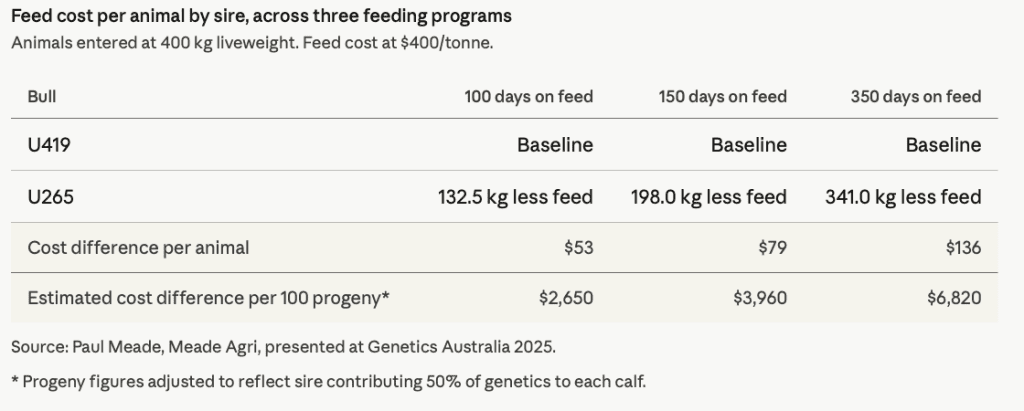
Using the data presented by Paul Meade at Genetics Australia, it is possible to accurately measure the differences that result from variation.
The table below shows the feed cost difference between progeny of two bulls across three feeding programs. With data from trials such as this feeding into genetic evaluation programs, producers can select sires that reduce variation and its associated costs across a drop of calves.
However, these opportunities are not limited to feed efficiency.
Across the board, producers wanting to address variation in their herds need to draw on genetics that are accurately measured and described. Without that accuracy, selection is much harder and the risk of wider variation and lost income remains embedded in the herd.
 Alastair Rayner is the Strategic Account Manager for Southern Australia with Vytelle and Principal of RaynerAg. He has over 30 years’ experience advising beef producers and graziers across Australia. Alastair can be contacted here or through his website: www.raynerag.com.au