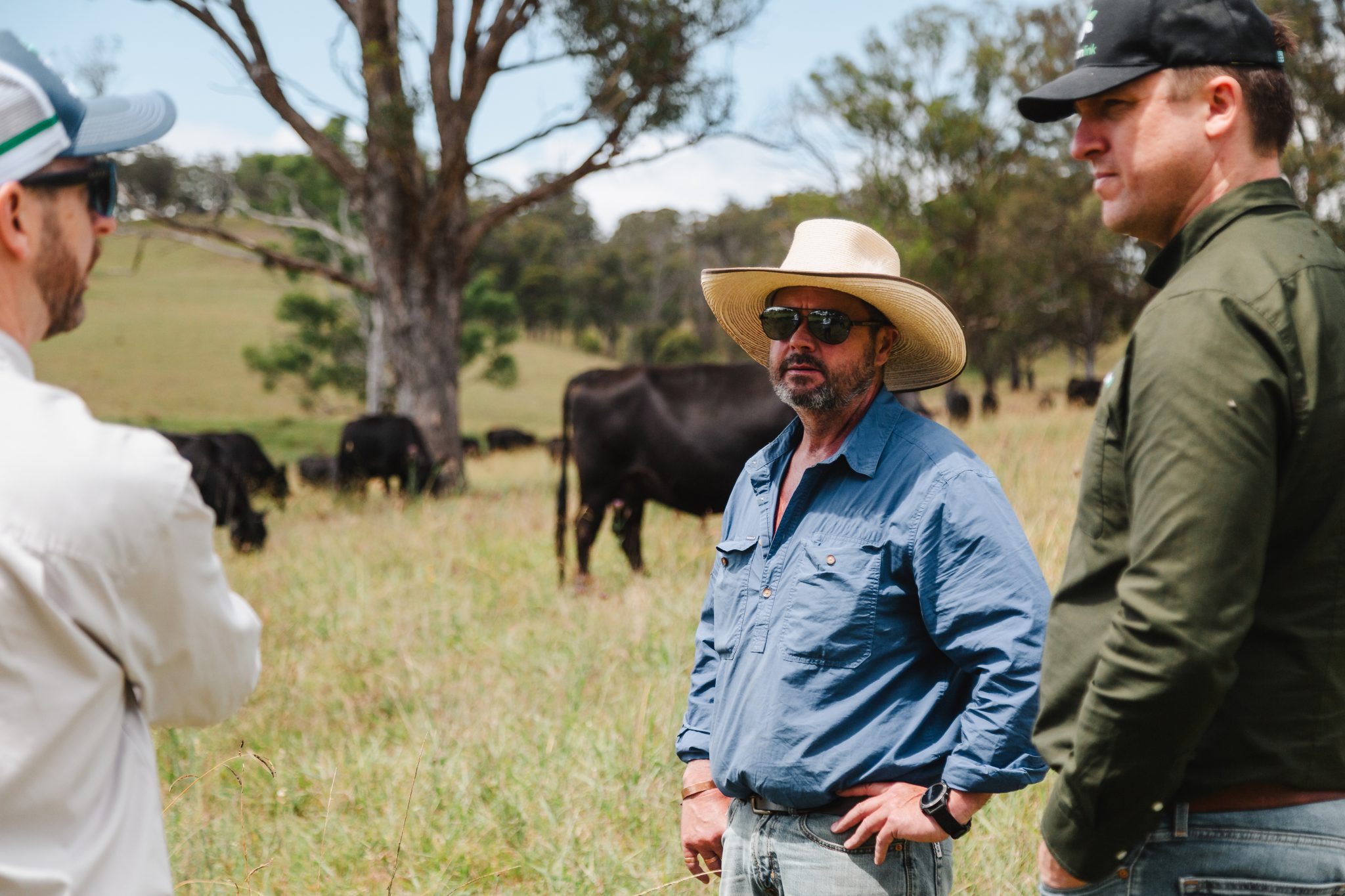
Nick Blomfield on Cheyenne, his property near Walcha where he runs one of the country’s most successful soil carbon projects. Photo: Supplied Carbon Link
A NEW modelled measurement tool has been put to the test with one of the most successful soil carbon projects to date recently receiving a second round of credits.
Run by CarbonLink and the Blomfield family, the Cheyenne carbon project has been issued 28,858 Australian Carbon Credit Units since it was signed up in 2016. The project was recently issued 16,373 after receiving 12,486 in 2024.
While other projects have been issued more ACCUs, the significance of Cheyenne is the number of credits it is able to get off a small parcel of land – with the project extending covering 759ha.
The main part that has excited Carbon Link has been the validation of its soil carbon modelling, which essentially estimates the movements in soil carbon before that data is matched up with physical soil core samples.
CarbonLink’s Hugh Armitage said until the recent issuance of ACCUs to Cheyenne, soil carbon projects had been completely reliant on core samples for measurement. He said the addition of modelling was added to increase accessibility and improve accuracy for landholders.
 “From our understanding this is the first model assisted project has been issued ACCUs,” Mr Armitage said.
“The challenge with just taking soil cores is you do not have an understanding of what the soil carbon could be between those cores, there is always a spatial uncertainty.
“The model estimates soil carbon over every metre of your property and then you go and take soil cores, which validates your model and gives trust in the soil carbon levels you have between your sampling points. Independent validation is the gold standard of model evaluation, this why soil cores have to remain separate to your model, they can not train your model.”
Mr Armitage said a number of other properties had recently undergone testing similar to Cheyenne, with plans to use the modelling for those projects.
The company says it is focusing strongly on adding models to the science of measuring soil carbon because it has the potential to lower costs significantly while increasing credit yields at the same time, which it says is a big win for landholders.
Positive future for modelling soil carbon
CarbonLink received two grants from the national soil carbon innovation program to develop the modelling used to produce credits on Cheyenne. While most of the information was kept in proprietary, Mr Armitage said the original work had created a solid foundation to improve the modelling in the future.
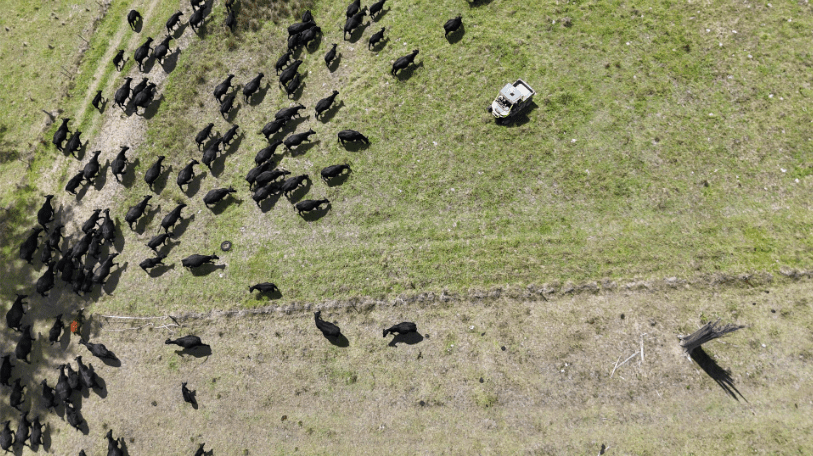
Cattle on Cheyenne staion. Photo: Supplied Carbon Link
“We are advancing modelling at a fast pace with assistance from Artificial Intelligence. The world of artificial intelligence is moving very fast.
“What is really important is the integrity of the framework. So, as the models change we can maintain the integrity.”
Asked about the involvement of AI in soil carbon modelling, Mr Armitage said it was a part of CarbonLink’s modelling tool – however, it could not work without human involvement.
“Every week it is improving, it helps us move a lot faster, but you can’t have blind trust in it,” he said.
“Artificial intelligence makes mistakes, that is why it is important to have people who understand how to use it, how to apply it and how to course correct it when it is going wrong.”
The company says Overall, getting more credits per project at a lower cost is a great breakthrough for producers.
Maintaining viability of the property.
Nick Blomfield, owner, Cheyenne Pastoral said by integrating soil carbon farming into the grazing enterprise over the eight-year project, he has been able to significantly and meaningfully diversify its income stream.
“For me, carbon farming is a must in maintaining viability of my property,” he said.
“This soil carbon project has taken the pressure off operating Cheyenne during tough conditions, and we’ve been able to survive extreme weather events, including three major droughts.”
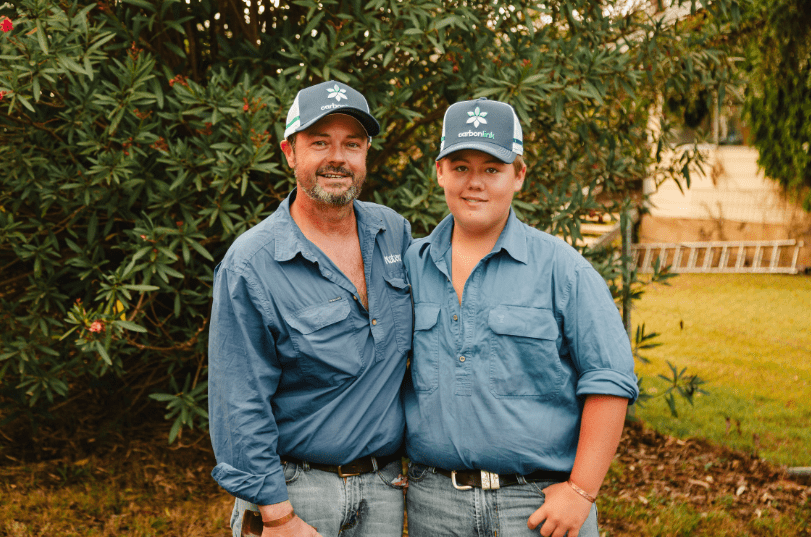
Nick and Hugo Blomfield. Photo: Supplied Carbon Link
Small changes, big impact
The 759-hectare beef cattle operation has employed several regenerative farming practices, including strategic subdivision of paddocks, the installation of additional water points, time-controlled grazing and biological soil amendments to achieve significant carbon sequestration equivalent to a 10,494-tonne increase in soil organic carbon.
The project, active since 2016 has also placed importance on soil health, through the application of biological inputs including chicken manure, rock phosphate and liquid plant food.
As a soil carbon project partner, CarbonLink uses a proprietary measurement platform built on more than 15 years of research and innovation in soil science. Unlike many providers who rely heavily on generic models or limited sampling, CarbonLink combines high-resolution measurement with advanced predictive modelling that’s tailored to Australian conditions.