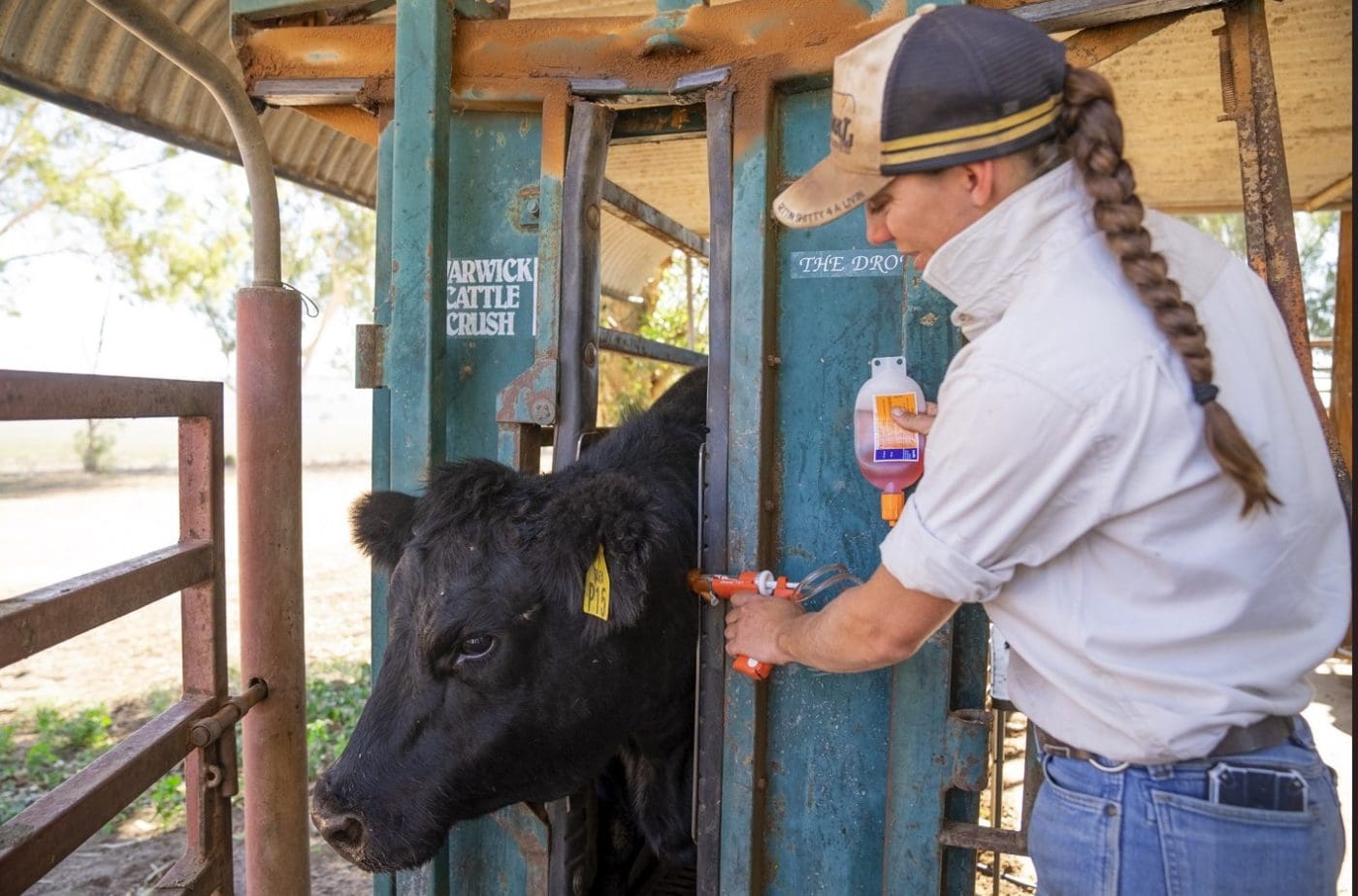
A SURVEY of Australian grainfed beef supply chains conducted by Beef Central suggests as many as 70-80 percent of feeder cattle of susceptible breed types may now be receiving pre-entry vaccination protection against respiratory disease challenges.
The adoption of pre-vaccination applied on-property before feeders arrive at the feedyard appears to have grown dramatically over the last year or two.
It’s happened for a number of reasons:
- The sheer value of feeder cattle today, and the insurance against morbidity and mortality. Feeder cattle prices have risen more than 160 percent over the past 20 years. The NLRS feeder steer indicator last week was worth 472c/kg liveweight, while the same steer a decade ago was worth 311c, and ten years before that, 180c/kg.
- Some gradual shift over time towards feeding more cattle from breeds with higher meat quality potential, that are more susceptible to Bovine Respiratory Disease.
- The growing awareness of the value of earlier vaccination to protect against BRD impact on-property, rather than just at the feedlot stage
- Broader community animal welfare expectations.
It’s worth pointing out a few qualifiers on the adoption of pre-vaccination programs discussed below. Based on our discussions, most, if not all operators only target susceptible breeds and regions – mostly Angus and British breed types bred in the southern half of the continent.
Prescriptions vary from yard to yard. Some accept feeders receiving either the first of two shots of Bovillis MH+IBR (the second administered at arrival at the feedlot), or the single vaccination of Bovishield One-Shot. Others prescribe Bovillis MH only. Vaccine batch numbers are mostly required as part of the paper trail for payment.
Some pre-vax does take place in Wagyu feeders, but it appears much less common than in Angus/British cattle. Wagyu infused cattle, even F1s, have a reputation for being much more resistant to BRD than straightbred Angus or Herefords.
One large Darling Downs Wagyu feeder told Beef Central his business selectively asked for pre-vaccination in southern-sourced F1 feeders arriving directly into the feedlot, but not for northern-bred cattle. He said many Wagyu feedyards gathered young cattle for backgrounding in paddocks prior to feedlot entry, and preferred to administer both vaccines themselves at that point, rather than asking vendors to do so.
Adoption of mandatory programs
While pre-vax programs have historically been done on a voluntary basis, where producers are rewarded for application. More recently, as seen in company responses to Beef Central’s questions below, some feedlot operators have moved to mandatory pre-vax programs for susceptible cattle. Effectively, some companies now won’t buy the cattle unless they have been pre-vaccinated.
However even among voluntary programs listed below, uptake is now surprisingly high – from 60pc to 80pc was quoted by some contacts.
30-year history
First, some history. Pre-vaccination programs for feeder cattle incentivised by price have been around the Australian feedlot industry for at least 30 years.
Most gained some momentum, only to fail, perhaps mostly due to fluctuations in feeder cattle supply: when lotfeeders got short of replacements, they were prepared to abandon the feeder pre-vax principles.
“Under the old voluntary programs, many feeder cattle breeders simply found it easier not to do it – despite the financial compensation,” an experienced feedlot contact told us this week.
In the distant past, pre-vaccination programs were mostly run by product re-sellers. Elders launched its ‘Red Star’ on-farm vax program in the 1990s, while a second program called FeederGuard was launched by Landmark (now Nutrien). Both worked on stat-dec principles, backed by receipts for vaccine product purchases.
FeederGuard and Red Star symbols at one point did appear on saleyard rails as a sale promotional tool, but the programs failed to gain any real recognition.
Some of the early pre-vax programs were offering price incentives of $8-$10 for a single shot of Bovillis, and $15 for both shots. In one early example, a yard was offering as much as $22.50 for two pre-vax shots of Bovillis plus Rhinogard IBR.
Rarely did the early voluntary pre-vax programs become widely adopted. In one case, an article written by this author in ALFA’s Lotfeeding magazine reported uptake at only 33pc of all feeders being bought by one large supply chain.
In 2010, Swift (now JBS) held a series of large feeder cattle producer info days promoting the voluntary FeederGuard program. More than 600 attended the events across northern and southern NSW and Victoria. The full FeederGuard protocol required the use of Pestigard, Bovillis MH (x2) and Ultravac, worth around $14 in product cost at the time. For that, Swift was offering a $22/head premium.
Later, in 2015, JBS re-launched a voluntary program, offering a $15 premium for feeders receiving their first pre-vax dose prior to feedlot entry. The program applied to Bos Taurus cattle entering the company’s Caroona, Prime City and Riverina yards.
65pc of all feedlot cattle illness
“Statistics suggest that up to 65pc of all cattle illness and mortality in Australian feedlots is the result of BRD, so it made sense to financially reward producers for establishing the immunisation of livestock against BRD with a simple, widely-available and cost-effective vaccine prior to induction at one of our NSW feedlots,” JBS said at the time.
“Efficacy of the vaccine is improved when applied in a low-stress environment, and with current technology requiring two doses for optimum protection (comment relevant to Bovillis only), an on-farm application of the first dose sufficiently prior to feedlot induction will greatly enhance the welfare and overall health of cattle in any at-risk feedlot population.”
In this 2015 article on feeder cattle pre-vaccination on Beef Central, it was estimated that about ten percent of Australian feeder cattle were being pre-vaccinated before they reached the yard, up from ‘virtually zero’ two years earlier.
One of the points made was that many grainfed stakeholders were acknowledging the growing expectation on the intensive cattle feeding industry from the animal welfare movement, and that better preparing cattle for lotfeeding was a step towards meeting community animal welfare expectations.
Based on the survey of large lotfeeders below, it’s likely that at least 70-80pc of all feeder cattle representing susceptible breeds and regions now receive some form of pre-vaccination before entering the feedyard.
While the programs outlined below are designed to offer the lotfeeder themselves some adequate protection against respiratory challenges in young cattle entering their feedyard, several stressed that they now actively promote the early application of the vaccine, so that the producers themselves can share the benefit of BRD protection while the young cattle are still in the paddock.
Grainfed supply chains’ pre-vax policies
Set out below are summaries of what six of the nation’s largest grainfed supply chains are doing in pre-vaccination. Collectively, they accounting for one-time capacity of more than half a million head. For further details on each company’s operations, refer to Beef Central’s earlier Top 25 Lotfeeders report : https://www.beefcentral.com/features/top-25-lot-feeders-2023/
JBS Australia:
 In October, JBS announced that from 1 January this year, all Angus feeders entering the company’s Queensland feedyards (Beef City and Mungindi) most be pre-vaccinated.
That followed a similar ‘mandatory pre-vaccination’ policy applied on Angus for the company’s NSW feedyards (Prime City, Caroona, Riverina and Yambinya) in 2022.
JBS is this year paying a $15 bonus for Angus feeders entering the company’s Queensland and NSW yards that have received the first of their two shots of Bovilis MH+IBR. The company delivers the second at induction. There is no two-shot pre-vaccination option. Vendors are required to complete a vaccine batch number declaration to receive the payment. First vaccine can be administered anywhere from six months to 14 days before delivery.
“In our NSW feedlots, pre-vaccination has helped us reduce respiratory issues, maintain consistent performance and reduce antibiotic usage,” JBS northern livestock manager Edwin Cooke said at the time.
Mort & Co:
 Mort & Co operates three Queensland feedyards with one-time capacity of 108,000 head. They include 70,000SCU Grassdale near Dalby, 21,000SCU Pinegrove near Millmerran and 17,000 SCU Yarranbrook near Inglewood.
All three yards have a mandatory pre-vax requirement on Angus cattle, which make up a considerable proportion of total numbers on feed. A rebate is provided on proof of treatment (product batch numbers) with the first of two shots of Bovillis MH + IBR, or the single shot of Bovishield MH 1 and Rhinogard IBR, which does not require a follow-up treatment at entry. Both attract a $20/head reimbursement.
Mort’s mandatory policy came in 12-18 months ago, replacing an earlier voluntary model which failed to gain adequate adoption. It’s no surprise that there’s been improvement in morbidity and mortality performance since the mandatory policy arrived.
No pre-vax requirement is applied to Mort’s Wagyu feeding programs.
Teys Australia:
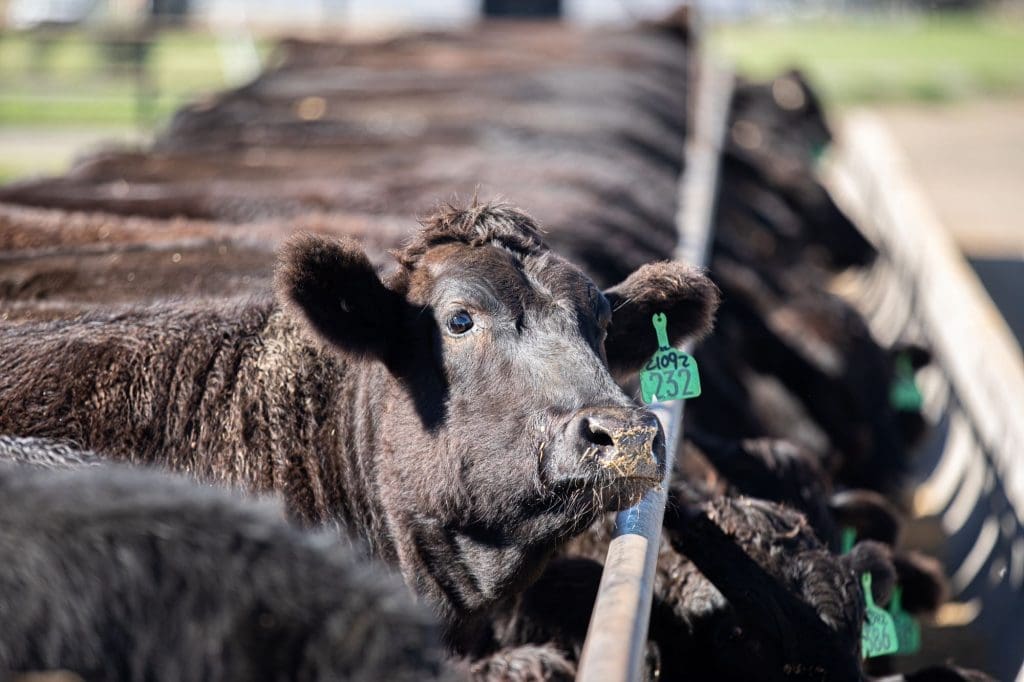
 Teys offers a pre-vaccination incentive (voluntary) for its NSW and Victorian feedlots (Charlton and Jindalee), plus two other yards used for custom-feeding (Gunyiwaraldi at Warialda and Associated Feedlot at Mathoura). The incentive applies to all feeder cattle in those yards, regardless of breed. No incentive is offered in Teys’ Condamine (Queensland) feedlot operations, where BRD health issues in cattle are much less. The exception is southern-bought Angus that Teys itself elects to truck north to feed at Condamine.
Teys accepts pre-vax treatments with both Rhninogard IBR and BoviShield MH1 (Zoetis’ single-shot products), as well as the first shot of MSD’s Bovillis MH + IBR. For either, Teys offers an incentive of $20/head.
Twelve months ago a higher $22 incentive was introduced, paid for feeders vaccinated according to the Australian Cattle Vets’ backed Immune Ready program, where the vendor has to provide a National Health Declaration covering the core vaccines for MH, IBR and either a five-in-one or seven-in-one (eg Ultravac).
Stanbroke:
 Since its recent purchase of the Rangers Valley feedlot near Glen Innes, Stanbroke now controls total feedlot capacity of about 90,000 head – almost entirely Angus or Wagyu derived. That comprises 50,000 head at the company’s Bottletree yard near Chinchilla on Queensland’s Darling Downs, and 40,000 head at Rangers.
Similar voluntary pre-vax incentives are offered at both yards, offering a $15/head premium for a single shot with Bovillis MH on Angus feeder cattle. Wagyu feeders are not included. The program has been in place for two or three years, with adoption continuing to grow, now at about 50-60pc. A declaration is filled out including vaccine batch number to qualify for the rebate.
NH Foods:
 NH Foods’ 75,000 head Whyalla feedlot runs mid-fed long and longfed programs for both Angus and Wagyu F1-Fullbloods.
The company offers a voluntary $15 rebate on the first shot of Bovillis MH+IBR, on both Angus and Wagyu-influenced feeders. Uptake is strong, at about 85pc last year. Some form of voluntary pre-vax program has been in place at Whyalla for the past eight years.
Thomas Foods International:
 TFI’s Southern Cross feedyard near Tintinara in South Australia is currently built to a capacity of 30,000 head – all Angus fed mostly from 130-150 days.
The yard currently offers a $15 voluntary bonus on pre-vaccinated feeders, but is currently considering a move to a mandatory application.
Already 100pc of long-standing feeder suppliers and 70pc of new suppliers are pre-vaccinating stock, using the first shot of Bovillis MH+IBR, with the second shot delivered at induction.