
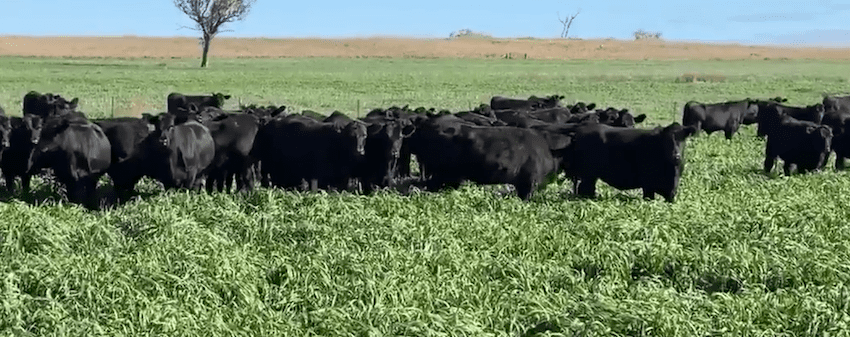
Backgrounder cattle running on oats
THE escalating crisis in the Middle East is beginning to filter through to Australia’s rural property market, with higher diesel prices and rising operating costs creating short-term pressure for producers and investors alike.
This week’s property review examines the potential flow‑on effects of the worsening situation, as many producers reassess input purchases and possibly delay acquisition decisions.
Diesel is not a marginal input, as it underpins almost every farm operation. It is essential for livestock transport, mustering, water pumping and in some cases power generation in extensive systems. However, cropping is likely to be the most vulnerable to diesel price volatility as fuel underpins every stage of production, from seeding and spraying to harvesting and grain haulage. Cropping will also be most exposed to fertiliser shortages, should the develop, and that in turn could impact livestock industries through hay, forage and grain production.
If the Middle East conflict continues to escalate, higher diesel prices may influence buyer behaviour, leading to fewer listings and slower transaction activity. Prospective buyers may defer expansion plans, avoid large, fuel-intensive holdings, properties located far from receival sites or ports, or operations with tight margins reliant on high throughput.
As Australia watches the developments, the National Farmers Federation has expressed concern about the impact on Australian agriculture, specifically highlighting threats to diesel fuel costs, availability and national food security.
The issue has drawn attention from other farm groups concerned about the potential impact of global instability on Australia’s highly import dependent fuel supply.
The Victorian Farmers Federation says recent geopolitical tensions highlight vulnerabilities in the country’s supply chain and the importance of reliable fuel access for agriculture and regional communities.
VFF president Brett Hosking said modern farming relies heavily on liquid fuels to run machinery, harvest crops and transport food and fibre.
“A secure, resilient and affordable fuel supply underpins modern agriculture. If our fuel supply runs dry, our agriculture industry and ability to feed millions would stop in a heartbeat,” he said.
Roger Hill, PRP
In terms of the rural property market, valuer Roger Hill of Preston Rowe Paterson say buyer confidence could become more cautious if the Middle East conflict continues for an extended period.
Mr Hill said any impact on grazing property values is likely to take time to emerge, while farming operations are more exposed in the near term due to their tighter margins and greater sensitivity to rising input costs.

Roger Hill
“Farming businesses are more likely to see value risks to materialise first because of the intensity of their operating margins and cost structures compared with grazing enterprises.”
Mr Hill hopes the agricultural sector will receive some level of protection if fuel rationing is introduced, given its status as a critical industry.
“It is still early days, however there will certainly be impacts on operating margins, as well as the potential for missed crop planting windows if there are delays to inputs such as spraying, planting and fertiliser programs.”
He warned secondary country with poorer soils, less efficient pumping systems and higher transport costs could be increasingly affected if disruptions persist.
“Lower risk, well located farms with higher quality soils and efficient water pumping systems are less likely to be impacted. Quality always sells and provides some protection against risk.”
Mr Hill said both farming and grazing clients are already reporting higher fuel prices, with many choosing to fill storage tanks in anticipation of further increases or potential rationing.
“If the crisis continues and rationing occurs, development activity is expected to slow as producers look to conserve fuel in response to the cost of inflation. Whether farming or grazing, there are serious risks associated with rising operating costs if this situation drags on.”
He said in grazing markets, properties with natural water sources, low lick use and close to markets are likely to fare better than those reliant on diesel powered water systems, helicopter mustering and higher transport and supplement costs.
“In farming markets, there may be crop substitution with producers opting for lower risk crops based on changing input cost decisions.”
Mr Hill said there was also a broader risk of stagflation – characterised by high inflation, slow economic growth and rising unemployment – if the conflict continues or expands.
“The last time this occurred was in 1973 and it nearly happened again in the 1990s. In that environment, we would expect a more cautious approach to rural property pricing.”
On the flip side, Mr Hill said Australian agricultural land had historically attracted increased global and institutional investment during periods of global uncertainty.
“Following the GFC, there was strong offshore and institutional investment, particularly in northern grazing assets, including the portfolio put together by Paraway Pastoral Co. Rural land continues to be viewed as a hedge against global investment volatility.”
Mark Barber, Elders
It is a view shared by Elders general manager of Farmland Agency and Investments, Mark Barber.

Mark Barber
Mr Barber said the impact on land values won’t be immediate or uniform, as buyers continue to focus on long-term earnings rather than short term volatility.
“It won’t be one-for-one. It will be somewhat diluted by the fact that people buy property for their long term earnings potential.”
While higher fuel prices are expected to cause operational strain, Mr Barber said Australian farmland’s appeal as a secure, long term investment could strengthen during periods of global uncertainty.
“From an investor or capital security point of view, the attractiveness of Australian farmland will probably increase for its long term security. In the face of rising inflation, farmland is viewed by many people as an inflation hedge.”
Mr Barber acknowledged that there could be some short-term operating pain, particularly from rising diesel prices, but said this alone was unlikely to trigger a broad correction in rural land values.
Instead, he said producers are reassessing how long the current crisis might last and whether they needed to preserve capital to manage higher costs across existing operations.
“Producers will consider how long the crisis will last and whether they need to keep some of their powder dry to fund rising costs on their existing operations.”
Mr Barber said cropping operations are among the most exposed to higher diesel prices, having increasingly replaced labour with capital investment in large machinery.
The uncertainty created by the Middle East situation appeared to be influencing the rural property market, with both buyers and sellers adopting a more cautious approach, he said
“The conflict will impact sellers in terms of holding back listing their properties and the confidence of buyers to act.”
“Some sellers are weighing up whether to proceed with listings, while buyers are carefully assessing their capacity to absorb higher operating and working capital requirements.”
Mr Barber said before listing their properties, sellers were likely to consider the unfolding situation.
“On the other hand, buyers will consider the uncertainty and assess whether they have enough to fund their other activities. They might need to reserve some firepower.”
Despite these short-term headwinds, Mr Barber said most purchasing decisions continued to be driven by long-term fundamentals rather than immediate cost pressures.
“For most, their decision to buy a property is based on the 10 to 20 year earnings potential, not the next 12 months.”
“Some producers considering expansion may choose to delay acquisitions until they are confident they can manage higher gearing, operating losses or additional working capital,” Mr Barber said.
Ultimately, the long term earnings capacity of agricultural land would continue to underpin values, even as global instability drives short term caution.
“That is part of the discussion – what is the impact of the long-term earnings on this block? Not, what might happen in the short term?”