
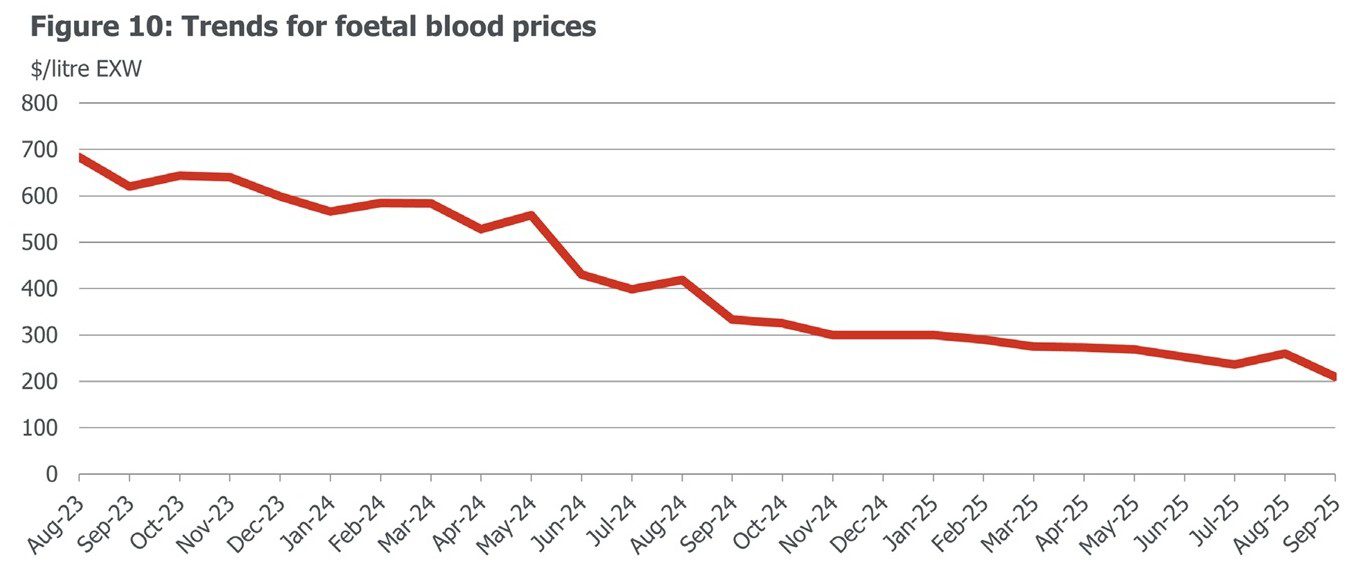
FOETAL blood extracted from unborn calves for use in a range of vaccine manufacturing and lab research applications used to be a valuable by-product for those Australian cow processing plants set up to harvest the material.
But as the graph published above shows, the market has collapsed over the past two years.
Australian foetal blood that was selling for close to $700/litre as recently as late 2023 is today worth barely $200/litre.
In fact some Australian meat processors with the capacity to do so have ceased extracting foetal blood, because of the low returns and the harvest cost involved, Beef Central was told.
In times past, the value of foetal blood, alone, could easily add hundreds of dollars to the value of eligible cows, making their meat value look relatively cheap. In some saleyards, pregnant cows have in the past clearly been sold at premiums.
The products manufactured from foetal blood are used in pharmaceutical, vaccine manufacture, pathology, diagnostic and other applications. Much less significant these days is the requirement for culture mediums used by the cell-based animal protein manufacturing industry, which is now switching to cheaper alternatives.
So what has driven the market down so hard?
Contacts involved in the processing and sale of foetal blood told Beef Central that the extreme high prices seen two years ago “were a bit artificial,” in part driven by vaccine demand and research during and after the COVID period.
However there was a range of other factors involved in undermining prices.
The first was that after the 2019-20 eastern Australian drought, pregnant females were in very short supply as herd rebuilding took place, forcing prices sharply higher for the next two years. A similar response occurred in 2014, for the same reasons (see second graph).
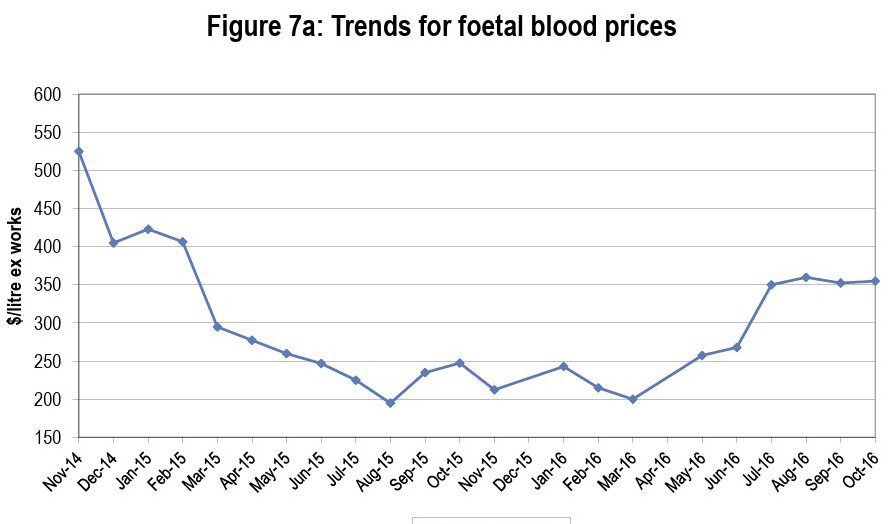
A similar price collapse for foetal blood happened in 2014-15.
Secondly, Brazilian meat access to China over the past five or six years has seen greater quantities of Brazilian foetal blood come to market. To export to China, Australian foetal blood must come from below the bluetongue zone, which has always added a ‘premium’ for eligible Australian serum, now being serviced also by Brazilian supply. Uruguay has also gained approval for export to China for foetal serum, some of which was previously being exported via the grey channel into Hong Kong.
New competitors have also entered the plasma manufacturing space in Australia, also serving to push down prices as supply has expanded.
After pregnant slaughter females came into short supply in 2022 and 2023 in Australia due to drought recovery and herd rebuilding, last year saw the herd reach maturity, leading to over-supply of raw material and downwards pressure on foetal blood prices.
This year has again seen buoyant supply of raw material, again suppressing the market.
The dramatic shift in prices has evidently delivered financial stress to some manufacturers, because material produced and stored earlier (plasma and blood products store well) at much higher prices is now worth only a fraction of what it was earlier.
Some Australian processors set up to harvest foetal blood simply extract it and sell it on to middle-men manufacturers, while others, like Midfield and Greenham in Victoria, and JBS Dinmore in Queensland, are (or at least have, in the past) been set up to spin and freeze the material in processed form on-site.
One of the big players in the foetal blood market in Australia is New Zealand’s ANZCO Foods, which has bio-science subsidiaries Bovogen Biologicals and Moregate operating plants in Melbourne and Brisbane.
Most of the material is exported, with the exception of a few domestic-only beef plants where the material apparently stays on-shore. In the case of non-EU accredited export beef plants, any foetal blood serum they produce is still permitted for export to EU countries, because it is not entering the food chain.
“Foetal blood is actually a sensitive area, because farmers, by-and-large do not get much remuneration for the material,” a contact in the trade told Beef Central.
“A light cull cow that might be worth $1200 or $1400 (even less during drought) could easily yield a litre of foetal blood from an in-utero calf. It means that cow – during the foetal blood price boom, at least – could cost the processor very little, when the blood component was taken into account.”