
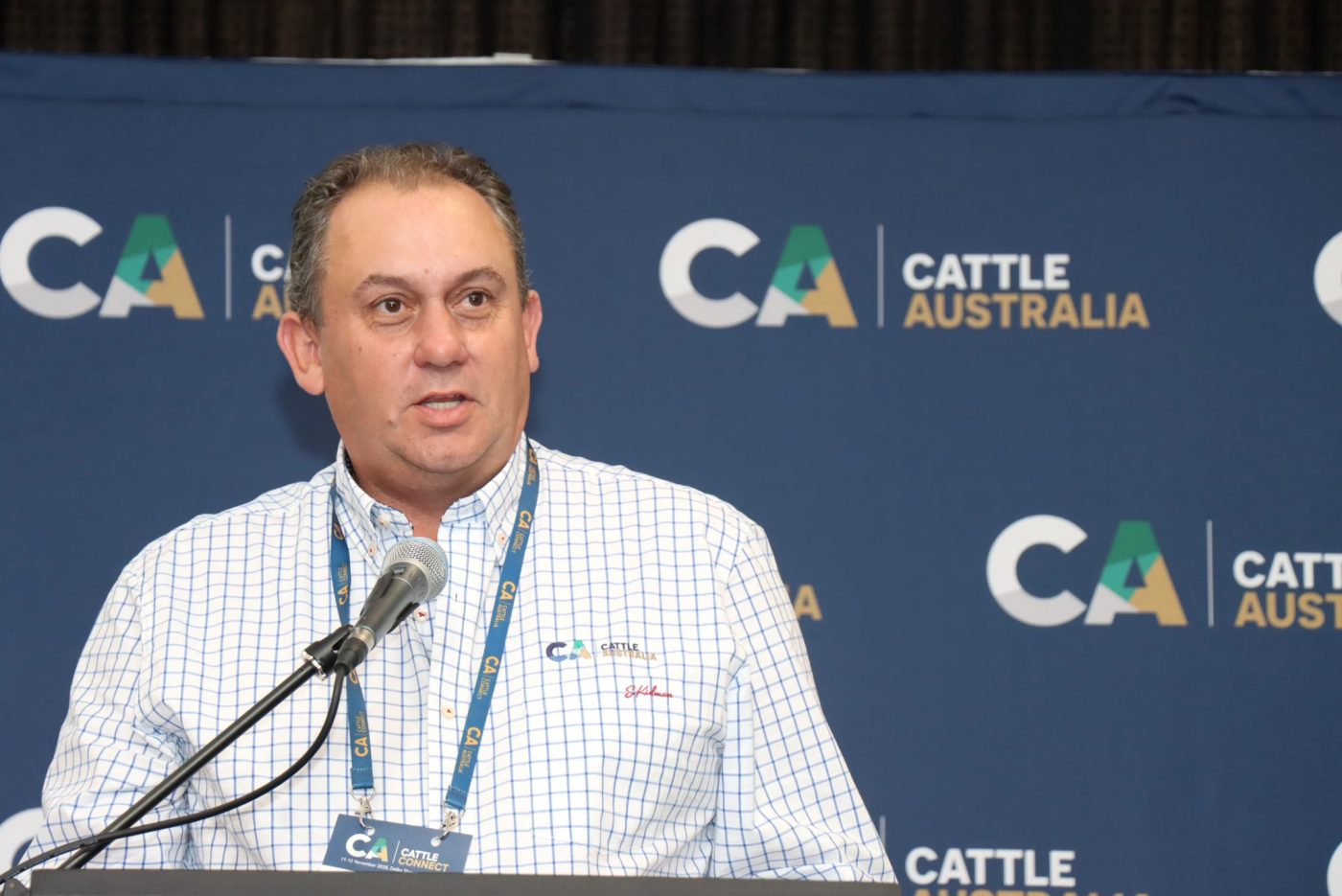
Cattle Australia president Garry Edwards addressing this afternoon’s Cattle Connect conference in Dalby, Qld.
With industry structures, costs and expectations changing dramatically since the last time Australia’s cattle transaction levy was last reviewed, Cattle Australia has outlined the case for the next major review at its annual Cattle Connect conference in Dalby today.
CA President Garry Edwards told producers that Cattle Australia’s role in driving a review of the levy was “really, really simple”.
“We’re here to look after the interests of the levy payers and ensure that the focus of that levy spend is done to improve the profitability, productivity and sustainability of our industry,” he said.
“And those words are very important, and the order of those words are incredibly important, because if we don’t use the levy to focus on matters that increase the profitability of the levy producer, we are wasting our time.
“…we all want to foster our sustainability efforts, but first of all, if we’re not profitable, it’s very, very hard to be sustainable or to be green if you’re in the red.”
Of the current $5 per head cattle transaction levy, 13 cents goes to Animal Health Australia, 29 cents to the National Residue Testing process, $3.66 goes to MLA for marketing and 92c to MLA for research and development.
He said the the review would focus “where that money gets deployed and how it achieves outcomes”.
It was also worth noting, he said, that there is currently no money allocated to an emerging emergency animal disease response.
Much has changed in the 19 years since levies were last reviewed, he said, using the following slide to illustrate:
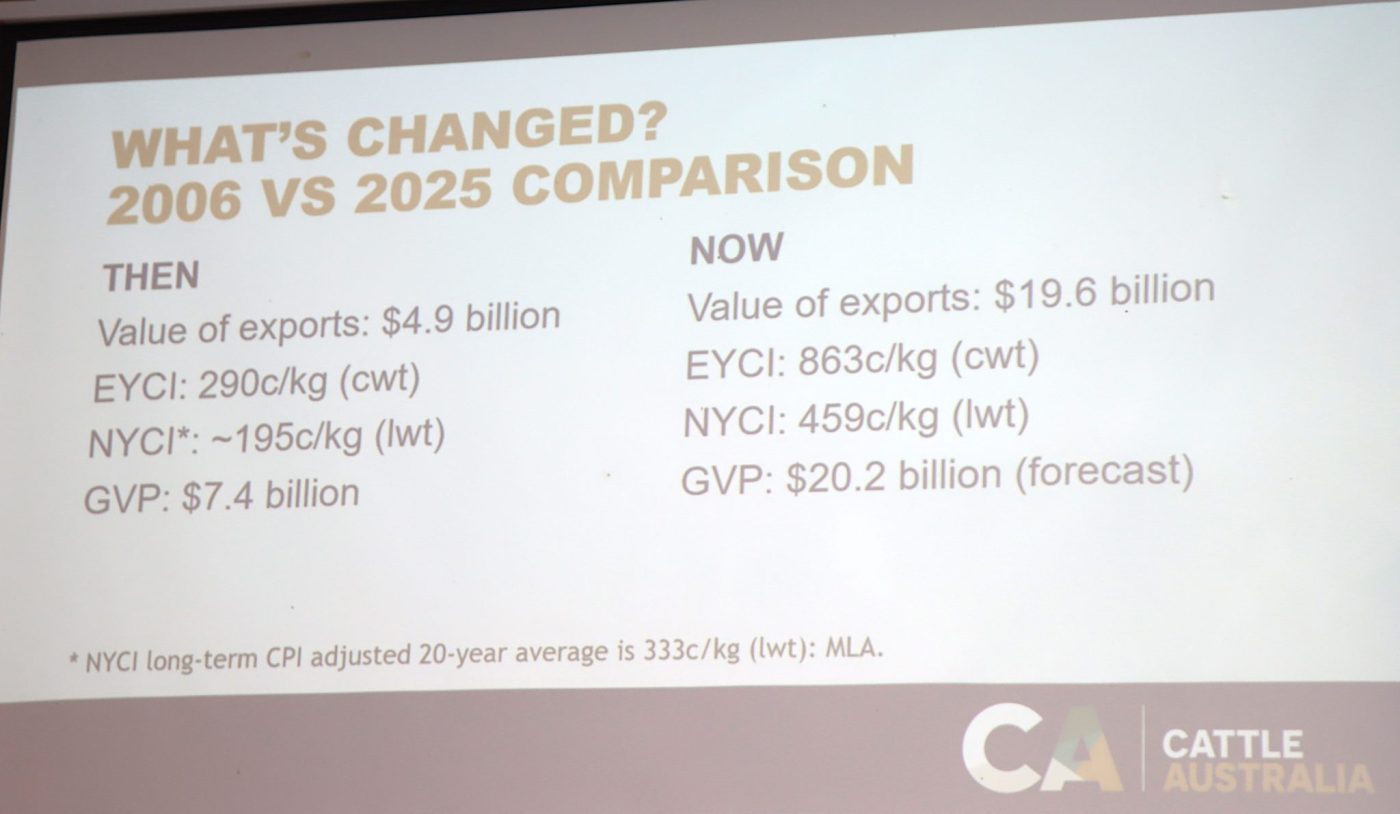
In that time the industry’s annual Gross Value of Production (GVP) had grown from $7.4 billion to $20 billion now.
Since 2006, he noted, there had been a cumulative 62 percent inflation on what $1 bought in theory to what $1 could buy today.
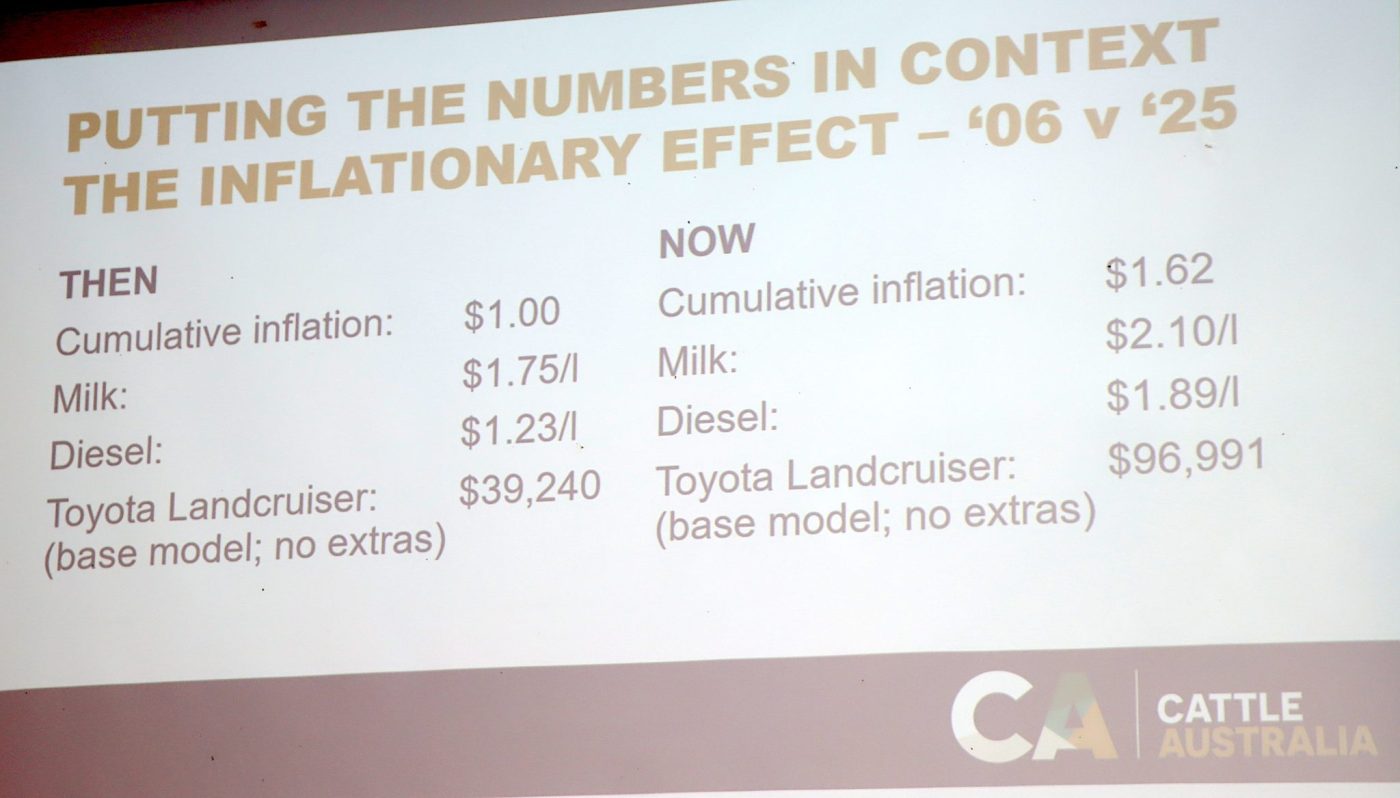
“I don’t think there’s anyone in the room that would be still running a business model on a cost base today in 2025 that they were on 19 years ago.
“And that’s what we as an industry are faced with, is the opportunity to address this and move forward.”
Mr Edwards said the process will involve Cattle Australia taking the responsibility of presenting the case for change to the industry and outlining “what it is that we need to do and why”.
“There’ll be a very, very broad consultation process right across the country, with producers explaining it, and just so that we avoid this and I don’t read any more headlines that misstate this – this is not about a pre-determined increase.
“This is about the appropriate allocation of the levy and the best utilisation of the funds.”
‘Unintended consequences’
Mr Edwards the review would also conduct consultation on the question of whether an assessment of the levy, and how it is allocated and split, should be conducted every three years.
He said there were “unintended consequences” with the current levy based on its fixed dollar nature.
“If we would like to put more money to Animal Health Australia, we can’t at the moment, because there’s no formal instrument to do that.
“If we’d like to extend what the National Residue Survey is doing to support our export industry, we can’t do that either.
“If we’d like to put more money to marketing, we can’t do that either.
“So this is a chance to deal with unintended consequences, and that will be our responsibility to speak to you and everybody else in the industry and give them the opportunity to understand this.”
‘Not about automatically increasing the levy’
He reiterated that the review was not about automatically increasing the $5 levy.
“It’s about what is the requirement and what is the outcome that the industry needs for this investment.
“There are challenges here that there’s an incredible amount of work that Cattle Australia does for this industry on a very moderate budget, compared to the $20 billion industry that we are.”
Ultimately the process will conclude with a report and a recommendation to the Minister and Shadow Minister, he said.
Advocacy discussion on the table
Among several questions from producers from the floor, Central Queensland beef producer and processor Josie Angus asked if the review would address restrictions that prevent the current levy from being used by industry for advocacy purposes, while fellow Central Queensland producer Cameron McIntyre also asked if CA could get a bigger share of any levy increase if it eventuated.
Mr Edwards said there would be an open discussion about what producers want to see “as the representation they need to create that profitable, productive, sustainable future”.
“If you don’t think that you should have representation in your industry, representing a $20 billion industry, the current total budget of Cattle Australia is about two and a half million dollars.
“So if you want to do that calculation, it’s a fraction of a fraction.
“Now when we think about how we invest and what we want to do to have our future, there wouldn’t be anything else we do in our businesses that requires a greater focus than representing our interests, our entire industry, to have the social capital to keep doing what we need to do, to represent and manage the programs that we need to do, to make producers aware of these matters.
“So absolutely it’ll (advocacy) be a topic of discussion.”
He said the process would also look at other precedents within the levy system, including the pork industry, where the industry body receives levy funding but also has scope to do advocacy related work.
Mr Edwards also pointed out there is often confusion around what advocacy entails.
“There’s an element of what we have to do that is always policy and advocacy, but the development of policy is not advocacy.
“And the reality is that the work that we need to do around alignment with governments and engagement to get the right things in policies for the industry to survive and be profitable and productive and sustainable are critically important.”
Mr Edwards said he was aware that a number of groups did not want Cattle Australia to undertake the levy review.
“The only groups that don’t want us to tackle that issue are the groups that are fearing their survival and relevance in the industry,” he said.
“The reality is, if that’s their reaction and that’s their thought process, then they probably need to consider their relevance today, because if they’re worried about Cattle Australia being more impactful by being better resourced, then you really need to ask, what are those groups actually doing for our industry? So I’ll leave that for people to ponder.”
Former MLA national project manager for grassfed beef productivity, Lindsey Perry, posed the question – given how much has changed since 2006, does the industry still need to allocate 74 percent of the grassfed levy to marketing, or “do we now need an increased proportion for R and D in the levy to ensure we remain competitive for the next 20 years?”
“Terrific question,” Mr Edwards replied, saying that is the “very point that we’ll be discussing with each of those producer consultation sessions, because the whole point is to be clear about where we want to be in the future, acknowledging the impact of what’s happened in the past and where it’s going, but that is the very, very issue that I suspect will be question number one.”
Keep an eye on Beef Central for more reports from the Cattle Connect conference in Dalby over coming days