

UNITED States president Donald Trump has announced plans to investigate the country’s major meat packers, claiming they are “driving up the price of beef through illicit collusion, price fixing and price manipulation”.
The President took to social media on the weekend to announce he had instructed the Department of Justice to immediately begin the investigation. The investigation will focus on the “big four” packers – JBS, Cargill, Tyson Foods, and National Beef – with the Government saying they control 85pc of the processing market.
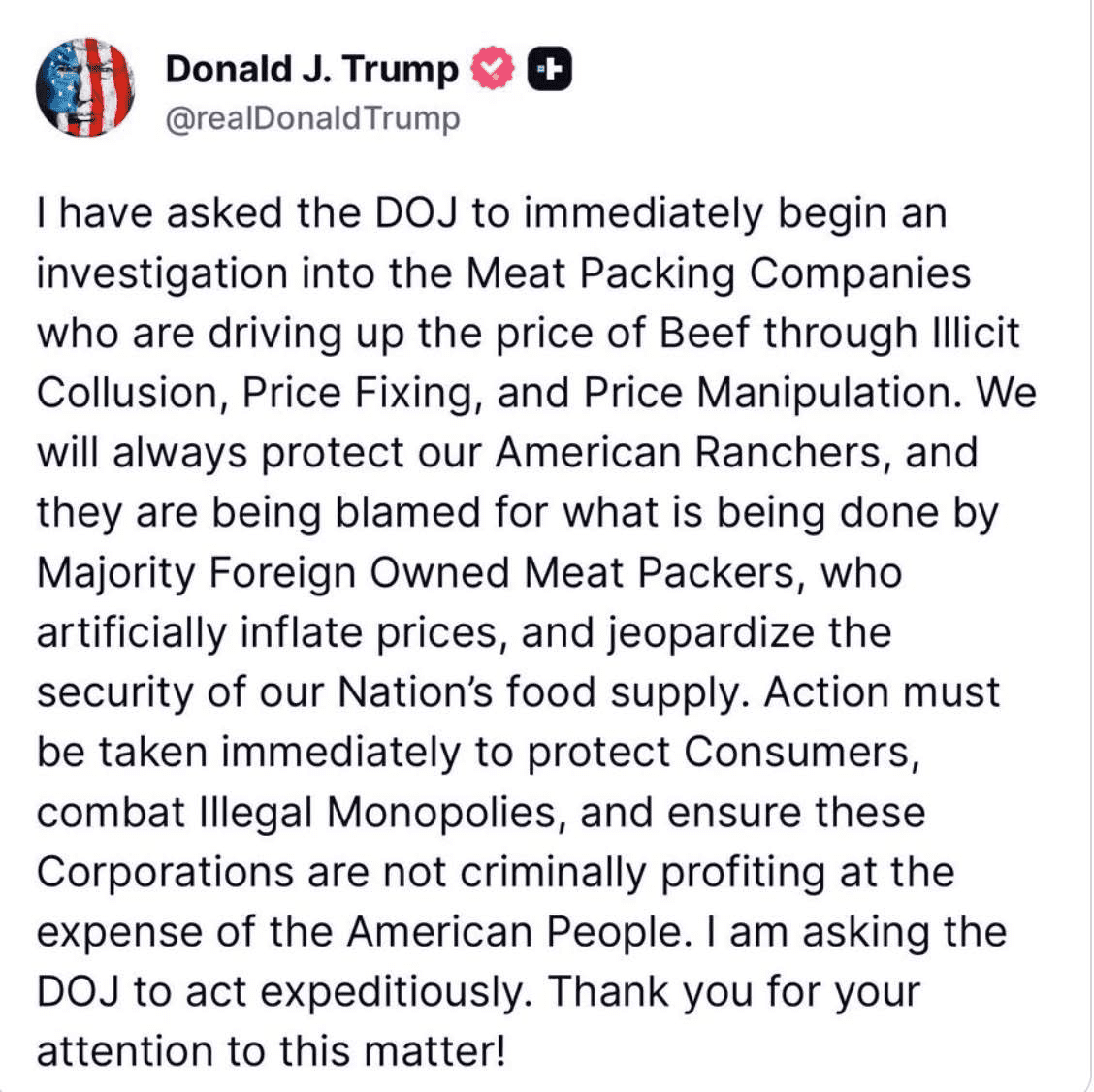 “For too long, a handful of giant meat packers have squeezed America’s cattle producers, shrunk herds, and jacked up beef prices at the grocery store,” a statement from the White House said.
“By examining whether these companies have violated antitrust laws through coordinated pricing or capacity restrictions, this investigation will root out any illegal collusion, restore fair competition, and protect our food security.”
The announcement clearly ignored the fact that the US beef herd is at 70-year lows due to the impact of drought, forcing beef prices to blistering record highs this year as supply and demand fall chronically out of alignment. US processors have recorded heavy losses most of this year, as cattle prices have soared. Hardly signs of collusive behaviour.
President Trump has been under pressure from the US livestock industry in recent times, after announcing plans to import beef from Argentina to bring down prices. The main industry lobby group, the National Cattlemen’s Beef Association, said he was undercutting ranchers at the time.
American ranchers appear to be a key part of Trump’s electoral platform, often praising them in his speeches and singling them out as a key focus.
The industry has been largely supportive of his administration, with several trade deals landing in their favour – including expanded access to Australia.
The NCBA has not issued a comment in relation to the latest announcement, however, it has received a mixed response from the industry.
Montana-based producer group R-Calf has welcomed the announcement.
“There has long been a disconnect between cattle prices and beef prices, and we believe this is evidence of market failure,” the group’s CEO said.
“We welcome this investigation to ensure that cattle producers receive competitive prices for their cattle, and that consumers pay prices set by a competitive market rather than a monopolistic one.”
Processors currently losing money
The American Meat Institute has responded differently, pointing out that most processors are currently losing money.
“Despite high consumer prices for beef, beef packers have been losing money because the price of cattle is at record highs,” president and CEO Julie Anna Potts said.
“For more than a year, beef packers have been operating at a loss due to a tight cattle supply and strong demand.
“The beef industry is heavily regulated, and market transactions are transparent. The government’s own data from USDA confirms that the beef packing sector is experiencing catastrophic losses and experts predict this will continue into 2026.
“U.S. beef processors welcome a fact-based discussion about beef affordability and how best to meet the needs of American consumers, who are the industry’s most important stakeholders.
“Beef packers rely on cattle producers and cattle producers rely on beef packers. The entire beef value chain is strongest when supply is balanced by demand. Beef packers remain committed to ensuring safe, delicious, and nutrient dense beef remains affordable to American families who rely on its nourishment. We welcome the President and his team to visit our members’ beef facilities, both large and small, to witness firsthand the pride, skill, and dedication they bring to their work every single day.”
Is market concentration an issue in Australian processing?
The nature of competition in the red meat industry has been a focus of policy attention for the ACCC and other parts of government for a long time, but especially so over the past 20 years.
In 2017 the ACCC estimated that the four largest Australian processing companies accounted for 51pc of total beef processing in Australia. This compares to the US where at the top four processed more than 80pc (USDA 2024 data).
There was an ACCC report to the Senate on Prices Paid to Suppliers by Retailers in the Australian Grocery Industry in 2002; an examination of the prices paid to farmers for livestock and the prices paid by Australian consumers for red meat, undertaken by the ACCC in 2007; and a report of the ACCC Inquiry into the Competitiveness of Retail Prices for Standard Groceries which analysed the meat industry in 2008.
This focus sharpened in 2015 when both the ACCC and the Australian Senate Standing Committee on Rural and Regional Affairs and Transport closely scrutinised the industry. The Senate Committee 2016 initiated an inquiry into the effect of market consolidation on the red meat processing sector.
The ACCC then issued its report on the cattle and beef market study 2017. Since the ACCC market study, there has been a spate of inquiries by various Federal and State Governments and other parties into competition law and policy, which cover red meat and/or red meat processing to some extent. In 2020, the ACCC conducted a three-month inquiry into bargaining power imbalances in supply chains for perishable agricultural products in Australia.
The subsequent post-pandemic inflationary surge and public concerns over high food prices have prompted a focus on the competition in the food and grocery industry which includes meat, in the past few years. According to the National Farmers Federation, the market power of food processors and retailers remains the top priority issue of concern for farmers (National Farmers Federation 2023).
In 2024 alone, the following inquiries and reviews were conducted:
- Competition Review (The Treasury 2023)
- The Senate Select Committee on Supermarket Prices (Senate 2024)
- ACCC Supermarkets Inquiry (ACCC 2024)
- Independent Review of the Food and Grocery Code of Conduct (The Treasury 2024)
- Queensland Select Committee Inquiry into Supermarket Pricing (Queensland Parliament 2024)
- ACTU Inquiry into Price Gouging and Unfair Pricing Practices (ACTU 2024).
None produced any serious evidence of collusion or market distortion.