
IN A salutary animal disease biosecurity lesson for Australia, South Africa is currently battling a serious Foot & Mouth Disease event that is impacting the nation’s lotfeeding and extensive livestock industries.
South Africa lost its FMD free status in 2019, but the current outbreak started in 2021 with all but one province (out of nine) since reporting outbreaks.
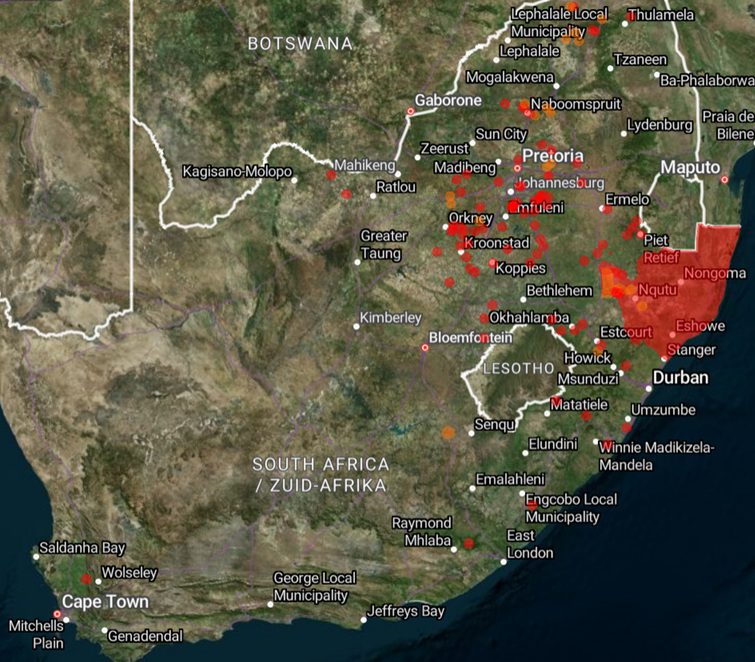
This map displays current reported FMD cases in South Africa. The red is confirmed cases, while orange is suspected cases.
South Africa’s Agriculture Minister recently detailed the country’s strategy to phase out FMD over the next ten years.
Speaking to local media last week Agriculture Minister John Steenhuisen said achieving FMD free status is a monumental task that is not going to happen overnight.
“Our strategy will have three phases over the next 10 years – starting with stabilisation, then consolidation and lastly removal of vaccination to achieve freedom without vaccination from the World Organisation of Animal Health,” Minister Steenhuisen said.
“This is a commitment to the long-term health of our economy and security of food supply and protection of our farmers.
“Vaccination is not a silver bullet to eradicate or manage this disease; it is merely one of the tools that can and must be used to combat FMD. It is however no replacement for good on farm biosecurity and great adherence to movement controls.”
The Minister outlined the country’s plan to vaccinate the entire herd, with the areas with the most severe FMD to receive vaccinations first.
“We plan to have 100 per cent of dairy and feedlot cattle vaccinated, 90pc of commercial cattle and 80pc of communal cattle,” Minster Steenhuisen said.
“The objective is to within 12 months reduce outbreaks by 70pc in high-risk provinces through vaccination and then to preserve FMD free provinces through buffer vaccinations and strict movement controls.”
In June 2025 local media reported three of South Africa’s largest commercial cattle feedlots, operated by Karan Beef, had tested positive for FMD placing approximately 160,000 head of cattle under immediate control measures.
Minister Steenhuisen said almost 2 million animals had been vaccinated over last few months.
Wild animals are believed to be contributing to the spread of the disease which is why surveillance efforts are also being extended to wildlife populations, particularly of buffalo.
“Buffalo are carriers of the disease but do not exhibit clinical signs of the disease so our surveillance must include buffaloes,” Dr Emily Mogajane, Chief Director of Biosecurity Coordination in South Africa said.
“Our strategy includes wildlife surveillance and targeted vaccination near reserves.”
Minister Steenhuisen and Dr Mogajane outlined they believe South Africa can achieve FMD free status again.