
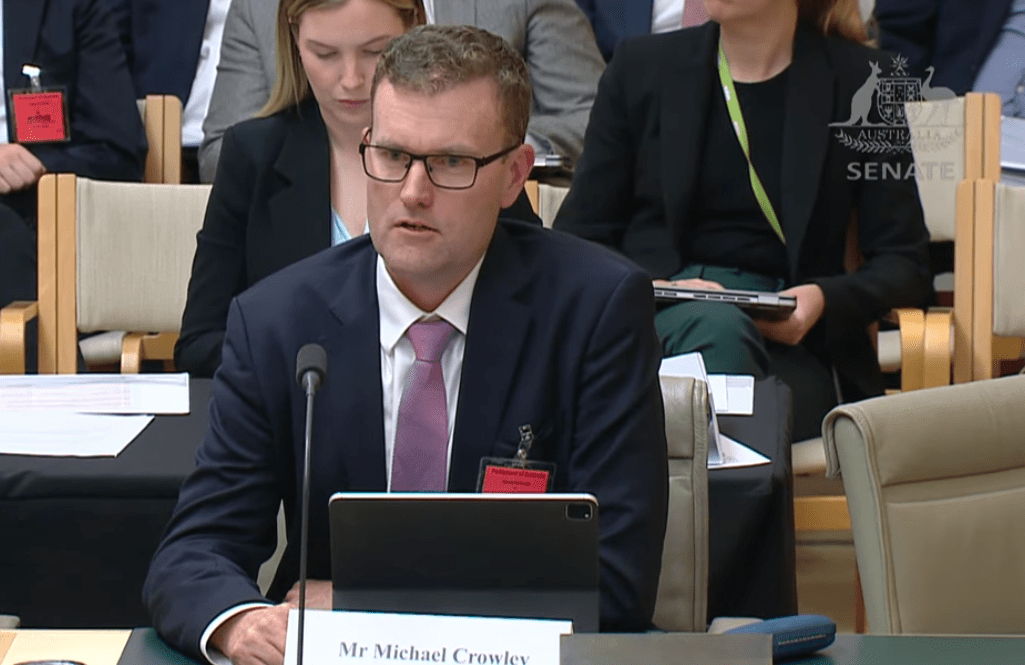
Meat & Livestock Australia managing director Michael Crowley told a Senate Estimates last night the levy-funded research and development corporation is making progress on using dual reporting frameworks to build the scientific evidence needed to demonstrate how Australia’s cattle industry is reducing emissions.
Appearing before the Senate Rural and Regional Affairs and Transport Legislation Committee in Canberra on Tuesday night and responding to questions from Nationals Senator Matt Canavan, Mr Crowley explained that Australia’s official greenhouse gas reporting under the Paris Agreement uses the GWP100 metric, which converts methane into carbon dioxide equivalents over a 100-year timeframe.
However, MLA, at industry’s request, was now also examining emissions using GWP*, a metric that better reflects methane’s status as a short-lived gas within the natural carbon cycle.
Mr Crowley said MLA is pursuing “dual reporting” to help industry and policymakers better understand both the national emissions position and progress being made in reducing emissions intensity per kilogram of production.
“Our net position on methane is an area we’ve been asked by industry to do a lot more work on, because there’s a lot of evidence that shows through actively growing pastures and through active land management, we can sequester carbon from the atmosphere as fast as we release it through methane as part of the natural carbon cycle.
“So there’s going to be a lot more work happening around the biogenic methane cycle and we’re also partnering with the Zero Net Emissions for Agriculture CRC in that space.”
“The theory we really want to run to ground”
In response to Senator Canavan’s question about whether factoring in the carbon cycle created the potential for methane emissions from the cattle industry to be net zero, Mr Crowley replied: “that’s the theory that we are really wanted to run to ground”.
“Looking at methane from a natural carbon cycle, as opposed to methane from burning fossil fuels, is a really important aspect for us to tackle, and we’re looking at collaborating internationally,” adding that work is underway with New Zealand, North America and Europe.
“We’re just looking at the whole of life cycle and being able to accurately account for that, because what we’re also finding is that as we improve efficiency in our production system, we’re delivering a really positive environmental outcome.”
While international reporting rules under the Paris Agreement currently remained fixed, Mr Crowley said stronger data could support future adjustment to reporting standards.
“If we have enough data and evidence to support our methane position, we’ll be in a stronger position to have those conversations ,” he said.
Bovaer concerns monitored
The hearing also canvassed recent controversy overseas surrounding Bovaer, the methane-reducing feed additive containing 3-NOP, which has attracted attention following reports of adverse animal impacts in Denmark.
One Nation Senator Tyron Whitten questioned MLA about its research investment and whether use of the product in Australia should be paused.
Mr Crowley said MLA is aware of the overseas issues and is in ongoing discussions with DSM, the company that commercialised the product.
“We haven’t seen any issues or adverse animal impacts in the trials that we’ve conducted here in Australia and it’s certainly been something that we’ve been discussing with DSM about further work,” he said.
He said the product had been registered for use in more than 50 countries and had been through a wide range of regulatory approvals around the world.
MLA would continue its due diligence on the use in both intensive and extensive feeding systems here in Australia, he said.
PNG and US cattle export protocols progressing
Department of Agriculture, Fisheries and Forestry official Dr Brant Smith also provided an update on live cattle export protocols.
In response to Senator Canavan, Dr Smith confirmed Australia has provided Papua New Guinea with a draft protocol covering breeder, feeder and slaughter cattle.
“That was provided last year to PNG’s Minister for Livestock,” he said. “While we haven’t received a formal response yet, we’re following up and are hoping to progress that work as a priority once we do.”
Dr Smith also confirmed Australia is actively working with the United States on live cattle export protocols, following questions from Nationals Senator Susan McDonald.
“It will depend on whether it’s breeder or feeder cattle, but it’s one of our priorities that came out of the livestock protocol committee, and that’s certainly something we’re working actively with our US counterparts on now,” he said.