
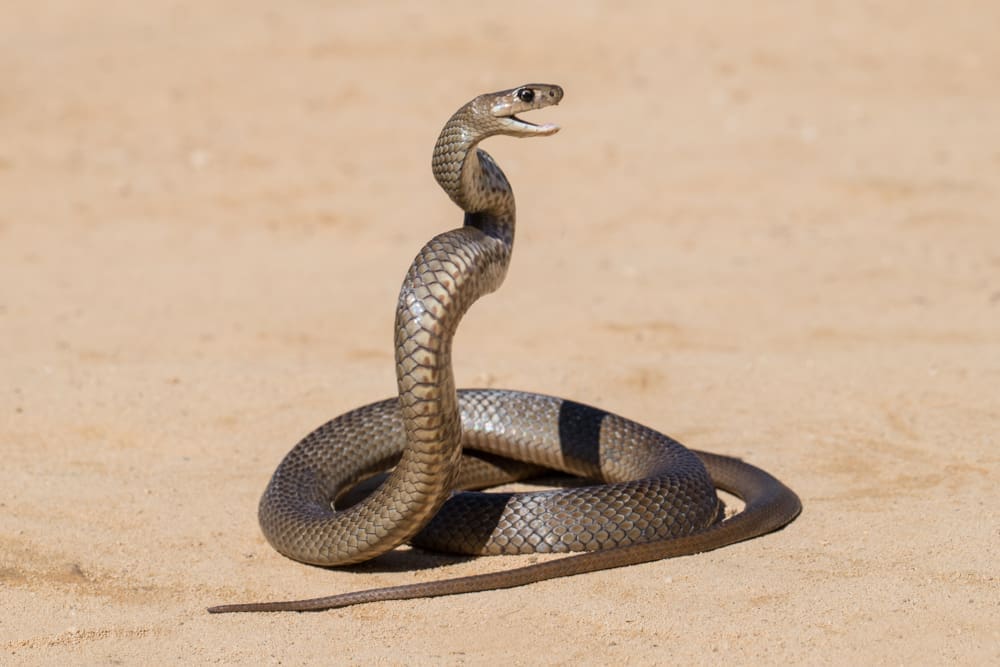
When threatened, eastern brown snakes put on a spectacular and intimidating defensive display, lifting the front half of their body vertically, ready to strike but eastern brown snakes are generally solitary animals except during breeding periods and are timid and reluctant to strike unless provoked according to experts – more information here. Image: Shutterstock.
A SINGLE broad-spectrum anti-venom that works against the bites of many different snakes is being hailed as a potential panacea for the treatment of venomous snakebites around the world.
After seven years an international team of researchers is close to developing a ‘universal’ anti-venom covering 17 venomous snake species in Africa.
The scientist leading the project has told Beef Central a similar approach can be used to develop a universal anti-venom for snake species found in Australia.
Leading the research is Professor Andreas Hougaard Laustsen-Kiel from DTU (Technical University of Denmark).
The team has bio-engineered an anti-venom covering multiple medically-relevant African snake species including cobras, mambas, and rinkhals.
The broad-spectrum anti-venom is yet to be tested on humans but in lab conditions is showing promising results. These include that it provides better protection against tissue damage, has a lower risk of immune reactions and can be produced at approximately half the cost of existing anti-venoms.
Snakebites cause the death of between 100,000 and 150,000 people worldwide each year. Three times as many survive with serious disabilities, including amputations and permanent tissue damage.
Snakebite victims are dependent on anti-venom, but in many countries existing versions have serious limitations, including that they do not cover all medically relevant snake species and cannot always neutralise all medically relevant toxins found in snake venoms, making it difficult to provide correct and optimal treatment.
From horse blood to high-tech nanobodies
A DTU paper explaining the breakthrough said existing anti-venoms are produced by immunising horses with snake venom and extracting antibodies from their blood.
The result is a large, undefined mixture of antibodies, only a small proportion of which target and neutralise the most dangerous toxins. This method produces a product with great variation in quality and a risk of serious side effects, Andreas Hougaard Laustsen-Kiel said.
“The horses’ blood is slightly purified and then given to people who have been bitten by a venomous snake. The anti-venom does work but can cause harmful side effects – it’s similar to a blood transfusion from a horse.
“At the same time, the quality varies because different horses are used in each production.”
“Instead, we have developed an anti-venom that does not require us to constantly extract antibodies from animals. Instead, we used phage display technology to develop our anti-venom.
“This method makes it possible to select and copy effective antibody fragments (nanobodies) and later produce them on a large scale and with consistent quality. This means that we would be able to produce the anti-venom in large quantities without compromising on quality.”
Why a universal anti-venom matters
The lack of a single anti-venom covering all snake species in a continent such as Africa is particularly problematic when several venomous species live side by side.
The venom of the cape cobra and the spitting cobra contain very different toxins: The cape cobra’s venom consists primarily of neurotoxins that paralyse the nervous system, while the spitting cobra’s venom is rich in cytotoxins, which, among other things, break down tissue and can lead to amputation.
This great variation means that an anti-venom that works against one species does not necessarily work against another.
It is not always possible to identify with certainty which species has caused the bite, further underlining the importance of having a multi-species anti-venom available.
Although the anti-venom shows promising results, it does not yet offer complete protection in every situation, only partly neutralising venom from snakes like the black mamba and forest cobra, and there is still some way to go before it reaches the market, the DTU said.
“We have already upgraded one of the nanobodies included and are in the process of improving another. We are constantly learning new things along the way, and it may turn out that some minor adjustments will need to be made in the future,” Andreas Hougaard Laustsen-Kiel said.
Snake season returns in Australia
In Australia snake season is back after the dormant winter months.
Approximately 3000 snake bites are recorded in Australia each year, with about 500-550 requiring hospitalisation, and an average of two deaths per year.
Of the total number of snake bites, about 57 percent happen in rural and regional areas.
Australia generally has enough anti-venom due to a coordinated national system, but the remote distribution network requires careful management to prevent shortages in certain areas.
CSL Seqirus is the only company in Australia that manufactures human anti-venoms for the country’s venomous snakes and other creatures, with anti-venom available at over 750 hospitals across the country, and dedicated logistics and resources in place to ensure supply including in remote areas.
Dr Laustsen-Kiel told Beef Central that “it would indeed be possible” to use the same approach used for African snakes for Australian snakes.
He said it would probably not make sense to make a “fully universal” anti-venom covering snakes in both geographies, as the venom in Australia and Africa are very different.
“Instead, I would probably develop to different products – an African anti-venom and an Australian anti-venom.
“As our approach makes it possible to produce the anti-venom in bioreactors and tailor the composition exactly as we want (as we use recombinant DNA technology and only use the alpaca/llama once), it may be that one or two of the individual nanobodies from our African anti-venom could be re-used in an Australian one.
“But we would need to supplement these with other nanobodies directed against some of the toxins that are unique to Australian snake venoms.”
First aid
The following information is from the Royal Flying Doctor Service (see original informatin source here)
The best treatment for a snakebite is first aid followed by anti-venom. Call 000 or 112 as soon as possible.
Snakebite first aid is simple, effective and could save a life. Always carry a first aid kit and/or bandages when out in the bush.
1. Apply a pressure bandage
- Wrap a bandage from below, upwards and over the bite site.
- Extend it as high as possible (e.g. all the way to the groin).
- Keep the limb still (e.g. don’t remove trousers).
- Use the same tightness as for a sprained ankle.
- Use a T shirt or other clothing if you have no bandages.
- Mark the area of the bite on the bandage.
2. Immobilise the bitten area
- Apply a splint if possible.
- Joints to both sides of the bite should be immobilised.
3. Call for help
- Dial 000, or 112 if you’re in a remote area with poor mobile coverage.
- Monitor symptoms.
Sadly, in almost half of all fatal snakebites, victims succumb to the venom before ever reaching a hospital. This is why it’s so important to know life-saving first aid (bandaging and immobilising the bite to slow the spread of venom) and to call for help as soon as possible – especially if you’re in a remote area.