
IF Australia doesn’t trade, the Australian people don’t eat.
It was a simple line delivered by WA mining industry leader David Parker which cut straight to the shared challenge facing both the mining and livestock sectors.
Earlier at the LIVEXchange 2025 conference in Perth, former Federal Trade Minister Andrew Robb told delegates the livestock export sector suffers because most Australians are too far removed from it to feel any personal consequence if the trade is undermined. The task, he said, is to help Australians understand how the loss of such industries would ultimately impact their own lives.
An exclamation mark was added to that message later the same day when the WA Minerals Council of Australia executive director took to the stage.
If the community doesn’t see you, you must help them understand why you matter
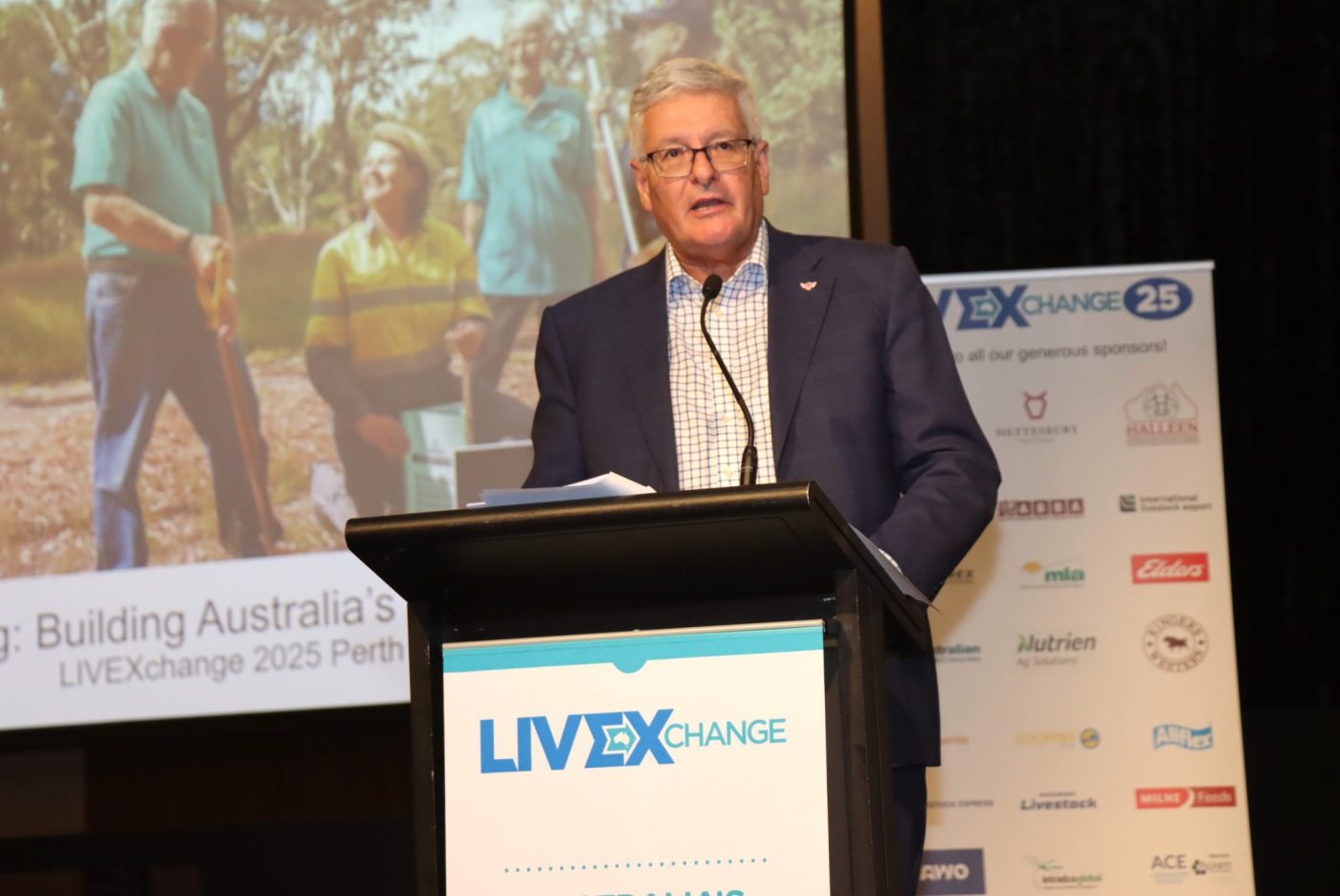
Throughout his address, Mr Parker repeatedly drew the conversation back to what the mining industry means to everyday Australians.
He provided the headline numbers of course – 300 mines operating across Australia directly employing 300,000 people and paying $395 billion in royalties and generating about $2.9 trillion in export earnings for Australia annually.
But he also regularly related that back to what the industry means to people who may have no comprehension of the role mining plays in their lives.
Industry “pays a lot of the nation’s bills”
For example, that $395 billion in royalties “pays a lot of the nation’s bills,” he said.
“Think of the PBS (the Pharmaceutical Benefits Scheme).
“Everyone wants a new medicine on the PBS. It’s got to come from somewhere.
“There’s not too many mines in Canberra or Perth. These come from regional Australia.”
The $2.9 trillion generated in export earnings also underpinned Australia’s trade.
“If Australia doesn’t trade, the Australian people don’t eat,” he said.
For every one of the 300,000 Australian people directly employed in Australian mining, another five people’s jobs benefited indirectly.
“The butcher, the baker, the candlestick maker – who support all those industries – the catering industries, the aviation industries, the fuel and logistics people all depend on that one person who’s at the direct employment of the industry.”
“Weve got to really promote our issues”
Mr Parker said it was a big national, regional story that agriculture was a key part of.
“We’ve really got to promote and address our issues,” he told the conference.
“The more you can actually get out there and tell your story, not be defensive about it, but be proactive about it and have those conversations, talk to people, make sure you’re listening at the same time, we can actually move this national development needle forward.”
He said Geoscience Australia had recently identified the Northern Australian economic opportunity at somewhere between about $3 and $5 trillion.
 “Now that’s agriculture and mineral development north of the Tropic of Capricorn.
“This is an enormous endowment for future generations of Australia, critical minerals, minerals we haven’t even heard of today, northern ports, northern towns, northern communities, indigenous communities across our North engaging with one of the most ferociously competitive areas of the world, North and Southeast Asia.
“Unlocking Northern Australia for the next generation should be a national imperative, and I would really believe that industries like mining and agriculture and transport will go a long way to securing Australia’s future for our next generation, providing the economy, providing the sustainability and providing the national security and resilience we need to drive this nation’s future forward.”
Mr Parker showed a recent Minerals Council of Australia advertisement (at top of article) as an example of the messaging the mining sector puts in front of Australians to explain its relevance to their daily lives.
“It is like dripping water on a stone. You’ve just got to keep it going”
Asked by Beef Central if agriculture should pursue similar public-facing campaigns, he emphasised that regular, consistent communication is essential for industries that operate outside the everyday experience of most Australians.
“I think advertising by itself has got to be joined up with other activities.
“You’ve got to have the on-ground experience, you’ve got to have the lived experience, and then it’s got to be topped and tailed with a very sharp, punchy advertising campaign.
“Remember, this is a very complex society we’re growing up in now.
“Someone was telling me the statistics the other day, out of 225 people in the national parliament, probably a few more have crept in since this stat, about eight senators and federal members live in Northern Australia.
“So we’ve got a job ahead of us. I think it’s just synonymous of just how detached the regional economic story is from mainstream south eastern Australia,
“And I think just by the advertising campaign, with the incursion programs, with delegations to Canberra, with the schools program…
“It is like dripping water on a stone. You’ve just got to keep it going. All joined up together in different messages to different markets, but regular messages to different markets at regular times.”