
JBS global chief livestock scientist Dr Sarah Klopatek provided a lively and entertaining address during Cattle Australia’s Cattle Connect event in Dalby
IN any scrutiny of the livestock industry’s contribution to Green House Gas emissions, it was important not to confuse ‘apples with apple pie’, JBS global chief livestock scientist Dr Sarah Klopatek told the Cattle Australia Cattle Connect event in Dalby this week.
Based out of JBS’s US head office in Greeley, Colorado, Dr Klopatek undertook a whirlwind tour of Australian cattle enterprises, feedlots and processing facilities during her Australian visit, providing the opportunity for some local perspective.
Giving a brief outline on the current US herd size impact from recent drought (the US national herd now sits at 80-year lows), she said with climate change came more extreme weather, changing temperatures, floods and droughts – creating more risk in the system.
“But to do something about this, let’s see where the emission are coming from,” she said.
Click on images for a larger view
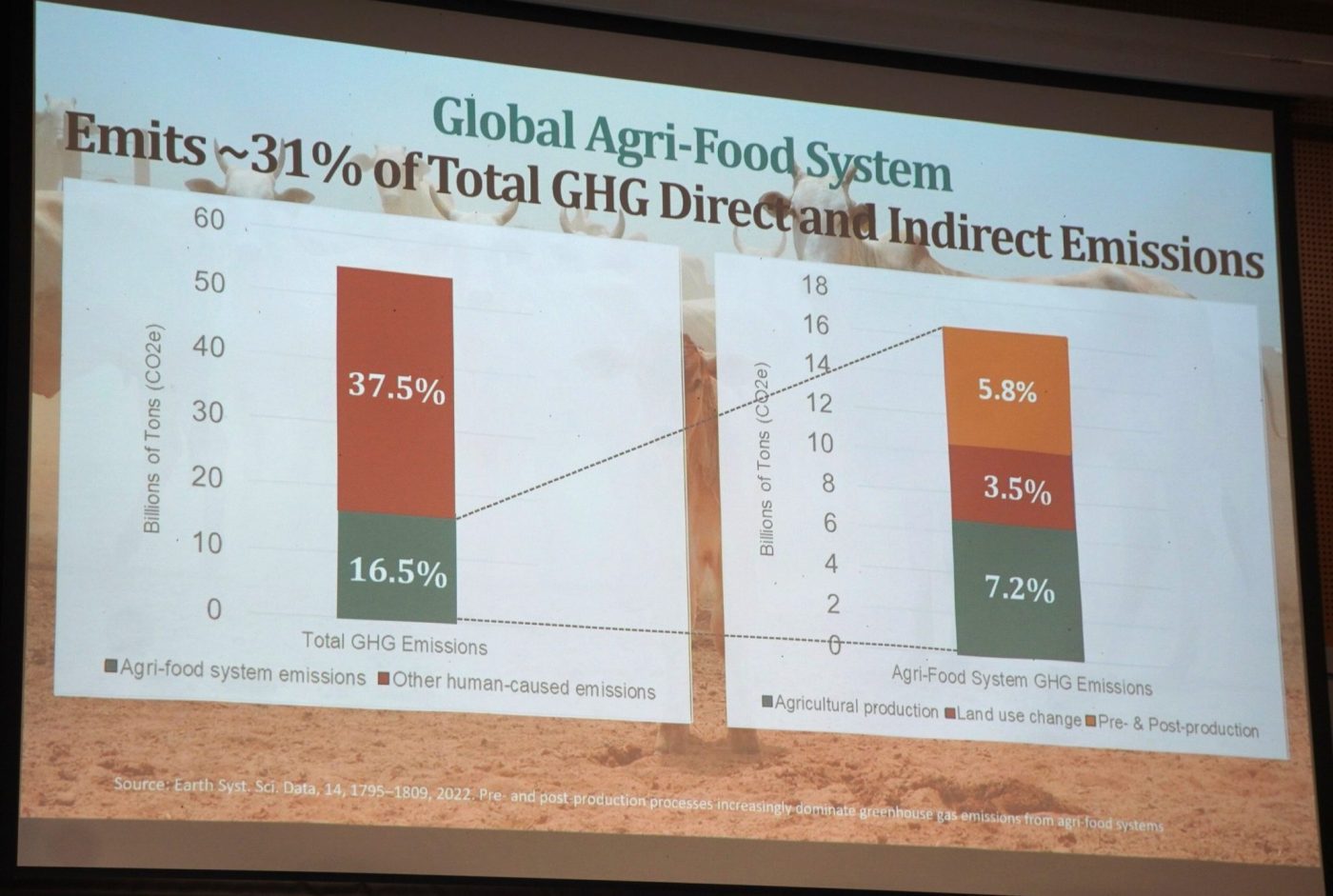
She used this slide to illustrate total world emissions (left hand side), and within that, total emissions from ag (right hand side).
In general, this was the only image the broader community got to see, she said.
The typical reaction was: “Oh my gosh: Agriculture is 31pc of total direct and indirect GHG emissions – we need to greatly and only reduce emissions here.”
Food security
The ‘31pc from agriculture’ figure became the core to Dr Klopatek’s presentation to CA members.
“Here’s what’s often left out of the equation: Food security,” she said.
“GHG emissions and food security do go hand-in-hand, and need to do so, if we are to have these conversations together.”
“When we look at beef supply and demand, global beef demand (as discussed in other forums at the CA conference) is going up – especially in those markets where economic conditions were improving, leading to higher consumption levels.
“Yes, (the global beef industry) needs to reduce emissions, but the world also needs to be more food-secure, meaning we need to produce more of it.
She quoted the summary of a group of 150 of the world’s most recognised scientists, including Nobel and World Food Prize laureates, who said: “The world is not even close to meeting future food needs. Humanity is faced with an even more insecure, unstable world.”
“So we don’t need to take our foot off the gas – we need to put our foot on the gas. We’re going to need more food research, more innovation, learn to do more with less, and produce fewer GHGs at the same time we are producing more food,” she said.
Who’s talking about and pushing sustainability?
So, who is talking about and pushing sustainability?
Dr Klopatek said there had been many surveys conducted around the world that had asked respondents whether they were prepared to pay more for a ‘sustainable’ or ‘environmentally friendly’ product.
Results showed that while consumers might ‘want’ something, there were not necessarily willing to pay for it.
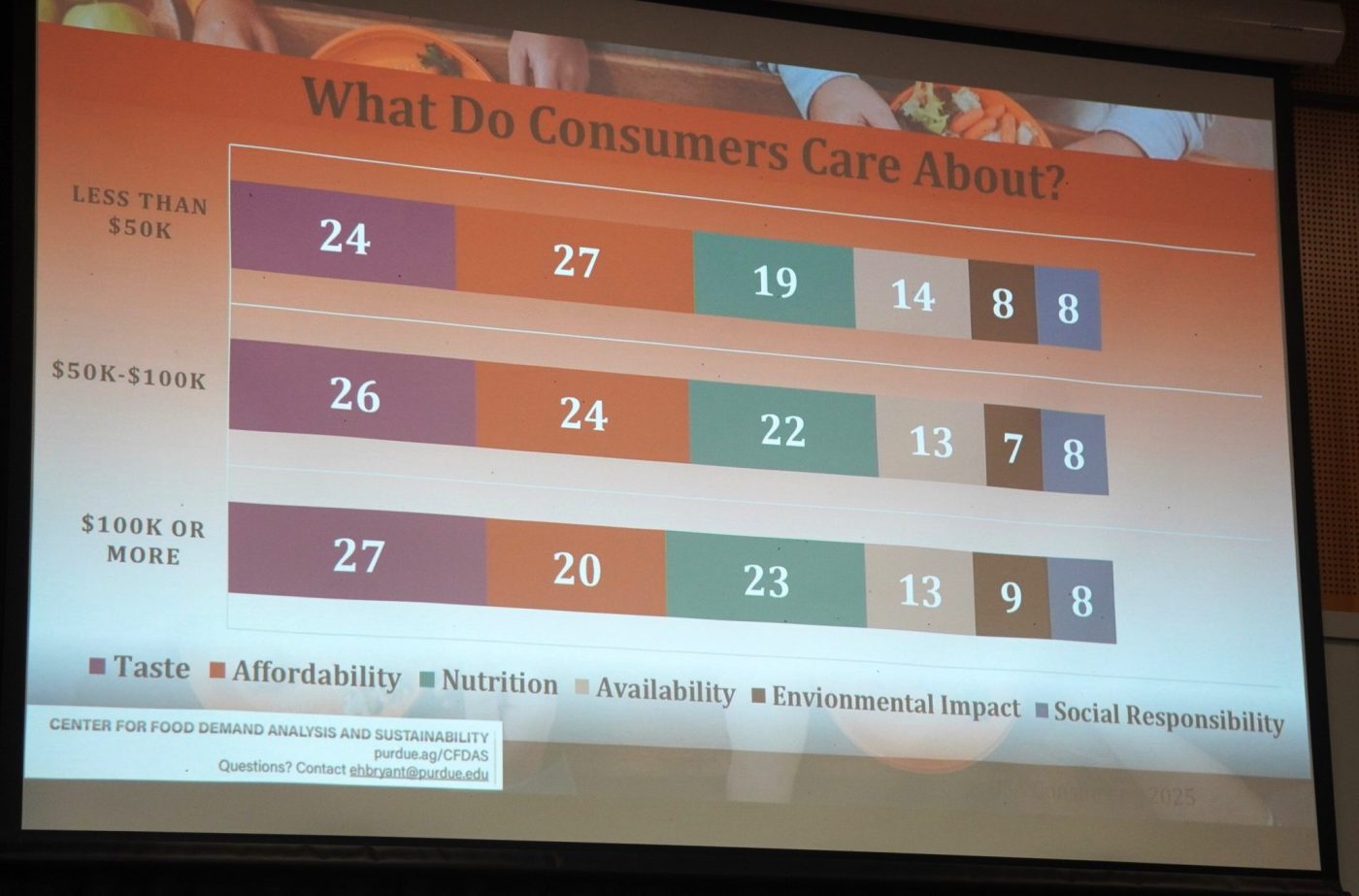
A US survey conducted by Purdue University asked what consumers cared about, divided into three economic groups, based on income. Results showed that for all three groups, taste and affordability reigned king, with environmental impact and social responsibility much lower on the list.
Click on images fort a larger view
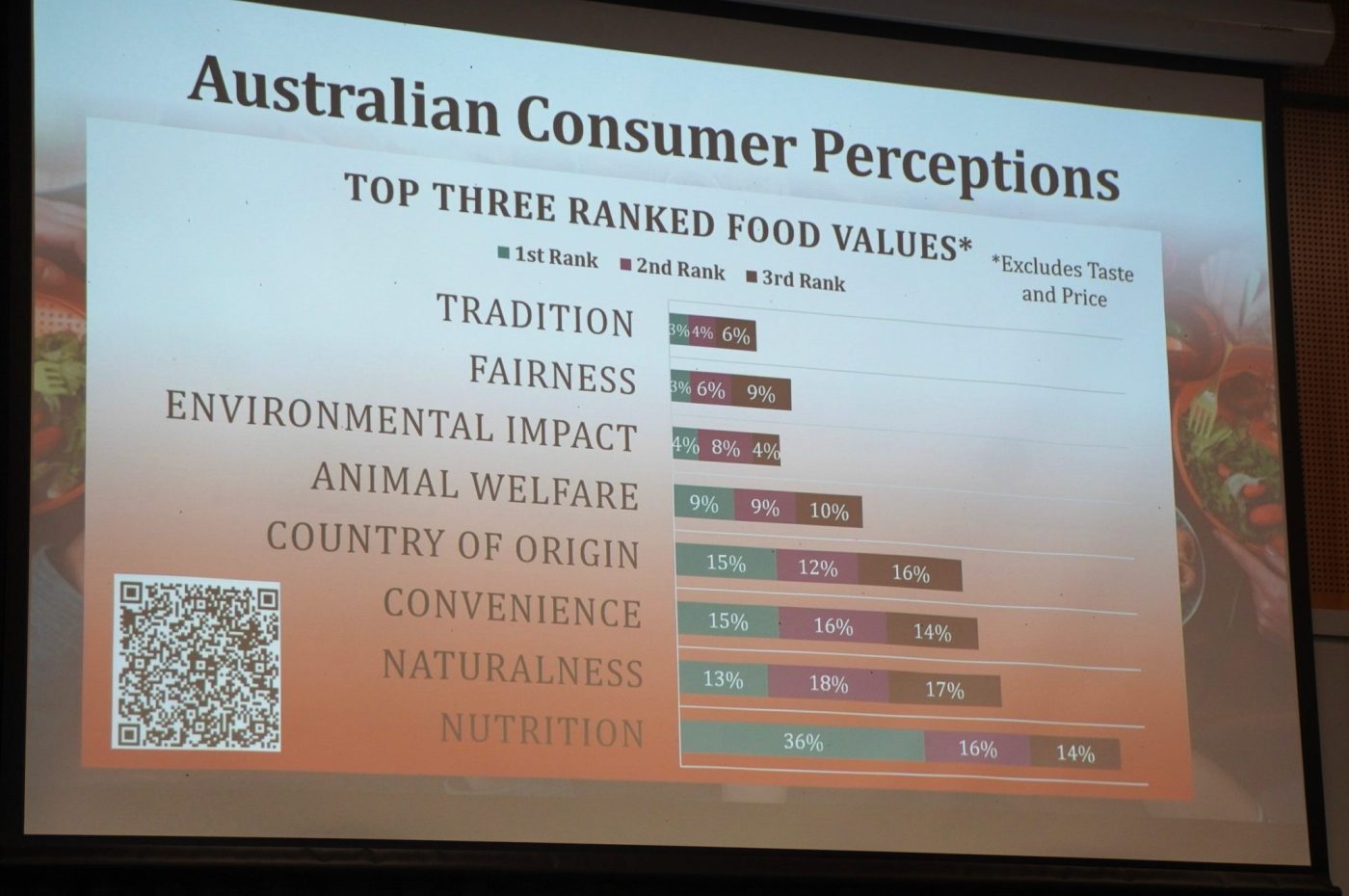
When price and taste are removed, a survey of Australian and New Zealand consumers ranked nutrition next highest, as illustrated in the slide below.
That’s going to become more and more critical – especially with social media and the emphasis on health, the drive for more protein and the reduction on over-processed foods, she said.
Further down the list came ‘naturalness,’ convenience, country of origin, animal welfare and environmental impact.
“Today’s customer clearly has a lot on their mind, and are thinking about a lot of things. But environment is not necessarily at the top of their mind when it comes to food values.
“But when you look at those downstream of the cattle producer – retailers, packers, lotfeeders, large end-users – the pressures are astronomical in this space.
The pressure points were coming from people like regulators and financial institutions. Financial institutions wanted to see climate risk decreased, and so had focussed on GHGs.
“That’s why downstream companies are under tremendous pressure in reporting, as well as reducing their own emissions. We say at times that it’s all about the consumer, but the pressure has really come from regulators and financial entities that are really driving this conversation.”
How do we talk about emissions at an industry level?
Dr Klopatek said it was important to have the tools to allow stakeholders to talk about the ‘full picture’ of sustainability.
Using Australia as an example, she said 15pc of total GHG emissions were coming from the ag sector. The majority of that (about 11pc) was from the livestock industry, with the rest coming from the energy, waste and industrial processes.
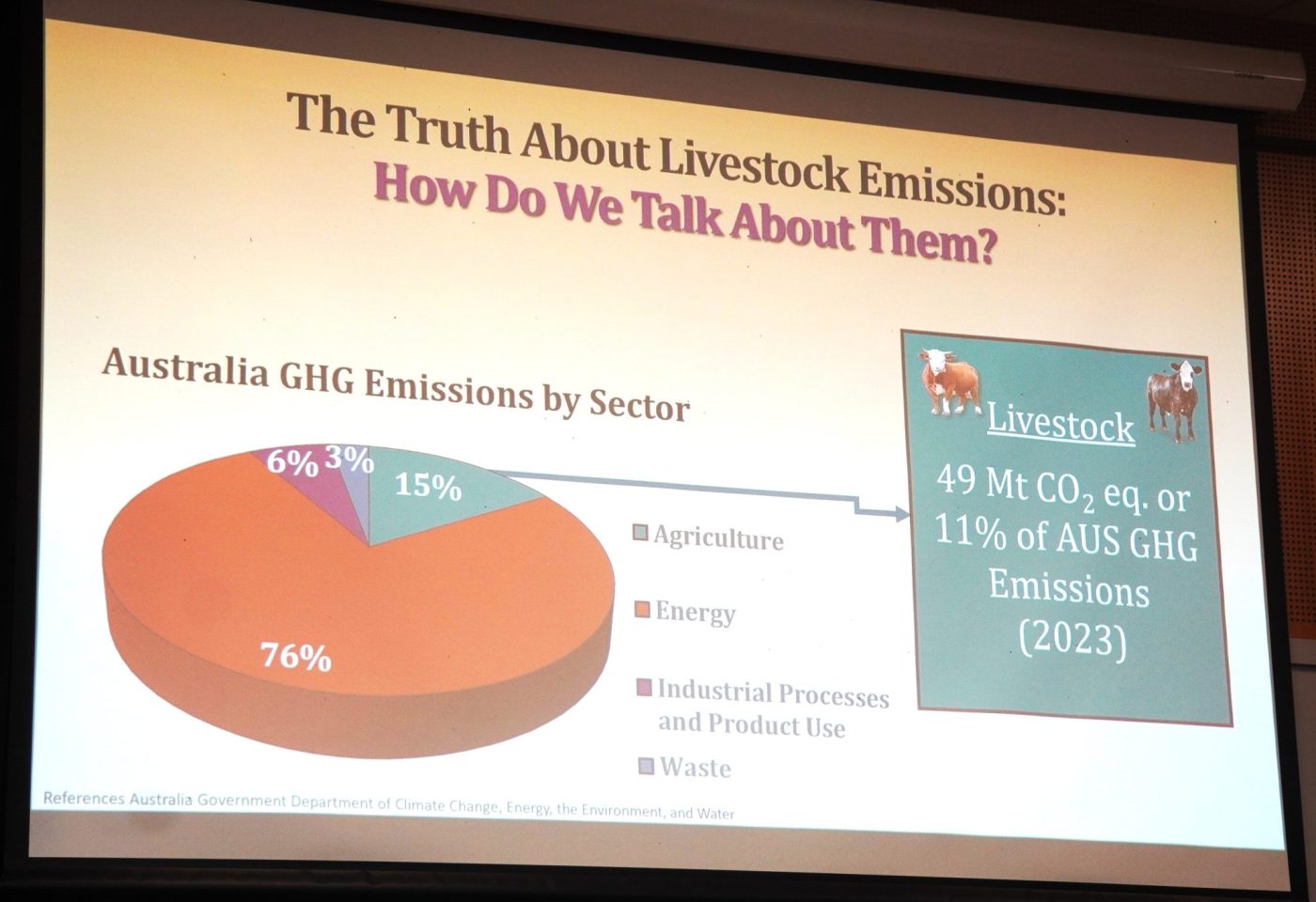
Click on images for a larger view
Apples versus apple pie
But instead of ‘just focussing on the 11pc’, it was important to have tools to talk about the industry’s emissions, in context.
“People have used this figure wrongly – and it has been devastating for our industry,” she said, using an analogy of an apple, versus an apple pie.
“An apple represents the direct emissions from a system – in this case direct emissions (enteric methane and manure) from cows. But if you step beyond that, it’s that cow’s feed, her transportation – everything that comes together to make that kilogram of beef on the shelf. That’s the apple pie.”
“What happens, when you see emissions referenced in the big city news, is that the transportation industry getting an ‘apple’ emissions factor, while the beef cattle industry gets an ‘apple pie.’ Those are not comparable.”
When global ag is attributed 30pc share of overall emissions, that is direct and indirect emissions (apple pie). Direct emissions are considerable less.
16 year legacy
“How we all talk about emissions – this is so incredibly important,” Dr Klopatek said.
An infamous 2009 FAO report (Livestock’s Long Shadow) suggested that livestock produce more emissions than the transport industry, globally. It literally said: “put your fork down – do not have livestock or eat meat because of climate destruction.”
“But that report took an apple pie approach, including the feed, transportation, refrigeration, processing costs in livestock. For transport, all that was accounted for was the fuel. No indirect emissions – it was an apple to apple pie comparison, and we (the red meat industry) have been dealing with it for the next 16 years.”
“We still see academic papers, policy briefs and news articles quoting the FAO report – and it was wrong. The FAO has since retracted the paper, but it is still getting mentioned, and still creating damage,” she said.
How the industry talked about emissions, going forward, was going to be critically important, Dr Klopatek said.
Using the most recent global report, comparing ‘apple pie’ numbers, it said livestock (including pork and chicken as well as beef and lamb) accounted for 11.1pc of global emissions, not 30pc as suggested in the original FAO report.
So why is beef continuing to attract a negative image?
The figure frequently mentioned on the news and in social media is that beef (on a global average basis) has one of the the highest carbon footprints of any food, per kilogram of protein (again, an apple pie figure).
“But what people don’t see – but need to see – is that cattle GHG intensity can be 10-50 times greater in developing nations, than developed nations,” Dr Klopatek said.
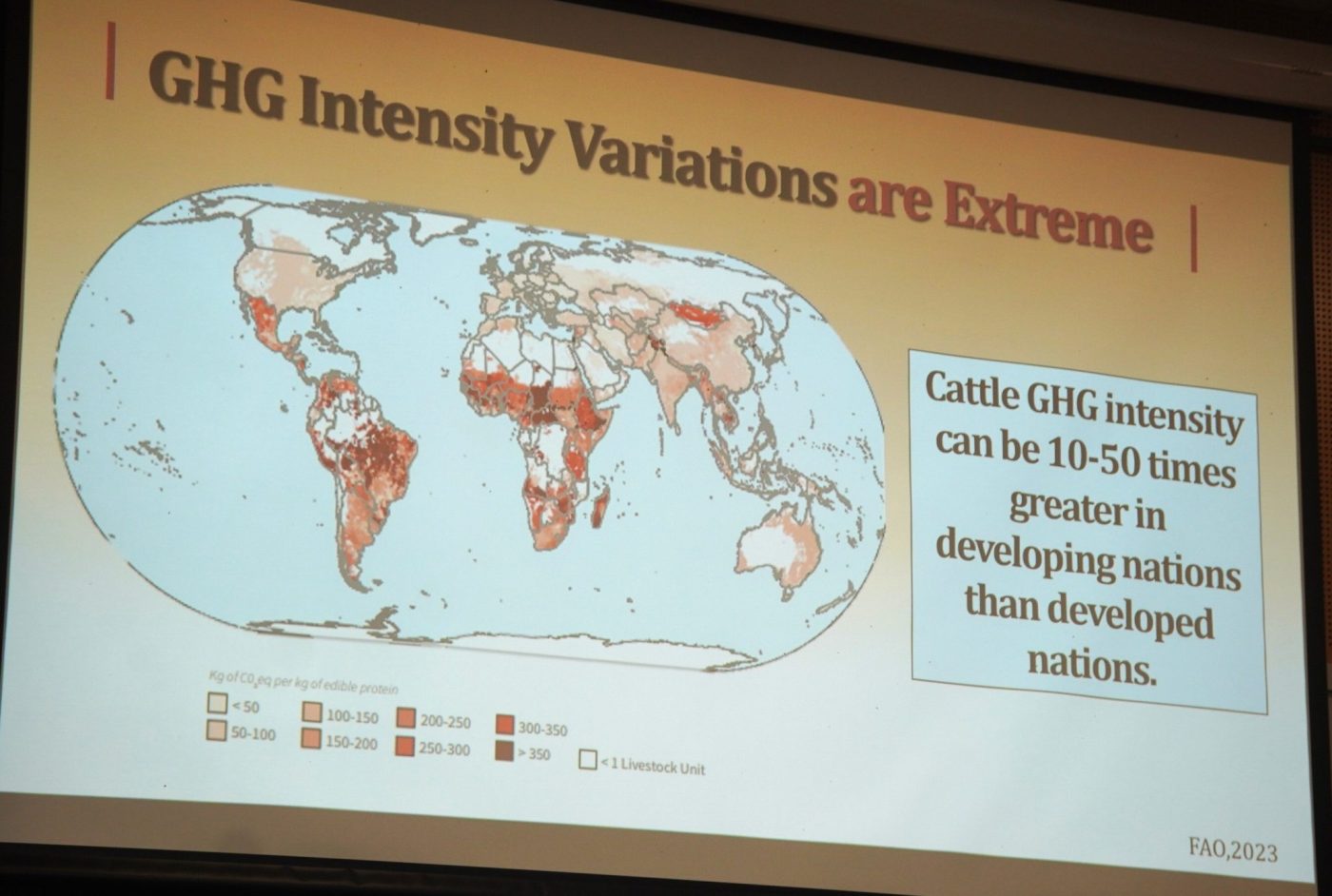
As seen in this slide, Australia is shaded light orange or white, which means this country is able to produce more beef with fewer emissions, than most other parts of the world (darker shades).
“This is incredibly important, because we need to tie food security and the reduction in emissions together. This is what we need to show the world – all the work beef producers, livestock researchers and others in Australia are doing is making this possible,” she said.
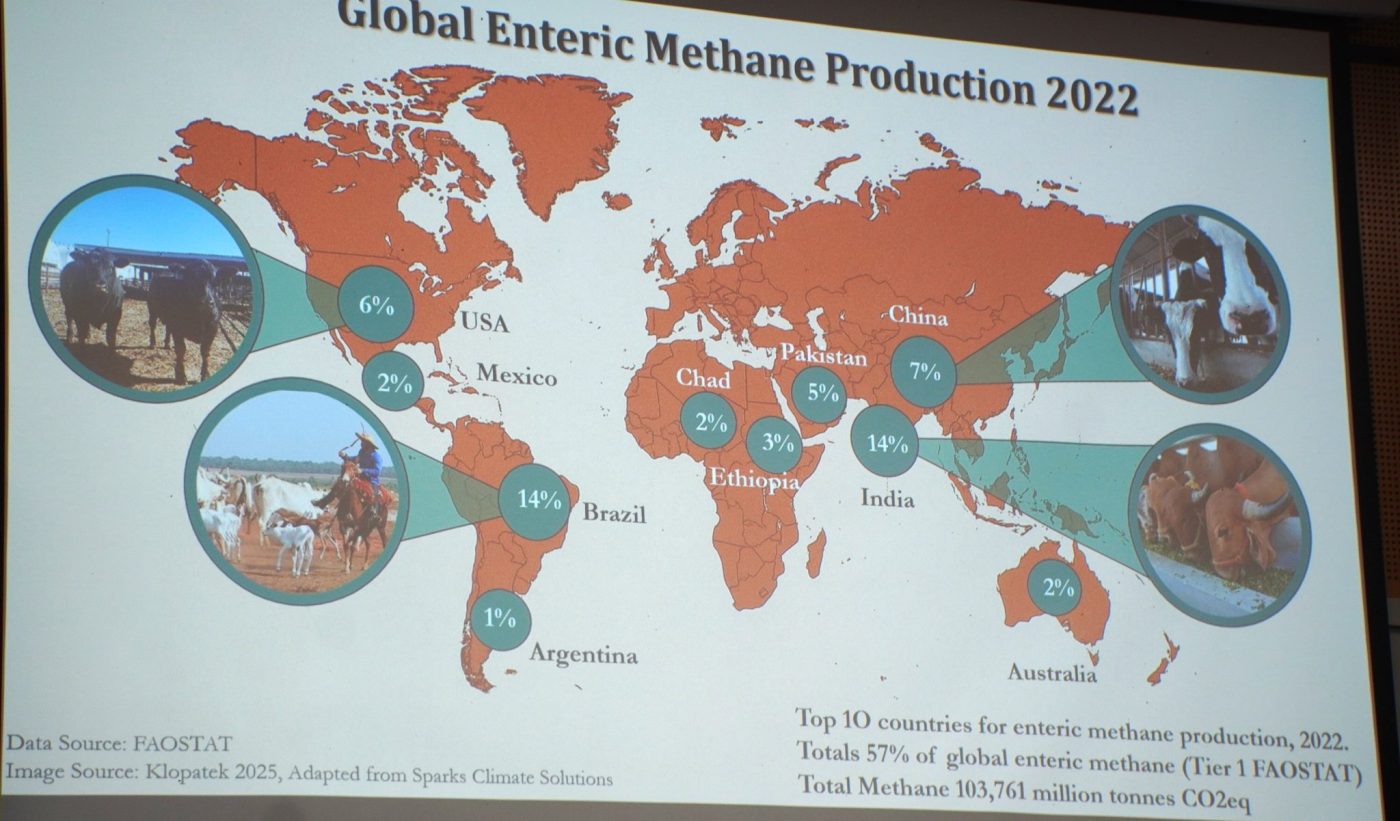
Another way to compare this was in this map of where global enteric methane from livestock comes from.
One of the reasons why ruminants (including cattle) were ‘really cool’ was that they were able to take a low-quality forage and up-cycle that into high-quality, protein-dense meat, and milk.
“They convert grass into a valuable food source – better than anyone else out there,” Dr Klopatek said.
But there was always going to be a trade-off: energy can neither be created, nor destroyed.
“That trade-off is enteric methane. Methane is a more potent GHG, it holds more heat than CO2, so that’s why cattle get such a big focus.”
He slide above, showing the geographic sources of enteric methane, showed that Australia’s contribution was 2pc, Brazil 14pc, US 6pc, China 7pc and India 14pc.
While an important figure, these should be shown in the context of global beef production, she said (see image below).
Although Australia only contributes 2pc of emissions, it produces 3pc of the world’s beef. In contrast, India produces 14pc of the emissions, but only 7pc of the world’s beef; China 7pc of emissions, and 12pc of the beef; and the US 6pc of emissions, but 22pc of the beef.
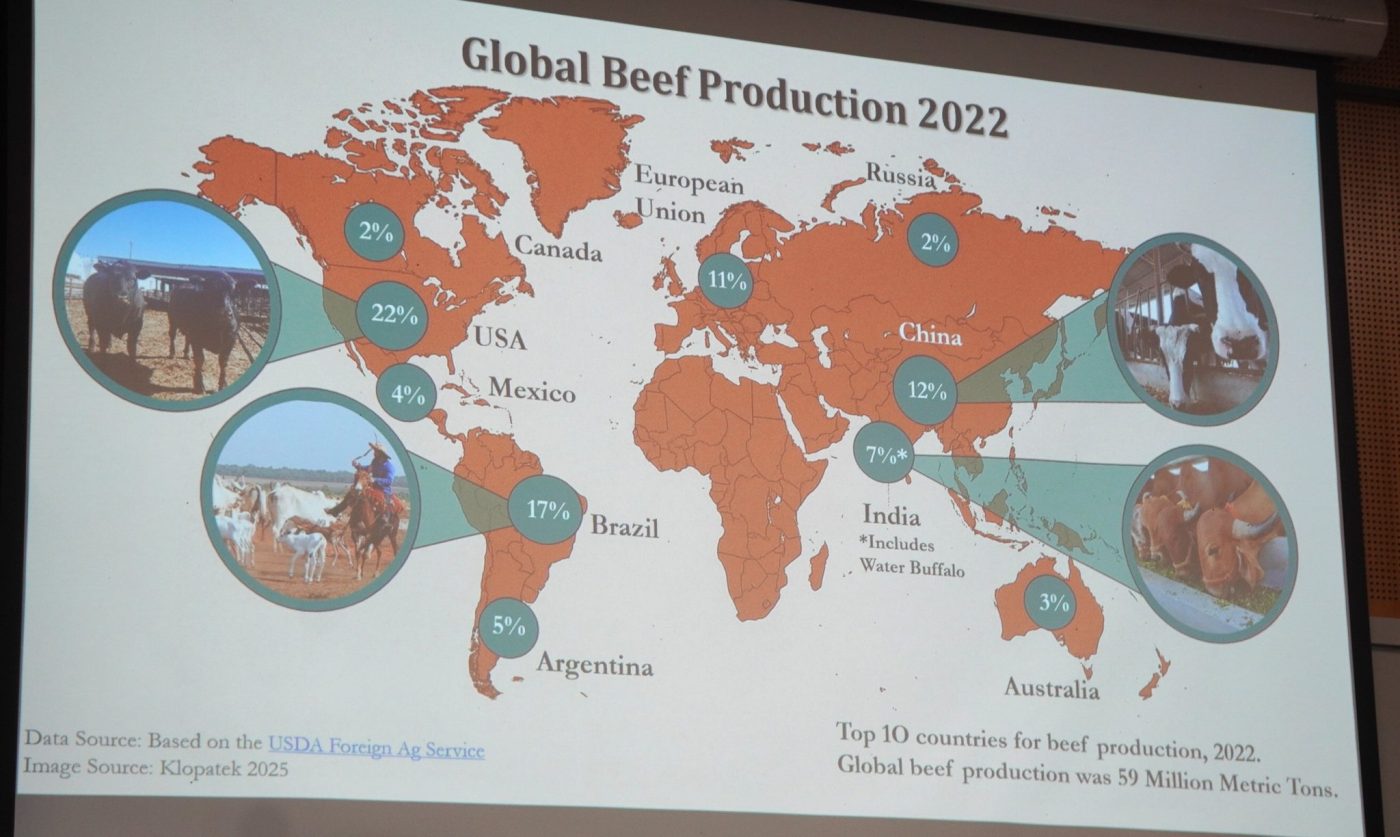
Efficiency matters
“Why is this important? Again, because food security and emissions need to go together, because we are going to need to reduce emissions and create more food, at the same time,” Dr Klopatek said.
Her own definition of efficiency was ‘doing more with less.’
“How do we have minimum input and maximum output? The graph below shows the amount of beef per animal, produced globally. It shows just one animal in the US produces the same amount of beef as four animals in Africa.
“What that means is that you are able to use the same amount of resources to produce four times the amount of beef – that’s astronomical. We really need to have that be a part of this discussion.”
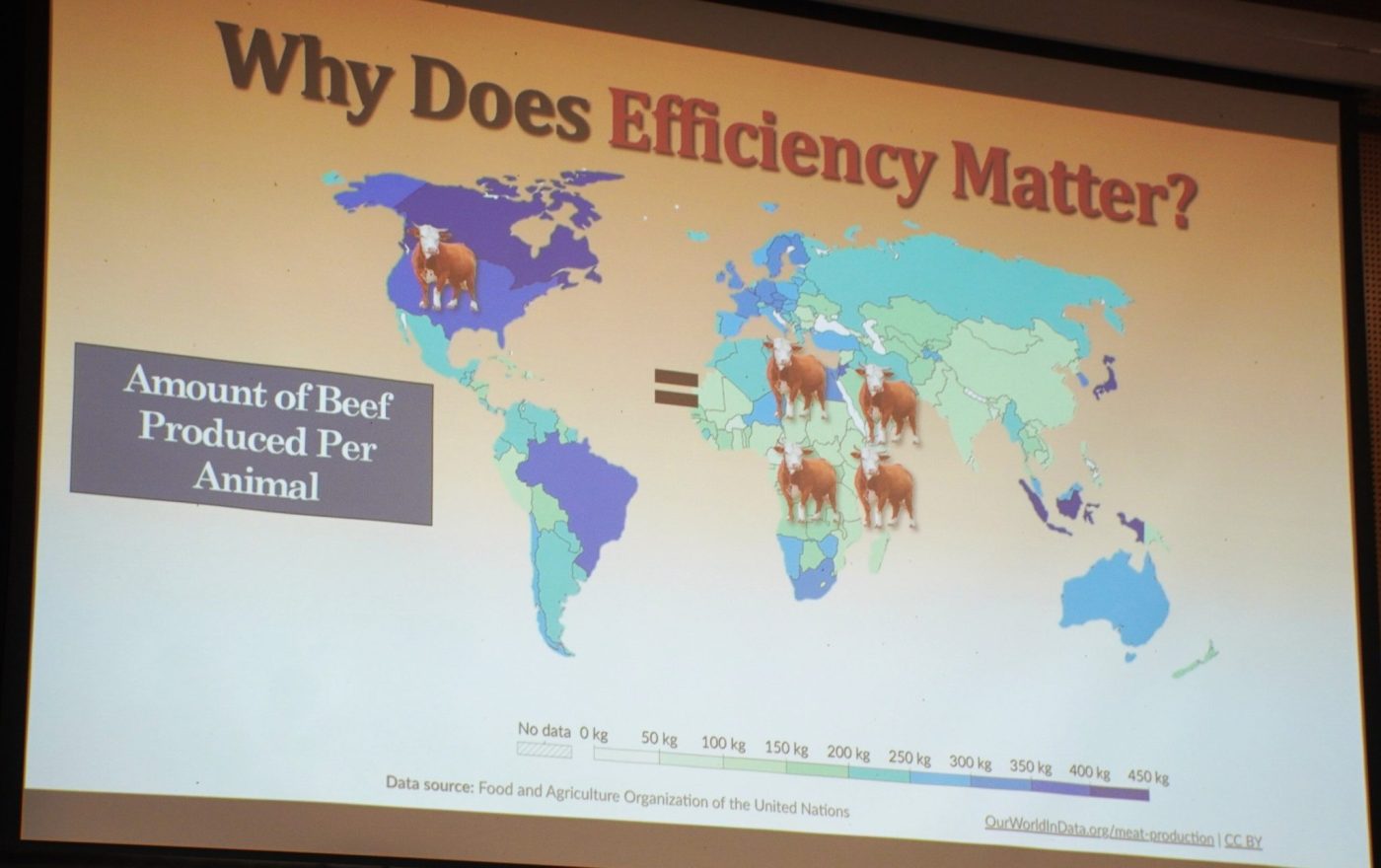
“To beef’s customers or consumers, efficiency might seem like a bad word, but it’s not: because it creates greater food security, more profitability and fewer emissions.”
From the balance sheet point of view, Dr Klopatek’s rattled off a series of influences on efficiency in beef, including:
- Implants (HGPs)
- Diet
- Reproduction rate
- Improved genetics, and
- Herd management.
“It’s literally everything you are doing on the ground, every day,” she told the cattle producer-heavy audience.
Emission trends
While total global beef cattle emissions (green line in graph below) had grown since 1960 due to herd expansion, the important part was that emissions from developing nations (blue line) had actually fallen since around 1975 (at the same time that more beef per head was being produced), while emissions in developing countries (red line) continued to rise.
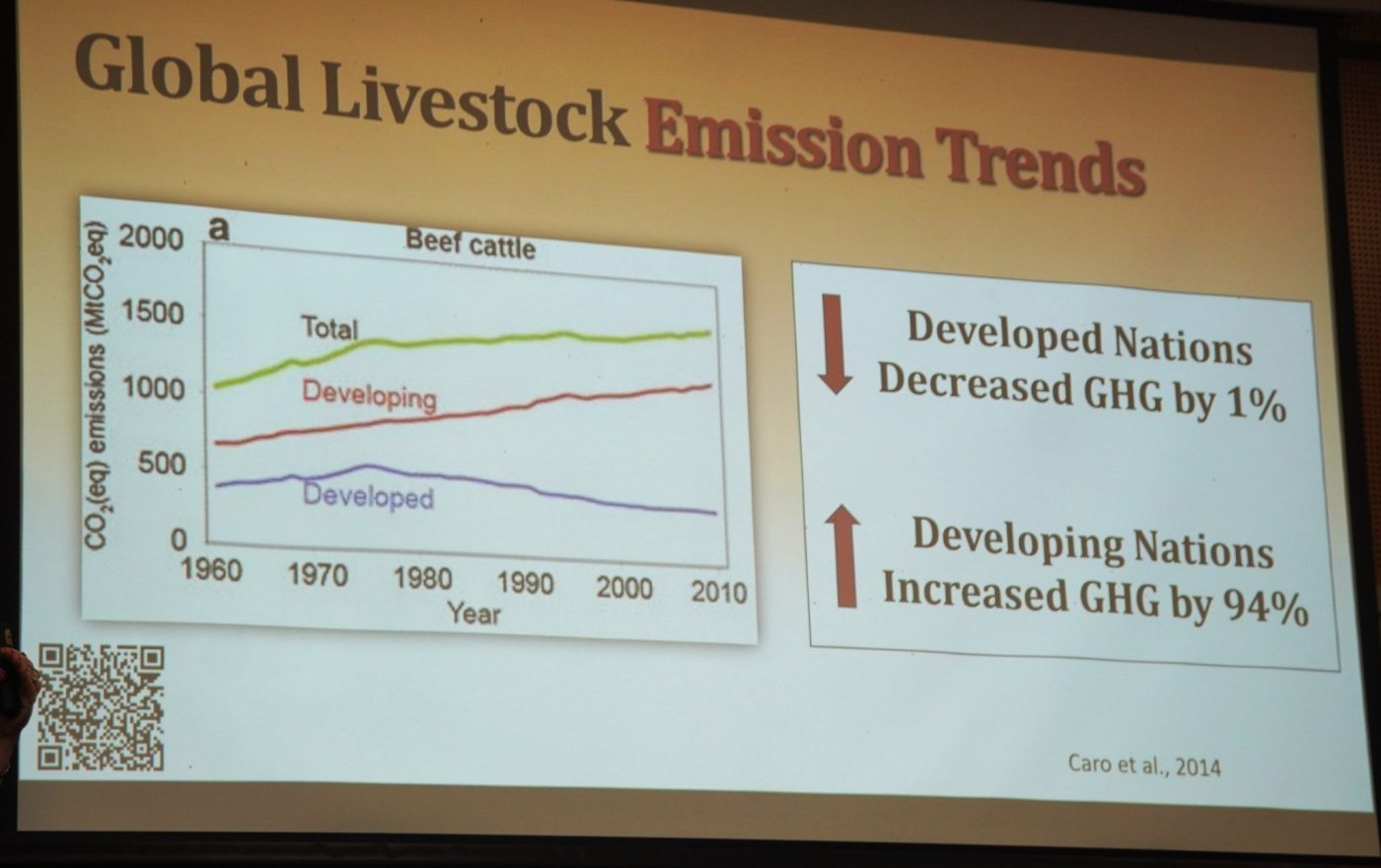
What’s happening here is developed nations have decreased emissions by 1pc since 1960, but developing nations have increased by 94pc over the same period.
“It means production systems matter, and location matters,” Dr Klopatek said.
“When having these discussions, we need to be keeping these things in mind.”
Grain versus grass systems
She said while GHG emission levels did not dictate whether a cattle production system was sustainable or not, but it could be one of many metrics used to evaluate system performance and efficiency.
“And system efficiency is a critical aspect in business, in environmental sustainability.”
A common question among consumers was whether grassfed or grainfed finishing systems were better for the environment and GHGs.
Her research while at UC Davis in California, in a Mediterranean climate, looked at four different production systems – conventional grainfed 140 days (yellow bar in graph below) and three grassfed systems, comparing GHG footprints and water use.
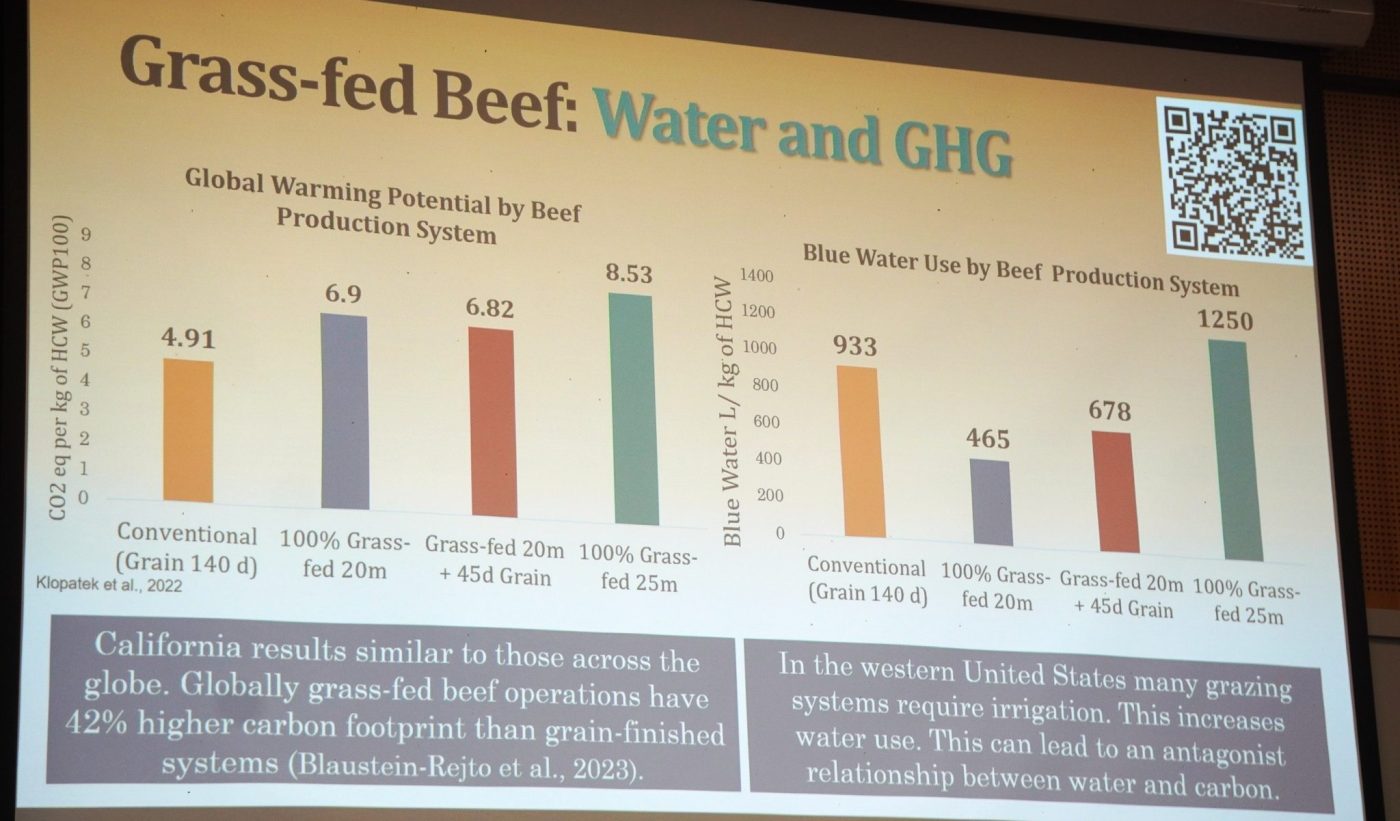
“In this study, grainfed did have a lower GHG footprint. Because of the diet and the days on feed, it’s common to see a lower enteric emissions in grainfeeding – but that system also had a higher energy footprint,” Dr Klopatek said.
“Fossil fuel use was higher for the grainfed system – so what we saw was tradeoff. One of the grassfed systems had lower water use than the grainfed system, while another had higher water use. Tradeoff. So when we talk about different production systems, I like to say every feed system is going to have trade-offs – there is no system absolute, and one will never be greater than another.”
“But at the end of the day, the industry is going to need to have diversity of beef systems – diversity creates resilience, and resilience creates sustainability. There’s a place for every type of producer and production system.”