
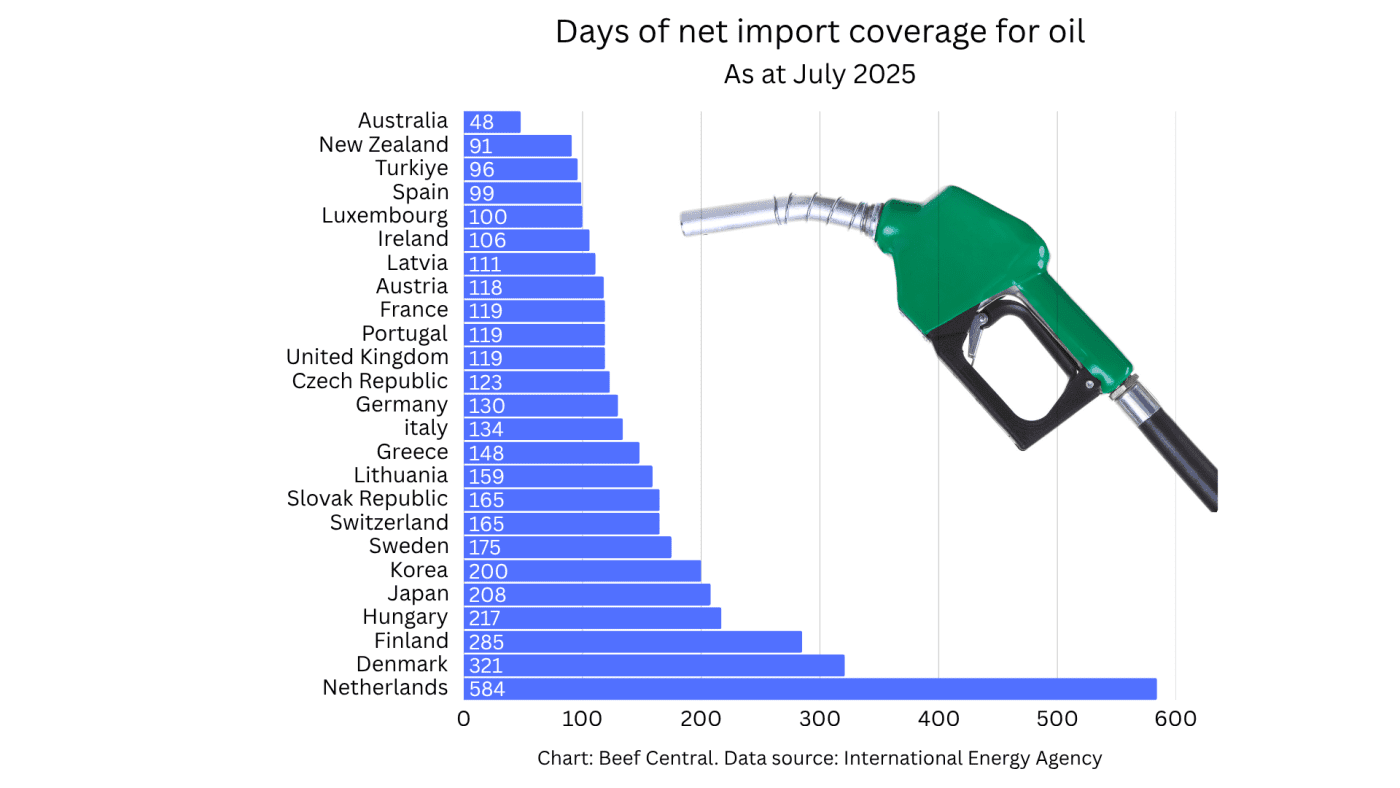
Click on chart to expand.
Latest data from the International Energy Agency lays bare Australia’s vulnerability to supply chain disruptions amidst an increasingly tense geopolitical landscape.
The IAE shows that in July Australia had just 48 days oil import coverage on hand, and was by far the worst positioned of the 27 net oil importing member countries of the agency.
Figures quoted by the Australian Financial Review last week from the Department of Climate Change, Energy, the Environment and Water further reinforced the scant nature of Australia’s fuel reserves, revealing that based on normal consumption rates, Australia was estimated to be holding just 20 days of jet fuel, 24 days of diesel and 28 days of petrol supplies in July.
That data comprises stock held within Australia and in domestic coastal waters, not ships carrying fuel enroute to Australia which at any given time cam account for an estimated two weeks of additional supply not included in the IAE numbers.
The IAE requires all member countries to hold oil stock levels equivalent to no less than 90 days of net imports to ensure they have enough oil in case of a global emergency.
As the above chart shows Australia is the only country on the list currently in breach of those obligations.
The next worst placed country is New Zealand which was only just within its international treaty obligations in July at 92 days.
IAE data shows that on average, the 27 members who are net oil importers had an average of 141 days of import coverage as at July 2025.
Substantive action needed: NFF
National Farmers Federation president David Jochinke called on the Federal Government to take substantive action to shore up Australia’s vulnerability to a supply crisis.
“Australia’s food security is only as strong as the supply chains that underpin it, and right now, we’re heavily reliant on imported inputs like fuel and fertiliser,” he said.
“We can’t afford to be caught short when global supply lines falter.”
Image: Shutterstock
The NFF has just lodged a submission to Federal Government’s National Food Security Strategy development process, noting that Australia imports over 90 percent of its liquid fuel needs.
While this had significant cost advantages, the current arrangements for the sourcing and distribution of liquid fuel in Australia left the agricultural sector vulnerable to a range of supply risks.
It pointed out that in 2021 supply disruptions saw Australia face an imminent shortage of the Diesel Exhaust Fluid AdBlue.
“The episode demonstrated how we must not just rely on reactive measures, and start proactively addressing supply vulnerabilities before they reach crisis point,” the NFF submission said.
It emphasised the need for the National Food Security Strategy to provide for a holistic plan to address future supply chain disruptions including for other critical inputs including fertiliser, agricultural chemicals, processing equipment and packaging materials.
Agriculture exposed
Earlier this year national security expert, Air Vice-Marshal John Blackburn (Ret’d), warned at an Australian Meat Industry Conference and on the AgWatchers podcast that Australia was sleepwalking into a national crisis due to a dangerous lack of fuel security.

John Blackburn. Image: Australian Security Leaders Climate Group
Successive governments had failed to confront the nation’s growing vulnerabilities in energy, supply chains and health, leaving critical sectors like agriculture exposed.
Australia had a dozen oil refineries with large storage facilities in the 1970’s but today has just two operating oil refineries, both of which are reliant on government subsidies which expire in 2027.
He said the Russian invasion of Ukraine in 2022 prompted the-then Morrison Government to commit to undertaking a national fuel risk assessment. However, the risk assessment stopped when the person leading that process left the job, meaning Australia has still not conducted a national risk assessment.
“The last time we did a national energy security assessment was 2011, and although the Liberal Government promised to do one in 2015, 2016, 2017, they never did.
“So that means that as a country we’re operating on a lot of assumptions and a bit of misinformation.”