
Editor’s note: Steve’s column was filed Friday afternoon, before the latest round of US beef tariff changes occurred.
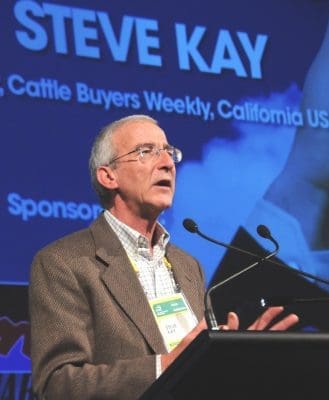
A monthly column written for Beef Central by US cattle and meat market commentator Steve Kay, publisher of US Cattle Buyers Weekly
I HAVE studied the United States meat industry closely since 1986, and I still can’t understand why the industry has repeatedly come under intense scrutiny and often savage criticism.
Meat packers here are highly regulated and operate under maximum transparency. That hasn’t stopped politicians and other groups, some of them cattle producers, from claiming that packers, especially those who produce beef, are scoundrels who collude to keep cattle prices down and beef prices up.
I was not surprised therefore when President Trump on November 7 claimed that meat companies are raising beef prices through collusion and price fixing and called on the Department of Justice to investigate.
None of his accusations have any merit. In fact, his accusations are far more spurious than other claims against packers in the past 30 years, all of which found no evidence of any wrong-doing by any packer. A new investigation would be a waste of the government’s time and would only cause packers to spend a lot of time and money in having to defend themselves.
Trump, as you may have read, said he had asked the DOJ to immediately begin an investigation into the Meat Packing Companies who are driving up the price of Beef through Illicit Collusion, Price Fixing, and Price Manipulation, he wrote on Truth Social. He added that “We will always protect our American ranchers, and they are being blamed for what is being done by Majority Foreign Owned Meat Packers, who artificially inflate prices, and jeopardize the security of our Nation’s food supply.”
Trump’s remarks are largely incorrect. No one has blamed American ranchers for high beef prices. Second, two of the four largest beef packers, Tyson Foods and Cargill, are 100 percent US-owned. JBS Beef North America is 100pc owned by Brazil’s JBS SA and National Beef Packing is majority-owned by Brazil’s Marfrig Global Foods.
Third, claims that these four companies control 85pc of the US fed steer and heifer slaughter are incorrect. My annual market data over the past decade has put the percentage at or below 80pc.
Packers losing money
The Meat Institute, which represents meat and poultry companies, immediately responded to Trump’s call for the DOJ to investigate the beef sector. Despite high consumer prices for beef, beef packers have been losing money because the price of cattle is at record highs, said Institute president and CEO Julie Anna Potts.
For more than a year, US beef packers have been operating at a loss due to a tight cattle supply and strong demand, she said.
Tyson Foods reported last Monday that its beef segment in fiscal 2025 ended September 27 had an adjusted operating loss of US$426 million and JBS on Thursday reported that JBS Beef North America had an adjusted operating loss of US$554m for the first nine months of 2025.
The US beef industry is heavily regulated and market transactions are transparent, said Ms Potts. The government’s own data from USDA confirms that the beef packing sector is experiencing catastrophic losses and experts predict this will continue into 2026.
US beef processors welcome a fact-based discussion about beef affordability and how best to meet the needs of American consumers, who are the industry’s most important stakeholders, she said.
The real reasons why US beef prices have risen
The Wall Street Journal in a November 12 editorial titled Beef Is Now Political Red Meat said its readers might want to know the real reasons why sirloin prices have shot up.
The US cattle herd has been shrinking for years owing to drought and rising costs for ranchers, the WSJ said. Meat packers have turned to Mexican cattle to meet Americans’ growing demand for beef.
But the Department of Agriculture this spring suspended Mexican cattle imports after the screwworm parasite was detected in herds south of the border.
A winnowed cattle supply has driven up prices. Live cattle prices have soared 24pc over the past year, which has compressed meat packers’ margins. Their profits have fallen, not increased, Mr President.
The Administration’s 50pc tariff on Brazil and quotas on Argentinian beef imports also contributed to higher prices. The real beneficiaries of higher beef prices have been US ranchers, not meat packers, the WSJ suggested. Ranchers have been pressing the Administration to continue its ban on Mexican cattle imports and to restrict beef imports, the journal said.
A November 10 article in the reputable online publication “Reason” written by Jack Nicastro, also cited the shrinking cattle supply.
“Like many of Trump’s theories about the economy and affordability, a more plausible and nuanced explanation exists,” he wrote.
“Since December 2020, the US has seen a plummeting supply of beef cattle in part due to drought and higher input costs. In July 2020, there were 32.1 million beef cows; in July 2025, that number had decreased by 10.6pc to 28.7m head.
“In August, the Agriculture Department revised its 2026 beef production forecast downward by 345 million pounds, representing a 2pc year-over-year decline,” he wrote.
“Trump has expressed concern that American ranchers are being improperly blamed for high meat prices at the checkout counter. To ascribe blame for the recent uptick in meat prices to four-firm concentration in the meat packing industry is unconvincing at best and, at worst, a deliberate smokescreen for his restrictionist trade policies that have exacerbated the problem,” wrote Nicastro.
Beef packers are the one segment that has been most negatively impacted in the current market, incurring huge losses due to poor margins and limited cattle supplies, says Oklahoma State University economist Derrell Peel.
Using logic that only works in the office of a politician, packers are supposedly wielding unacceptable market power while paying record high cattle prices and artificially raising beef prices but not enough to avoid losing a couple of hundred dollars on every animal they process – certainly many millions of dollars.
If US beef packers had any significant ability to exercise market power, he is certain that the industry would not have record high cattle prices and packers would not be losing money, he says.