
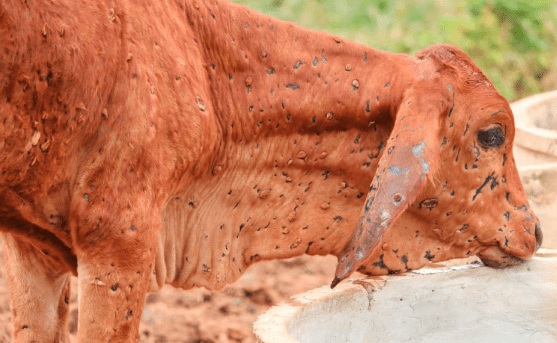
An Australian Government report says proactive work with key beef trading partners has secured at least $761 million worth of beef exports which previously may have been at risk if a detection of lumpy skin disease in Australia was to occur.
LSD, which can be spread by airborne insects, has moved from Africa to Europe to South East Asia in a little over 10 years. It has been spreading in Indonesia since 2022, and its confirmation in Bali last week now places it within 1200km of the Australian mainland.
How would trading partners react?
A pressing question for Australia’s export-dependent beef industry is how key trading partners would react if lumpy skin disease were detected in Australia, and whether pre-negotiations can help to ensure market access could be quickly recovered following an outbreak.
While the details of country-to-country trade negotiations rarely appear publicly, a recent report on the Department of Agriculture, Fisheries and Forestry website provides some insights into the kind of pre-emptive LSD-related discussions currently underway.
DAFF reveals $761m in exports now less exposed
A National Lumpy Skin Disease Action Plan Progress Report for the period 12 August to October 2025, published on the DAFF website, notes that, whilst trading partner reactions cannot be anticipated in the event of an LSD incursion, to date approximately $761 million worth of exports previously at risk could now continue without disruption.
Beef Central asked the Department for further detail on the $761 million stated figure and which trading partners it refers to.
Specific information around trading partner negotiations could not be shared, the response stated.
However, it emphasised that the Government is working with trading partners to minimise possible effects on trade should a biosecurity outbreak one day happen.
“Australia’s strict biosecurity system is designed to reduce the risk of diseases such as LSD being introduced into Australia, including decreasing the risk posed by international travel and trade,” the Department’s response stated.
“In the event of a detection of LSD in Australia, the Government works with trading partners and industry to minimise the effect on trade.
“The Government is engaging with the Indonesian Government to better understand the situation in Bali and will continue to provide ongoing support for Indonesia’s response to LSD.
“The Australian Government will never compromise on biosecurity – our biosecurity system is world renowned, and vital in protecting our rural communities, our $100 billion agricultural industries, our economy, and our way of life.”
Trade preparedness strategy now finalised
The latest National Lumpy Skin Disease Action Plan Progress Report states that DAFF has now finalised its LSD trade preparedness strategy in consultation with industry and state and territory governments.
“This strategy identifies priorities to mitigate trade losses that could result from an outbreak of LSD.
“DAFF is implementing the LSD trade preparedness strategy, which included a comprehensive review of current export certification across multiple commodities to identify certificates that do not align with internationally recognised scientific standards.
“DAFF continues to make positive progress in accordance with the identified priorities. This includes pre-emptively identifying certification where animal health statements could better align with science-based recommendations.”
To view latest progress reports on DAFF website click here
Lessons from past protocol flaws
Further insight into the importance of proactive trade negotiations was provided by former Australian chief veterinary officer Dr Mark Schipp in an address to the LiveXchange conference in Perth late last year.
Dr Schipp was asked at the conference in Perth by veteran WA export industry stakeholder Garry Robinson how prepared Australia was diplomatically to re-establish trade as quickly as possible in the event of a major disease incursion.
He responded by explaining that proactive work by Government and industry negotiators had helped to achieve a change in the wording of a protocol that could have seen Australian beef exports to Korea frozen if an outbreak of a pig disease, African Swine Fever, had occurred on Australian soil.
Dr Schipp said that when African Swine Fever entered Indonesia and Timor Leste in 2019, followed by Lumpy Skin Disease and then Foot and Mouth Disease in Indonesia in 2022, “we took a big effort to look at what would happen if we had an incursion of those diseases”.
Some of what the review revealed was “quite surprising”, he said.
It found that had African Swine Fever (ASF) had crossed into Australia one consequence would have been an immediate stop to Australian beef exports to Korea.
“It was because of the way the certificate was written,” Dr Schipp said.
“It said Australia is free of ASF, so we would have had to stop exporting beef to South Korea if we had an ASF incursion.
“So that has been fixed, but there are a number of examples like that,” he told the conference.
The example underscored why there have been ongoing calls for Australia not to wait “until the middle of a storm to fix its roof”.
Dr Schipp said disease protocol negotiations with trading partners were “difficult conversations to approach”.