
AFTER a year of steady increases, lean manufacturing beef prices for Australian 90CL grinding meat heading into the US market have seen a sharp correction in value over the past three or four weeks.
Expressed in Australian dollar terms, our lean trimmings have fallen about A$1/kg since the third week in November.
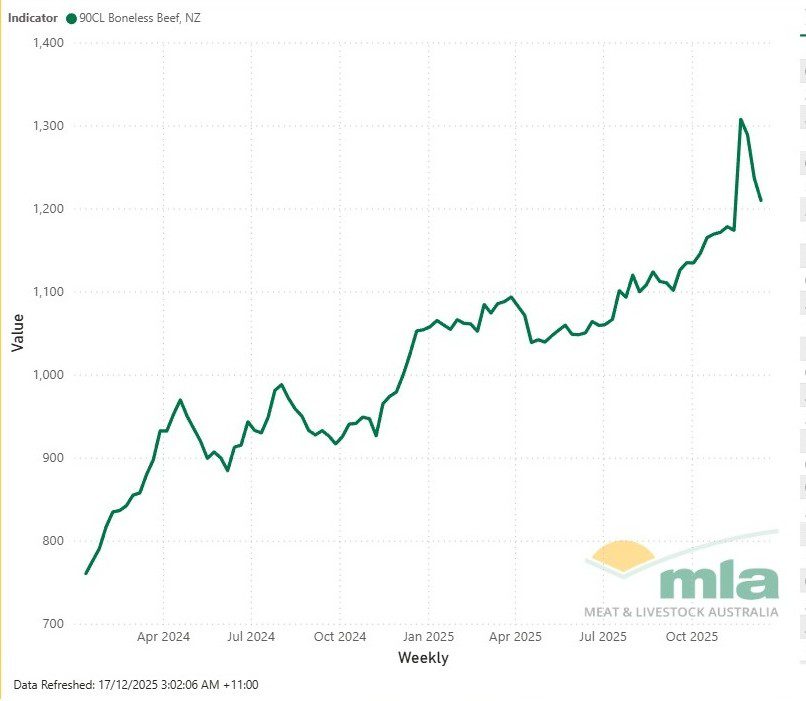
Click on graph for a larger view
The market hit an all-time record high quoted by MLA at A$13.07c/kg (CIF) during the week of 21 November, but was down to $12.09 last week. Active market participants were quoting as low as $11.20 on the spot market on Wednesday this week.
Putting that into broader context, though, 90CL prices had never gone above A$10/kg in history, before the big surge that started in December last year.
As this graph plotting 90CL imported beef prices into the US since the start of 2024 shows, prices have grown steadily, from around A$7.60 in January 2024 to the recent high just over $13/kg. That’s a lift of almost $5.50/kg or 72pc in just two years.
Three key factors
Three key impacts are involved in the recent downwards adjustment, traders told Beef Central.
The first is the currency effect, with the A$ rising about US2c since late November to mid US66s this week.
The second is the large volume of imported beef sitting in US bonded cold storage, waiting for the 1 January tariff re-set.
The third, much bigger factor can be explained in one word: Brazil.
Readers may remember that US President Trump last month dropped the 50pc additional tariff on Brazilian meat entering the US.
That’s sharpened the competitiveness of Brazilian imported meat entering the US, relative to Australia. At its peak, Brazilian beef was attracting a dizzying 76.4pc total tariff under Trump’s measures earlier this year.
From 1 January, Brazilian beef will be level terms with Australian, attracting no tariff at all.
But because of the very small volume in Brazil’s ‘Other Country’ quota used to access the US market, it is inevitably that Brazilian meat will quickly fill the quota, attracting a 26.4pc tariff for the remainder of the year.
This year, Brazil managed to fill its entire annual quota on 17 January. Next year, it could be even a day or two earlier. In our final Week in Beef podcast for the year published yesterday, our estimate was 15 days. Most of that could be filled with Brazilian product already in bonded cold storage.
Light volumes of Brazilian and Australian beef being traded this week, will not enter the US market until between late February and April next year, heading into grilling season.
The exception may be some pre-sold Brazilian beef held in bonded cold storage in the US for the new trading year, which may be brought forward now that the heavier tariff burden has eased somewhat.
“With the change in tariff conditions for Brazilian beef about to happen, and a lot of imported meat in bonded cold storage, we think there are a lot of US customers currently sitting on their hands, happy to wait a while,” one trader said.
Some unusually large US weekly beef kills recently (600,000 head last week), as well as softer US fed cattle prices, have gone against all expectations, and have thrown another element of ‘doubt’ into US imported beef buyers’ minds. However US domestic production will continue to struggle through 2026, burdened by a beef herd size at 70 year lows, and little clear sign of herd rebuilding.
Skittish US buyer sentiment
“Skittish is a really great word to describe US imported beef buyer sentiment heading into 2026, and to be honest, it’s been that way most of this year – and particularly since Trump’s first round of tariff moves in March,” a trade source said.
If it’s assumed that an Australian export packer has a forward-sold position of four to six weeks, with the addition of larger Queensland plants closing today for Christmas break, and three to four weeks on the water to US east or west coast ports, that would put this week’s trades well into March delivery.
Beef Central asked whether the current sharp price decline for imported trimmings was due to a stronger negotiation position for US importers, knowing that Brazilian meat was coming back in under more favourable tariff terms.
“That’s a part of it,” one veteran trader said. “But equally, the sheer weight of Brazilian meat now likely to arrive in the US will change the supply-demand dynamics.”
“And it’s being seen not only in that lean trimmings market, but also in some of the round cuts, like topsides and outside flats. It’s just so hard to compl3ete with Brazil in that very lean, commodity beef space. It’s everything from jerky to fajita meat or Philly cheesesteaks at a sports ground. It just fits that purpose, and is available in huge volume.”
“But Brazil is less competitive at that better quality end of the market, where Australia is continuing to grow in grainfed production, for example.”
When prices are compared this week between Australian and Brazilian imports into the US on manufacturing beef, the current 26.4pc tariff accounts for a big part of the price difference.
Evidently Brazilian exporters are largely wearing the tariff burden themselves, rather than passing it forward to the importer, Beef Central was told.
That’s not that unusual, given that for periods this year, Brazil continued to send monthly consignments to the US of 10,000t or more, despite the tariff burden of 76pc or 66pc.
Will other markets be affected by Brazil’s volume growth into the US?
So are meat customers in other export markets reacting to the prospect of more Brazilian meat entering the US next year, and hence displacing some Australian product?
“Not really. None our our sales team have said they have customers in Japan, Korea or elsewhere wanting to sit in their hands until the US trend becomes clearer,” one trader said.
“Making that more complex is the looming access of Brazilian beef into Japan and Korea, which could happen some time next year,” he said. “It will happen; it’s just a matter of time, but its not close enough to be influencing Australian beef sales into those markets yet.”
“But like we see in the US, there’s still absolutely a place for Aussie product at the better quality end. There are enough large end-user customers (like McDonald’s, Costco and Burger King in the US) that choose not to use South American manufacturing beef – whether it be for quality, shelf-life or environmental considerations.”
“But we would be naïve to think that that’s a forever thing. Brazilian beef has come so far over the past 10-15 years, in terms of quality, packing, cutting lines, shelf-life and other factors.”