
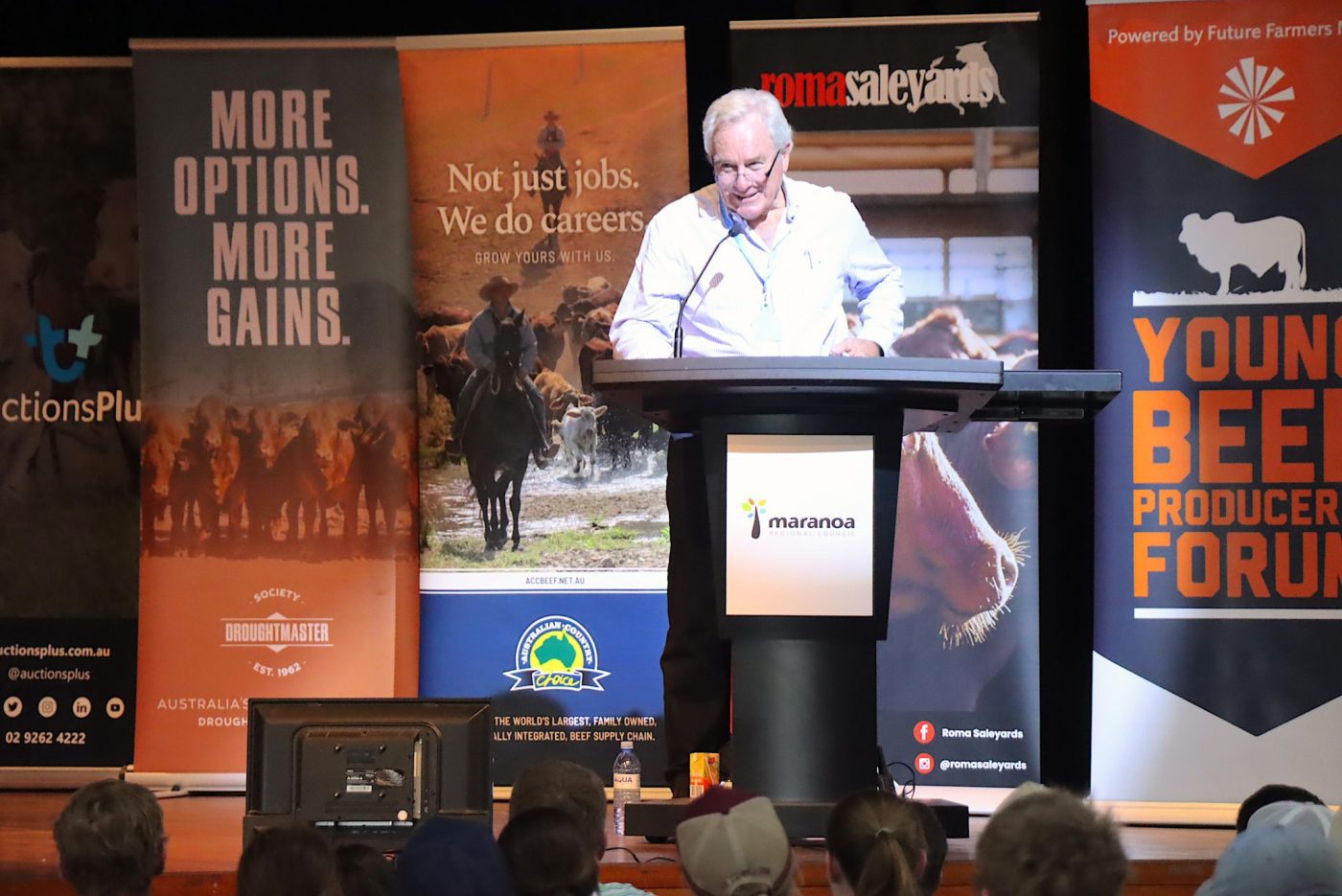
When it comes to selling Australian beef to the world, few have a track record like Richard Rains.
The former Sanger Australia managing director and partner helped to open some of the industry’s most valuable export markets, convinced McDonald’s in North America to put Aussie beef in its “All American” burgers, and backed the rise of what became one of the world’s largest organic meat businesses.
In 2012 he was recognised by the Export Council of Australia as an “Australian Export Hero”, joining a small and distinguished group of recipients, including The Wiggles and Gina Rinehart in the years immediately before and after his own induction.
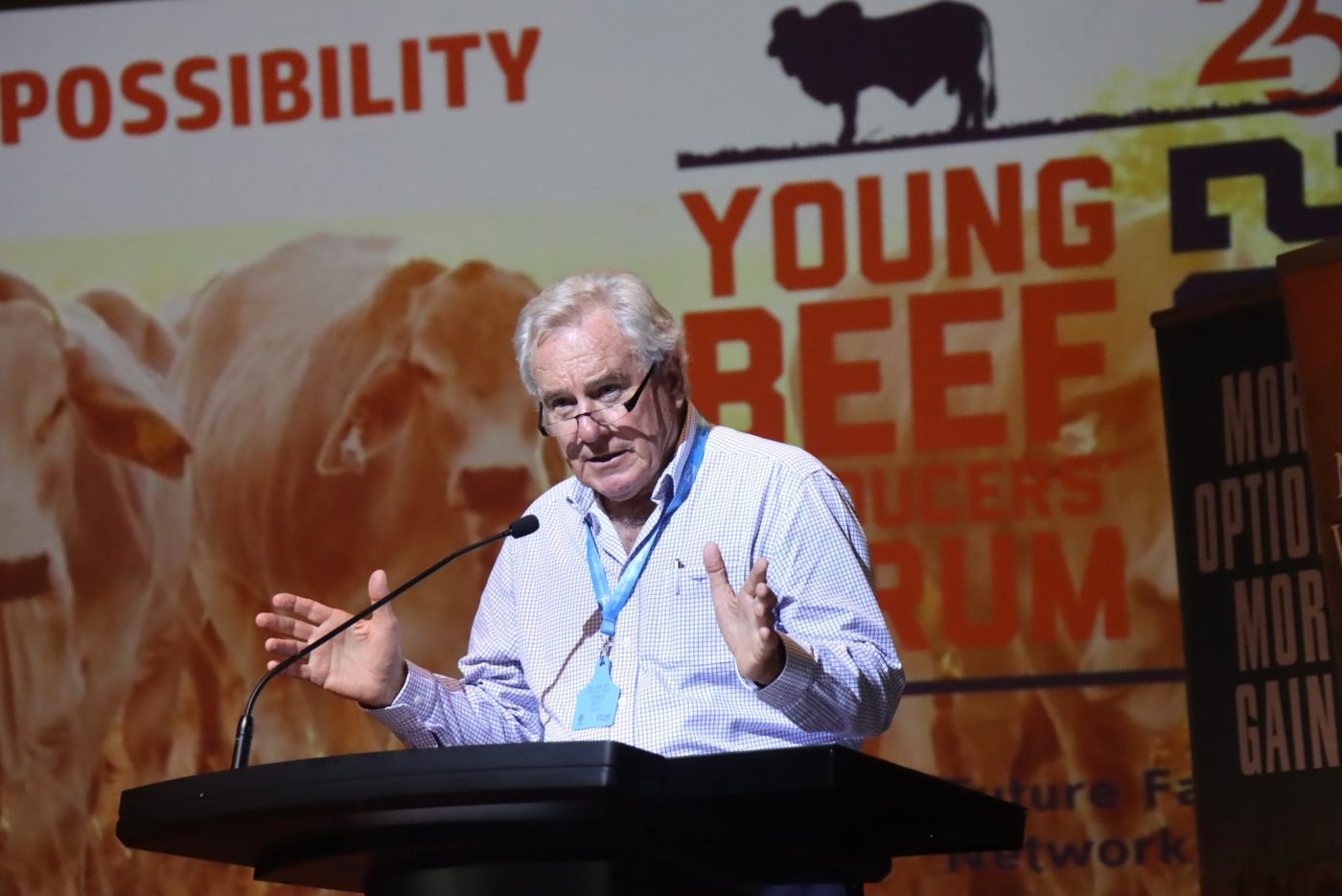
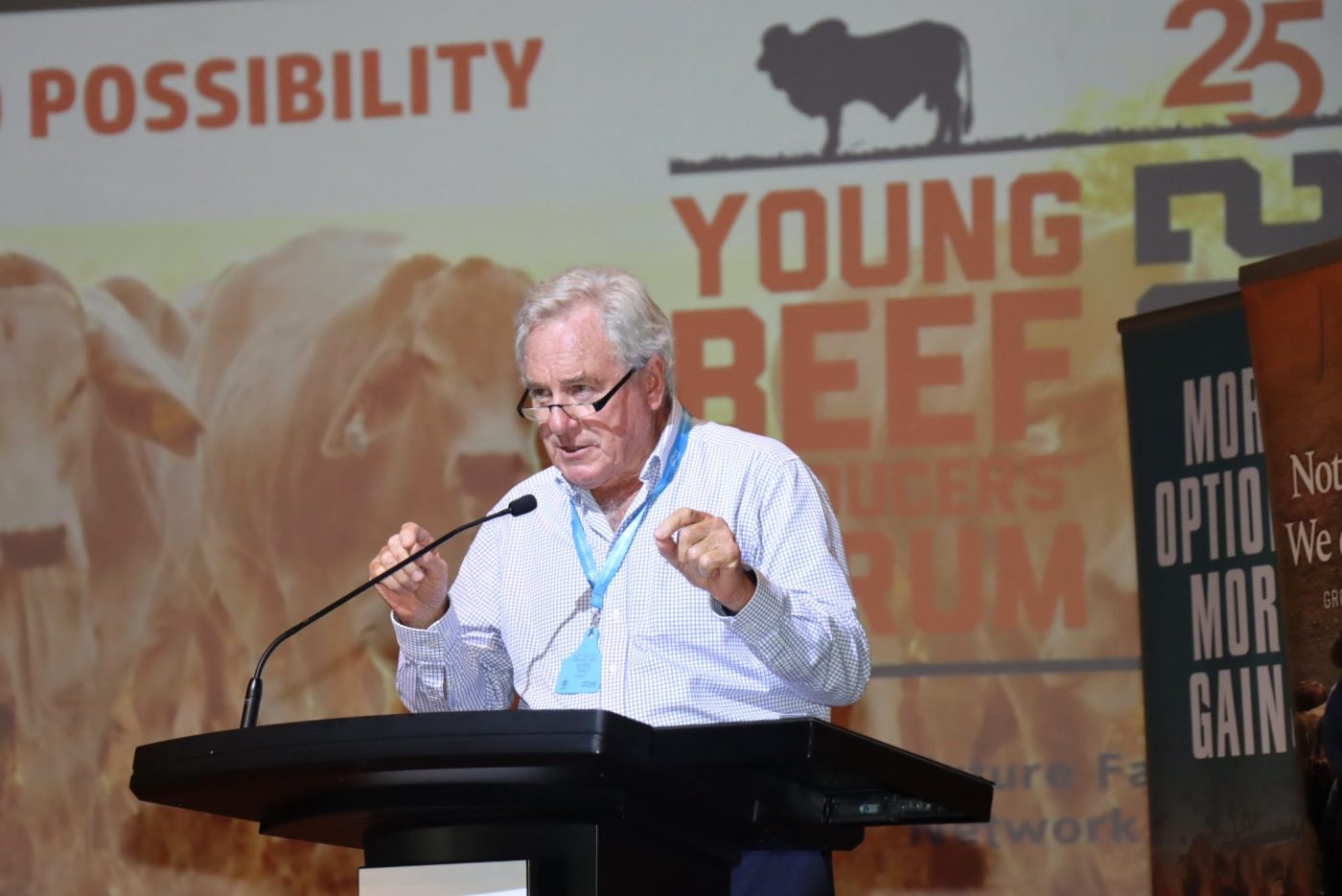
At Roma in western Queensland last week, the son of a mixed farming and grazing family from Dunedoo in NSW shared “a few gold nuggets” from his stellar 40 plus years in the trade with more than 250 young producers and industry professionals at the 2025 Young Beef Producers Forum.
Richard, who grew Sanger from a $50 million turnover business to $500m before selling his equity in a management buyout in 2013, told the room of future leaders in the Australian beef industry to remember they are in the food industry – “one of the safest industries you can be in” – but also one that can’t afford complacency.
Below are eight key takeaways from his Roma address.
1. Think outside the box
Growing up at Dunedoo Richard attended the small local primary school, joking that “I was dux and the other fellow came last”.
After boarding school in Sydney he planned to return home to the farm, but with times pretty tough in the bush, his dad suggested he stay in Sydney and try his luck there instead. “That came as a bit of a shock to me, but that was in the days when you didn’t question what the old man said.”
So he got hold of the Yellow Pages (and yes, he took time to explain to the Young Beef Producers Forum crowd last Thursday what the ‘Yellow Pages’ was!) and wrote to every company in Sydney he could find that had any relationship to agriculture.
 “I got one response that was from a company by the name of Dalgety, very similar to what Elders are today, a very diversified firm.”
They needed someone to cover for each of the people on their respective trading desks exporting grain, meat and sheep skins for when they were sick, on holidays or travelling.
Richard completed an 18 month traineeship, which included working in a sheepskin grading shed in Sydney. “Truckloads of skins would turn up. Sometimes they were dry, sometimes they weren’t. The ones that weren’t dry, you’d have to hang them over a wooden rack while they dried. And of course, all those wonderful things that were in the wet skins would shower down over you, which wasn’t very pleasant, but that’s just the way it was. I knew there was a carrot at the end of the rainbow.”
After also learning the ropes in grain grading sheds and at the Casino Abattoir and Homebush Abattoir (now the Olympic Stadium site in Sydney) he returned to Dalgety’s offices in Sydney.
He spent his first day on the sheep skin trading desk, and on his second day he moved onto the meat desk to help there. He never made it to the grain desk. “I didn’t ever leave the meat desk. I don’t know whether he was the busiest or whether that’s the desk where I felt more comfortable, but that’s where I landed.”
His first big break came as a 20-year-old cadet at Dalgety when he sold the first imported meat the Republic of Korea ever bought – a 500-tonne shipment of frozen bone-in quarters.
Korea paid via letters of credit, but the “kicker” was that the letter of credit would only pay 90 percent of the value of goods that was on the shipment, and the final 10 percent would only be paid after the goods arrived in Korea and passed inspection as being of sound quality and the correct quantity.
For many exporters, that level of risk was a deal breaker.
“A lot of my competitors said, ‘Well, hang on, that’s not for me. There’s a trap there, we’ll never get that 10 percent,’ so they decided to sell everything through us and let us take the risk,” he recalled.
What they didn’t know was that Richard had built that 10pc into his selling price to Korea.
“So even if I didn’t get paid, I still got my money,” he said. “And never once did I get stitched for $1 by the Koreans. They gave us that balance 10 percent every single time.
“So it was a very good lesson I think to think outside the box, work out how you can make this business work.
“And it was very nice business for us for a long, long time.”
2. When opportunity knocks, find a way to say yes
When Sanger’s global parent company collapsed in 1980, the Australian operation could easily have gone down with it. Instead, local boss John Cooper bought the Australian business from the liquidator, and invited a young Richard to take a stake.
“He very generously offered me the opportunity to buy some equity in the business, which I very gladly did, even though I didn’t have two coins to rub together,” Richard said.
“We lived on bread and dripping for a few years, but it was the greatest thing I could have ever done.”
That step turned him from an employee into an owner, changing his mindset and his appetite for responsibility.
“That was another great lesson for me, when you get opportunities like that, don’t let them go, just find a way to make it work.”
3. Honour your word
Sanger signed cornerstone deals to market the entire kill from the Bindaree meat processing company at Inverell and then from the Monbeef abattoir at Cooma.
“We did a gentlemen’s agreement with them to market their entire production, no questions asked, whatever they produced, we sold.
“So just those two plants gave us a fairly significant volume of meat, combined about 1700 cattle every day, five days a week, and to have to sell it all.
“You don’t have the luxury of sitting on your hands. There’s an old saying in the meat industry – sell it or smell it.”
Perhaps remarkably in today’s red-tape heavy business environment, there were no formal contracts, just handshakes.
“That was designed by me. I didn’t want a contract,” Richard said.
“What’s a contract for at the end of the day? For mine, it’s only about taking someone to court if you have a dispute.
“Well, I didn’t want to go to a court room, I’ve never been in one, I wouldn’t know what one looked like thankfully, and I’m pretty proud of that.
“And the other thing was, I figured that if I had a contract with these guys that we had to sell their entire production, my team could sit back and put their feet up and say, we don’t have to work too hard, we can coast and sell it as it goes, it’ll be all right.
“Whereas living by the seat of our pants and Bindaree and Monbeef having the option to say tomorrow, ‘you guys aren’t performing, we’re out of here’, we had to perform every day, and make sure that every kilo of meat that came out of those abattoirs was sold at the best possible price we could find, wherever it was in the world.
“And that is what we had to do and that is what we did, and I think we did an unbelievable job at it if I may say so myself.”
4. Volume creates its own advantages
With whole-of-plant agreements and exports to 30-40 countries, Sanger was able to build serious scale and leverage efficiencies which helped to create strong business advantages for both itself and its customers.
The large throughput enabled Sanger to secure better freight rates, lower insurance costs and banking fees and more competitive foreign exchange terms than individual plants would have been able to achieve on their own.
“I genuinely believe that we operated for those abattoirs for virtually no cost, our margin was probably equivalent to the savings that we achieved by having the volume that we had.
“So that was a great benefit to our business.
“Volume really mattered and we made sure we used that volume to create significant advantages for our business.”
5. Treat your banker like a business partner
As the size of the business grew, so too did the size of its financial exposure.
“We turned over a lot of money, therefore we needed a lot of money to be able to turn that money over,” Richard said.
“I treated my banks as my business partner, and I think that stood us in very good stead.
“Whatever I had, I had to put up as collateral at the bank to be able to borrow the amount of money that we did.
 “So as I was able to say to my bank, before you’ve lost one of your dollars, I’ve lost every single one of mine, and I’ve got no intention of losing one of mine.”
Any time there was even a hint of a bad debt, Richard said his first phone call – or telex, fax or email depending on the moment n time – was to the bank.
“After I retired from the business, my bankers told me that they thought that was just gold.
“They had every confidence that I knew where every dollar was in my in my business, and that I managed it, and so they were very confident that we were across the situation and we weren’t going to take unnecessary risk.”
Hand-in-hand with that was a willingness to spend heavily on insurance. Richard invested more than $300,000 a year in what he termed a “political risk policy” designed to protect the business if a disease like BSE or Foot and Mouth Disease or a Government decision suddenly shut export markets.
“We never had a single claim, thankfully,” he said.
“But that’s not the point. The fact was that I could sleep at night, my staff could sleep at night and so could those people at the abattoirs, because they knew their jobs were secure.”
6. Employ people who are smarter than you
Richard said he never made it to university, but did employ a lot of university graduates “because I was able to, and that was just a great benefit to my business”.
“Another little gold nugget I’d like to share with you – when you get the opportunity, employ people that are smarter than you.
“I know a lot of people out there who might say: ‘they might take my job or they’ll show me up’.
“Look, terrific if they take your job. I was the majority owner of the business, and eventually that’s what happened to me.
“Happy days, I was tickled pink that somebody was able to come along and take over my role and my company.
“I was able to retire in 2013 at the tender age of 58 and entered what I still believe is the best chapter of my life. To be able to come and do things like this and not worry about the team that I’m leaving behind is pretty special to me.
“Never be afraid to employ someone who is smarter than you, because they can only be better for your business.”
7. Relationships open doors that strategy alone never will
Nothing illustrates this point better than the McDonald’s North America story.
Sanger already supplied McDonald’s Australia and other US burger chains with Australian beef, but McDonald’s home market was seen as untouchable.
“I determined that there had to be an opportunity to get meat into them.
“But all my colleagues said ‘you’re wasting your time, their marketing slogan is the All American burger’. What makes you think they’ll put Aussie beef in that?’ I said, well, you just give me a chance.”
He built a relationship with a senior buyer at US burger patty manufacturer Keystone Foods, a major supplier of burger patties to McDonald’s North America, meeting him regularly in Philadelphia and Brisbane (Keystone Foods then also owned the meat processing plant at Coominya which is a principal supplier of beef patties to McDonald’s Australia).
A turning point came when Richard invited him to play a round of golf during a trip to Sydney.
“Of course he won,” Richard said, adding that they went on to the “nineteenth hole” and bonded further over a few beers (he pointed out that they’re still “joined at the hip” and great mates today).
“As we were leaving, he said, ‘Now Rains, what is it you want to do again?’”
Richard’s answer was simple: he wanted to sell Australian beef into McDonald’s North America.
At the buyer’s next meeting with McDonald’s founder Ray Kroc in Chicago, he pitched the idea.
What followed was a long and nerve-wracking series of “samples”- not simply a few cartons as might normally serve but, given McDonald’s huge size, 30 containers at first, then 50 containers – before the green light finally came.
“I don’t know how many thousands of containers we sent to McDonald’s North America after that,” Richards said.
“But it was just the most amazing trade. It just worked so well for everybody and the rest is history. I think we probably changed the Australian beef industry to some extent.”
His takeaway for the Roma audience was this: “That all came about because of a relationship. “I connected with a fellow who believed in me and gave me that opportunity. I can’t stress enough the importance of relationships.”
8. Stand out, don’t be greedy – and never burn a bridge
Among the numerous gold nuggets Richard shared were several focused on proven business strategies.
One was the value that can be achieved from differentiating your product in the market place.
“I think it’s important to stand out from the crowd. I found that we could get a premium for a product that had a tag on it, be it organic, be it natural, be it HGP free, be it Angus, be it Wagyu, be it grassfed.
“If you could put a tag on it you found a slightly different customer who was prepared to pay a slight premium for that product, and that made all the difference to us in those days. “
“And I encourage you to think about that -. What can you do to make your product more appealing to your customer?
“Don’t do the same as everybody else. Step out of the lane a little bit and do something a little bit differently. It’s certainly worked well for us, and I think it can for you as well.”
More simple rules he offered included:
- Never burn a bridge. “You might need to walk back over it one day. Take one on the chin if you have to, but just be careful what you leave behind.”
- Be ruthless about getting paid on time. If an invoice was due and the money wasn’t there, Richard said he was always very hard on getting paid on time. “If I had an invoice that was due for being paid the day and the money wasn’t already in my account, I’d be up that customer’s ribs to make sure that I got paid on time. And not everybody appreciated it, but bad luck. I’d say ‘if you if you don’t want to get me off side, pay your bill on time’. I think what that did was if a customer was going to late-pay somebody, they late paid somebody else, not me.”
- Don’t be greedy. “Always leave something in the deal for the next person, because you want them in a position where they can pay you and that you haven’t bled them dry.”
“You’re in the food business – people have to eat”
Richard reminded the forum that despite shocks like the Global Financial Crisis and COVID, demand for food, especially safe, high-quality protein, doesn’t go away.
“When the GFC hit, I thought ‘oh no, my business is cooked’. No one’s going to have any money, no one will be able to afford the product.
“But my business didn’t blink. There was not a blip on the radar of any nature.
“What I realised was people had to eat. It didn’t matter what they had in their pocket.
“What changed was people didn’t have to eat in a white table cloth restaurant.
A lot of people moved on to a family restaurant.
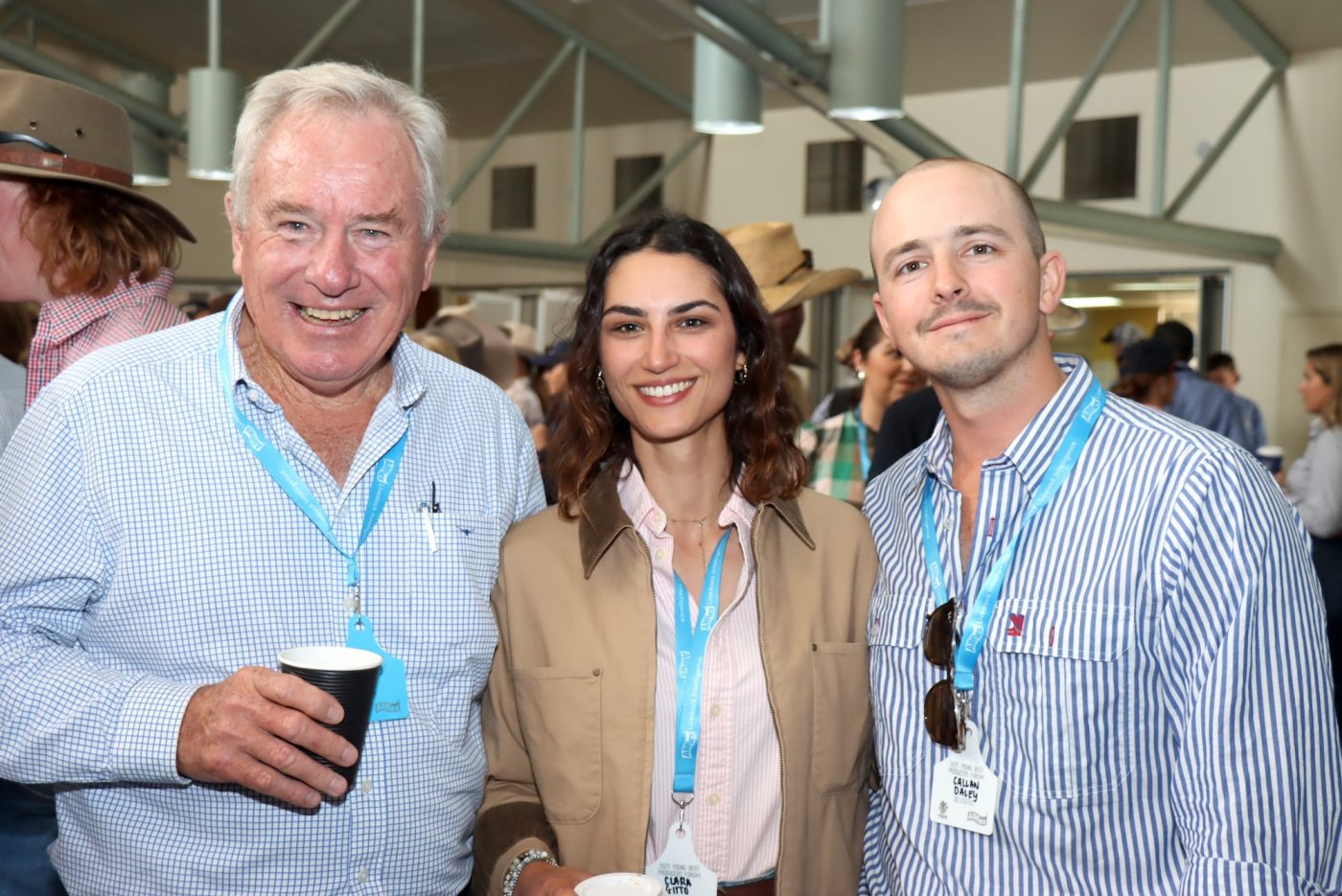
Richard Rains caught up with Clara Gitto and Callan Daley, Daley Cattle, Injune at the YBPF in Roma.
“But in particular, during that period, and the same with covid, people ate at home instead of going out, and so they could save an absolute fortune.
“And when they ate at home, they probably ate a bigger steak than what they did when they were in the restaurant.
“I think it’s a very good lesson to remember that you’re in the food business.
“You might think you’re in the meat business, you’re really in the food business, and people have to eat every day. So I think you’re in the safest in one of the safest industries that you can possibly be in.”
Now retired, Richard devotes much of his time to mentoring, including through programs such as the Graeme Acton Mentoring Program, Advancing Beef Leaders and more recently through the Zanda McDonald Award, which he formerly chaired.
“Retirement is absolutely the best chapter of my life. I love helping young people.
“I got a lot of help along the way in my career.
“If I had a problem, I’d find out who might have the answer, and I’d get them on the phone and find out, did you have this problem? How did you solve it? What did you do? How did you go about it?
“And I think it saved me a lot of grief, a lot of time, a lot of angst, and I would really encourage you to do the same. Find somebody in your situation who has had the same problem, and find out how they handled it.”
He also encouraged the 250 or so young members of the crowd in Roma to consider what they would like to achieve.
“And think about this: what would you have to achieve in your career for an award to be established in your honour by the time you’re 41 (Zanda McDonald’s age when he died in 2013)?
“There’s opportunity out there. Let’s have a go.”