

Richard Koch, Elders
Elders analyst Richard Koch provides this regional cattle market summary following an Elders regional livestock managers’ hook-up each Monday…
WIDESPREAD rainfall of 150-250mm through northern, central and southern Australia has shifted livestock market sentiment over the past three weeks.
Two or three separate rain influences across broad areas has turned the season into a bird for many of those across the northern and central third of Australia and, with more rain in the forecast, many will shut the gate until after Easter.
Live exports
The northern live export industry is basically at a standstill with only the odd ship moving, filled mostly with company-owned cattle out of holding facilities.
Thoughts are that prices would need to move about 30c/kg (all price reference in liveweight, unless otherwise stated) lower to generate import interest. However, it’s largely academic with the risk of sourcing cattle to fill ships too great.
Vessels that were moved across to Townsville are now anchored, with cattle too expensive and too difficult to move at present.
The possibility of another tropical low or cyclone off Townsville has seen exporters put the cue in the rack for now. Darwin feeders back 20c/kg to a nominal $4.50c/kg, while live exporters are trying to fill boats ex Townsville at $4.20c/kg for Indo feeder steers and $3.80/kg for heifers, down around 20c/kg from last week – but these are speculative offers and are unlikely to attract much interest.
Central Queensland
In a rare phenomenon, feeder cattle out of Central Queensland are trading at a premium to southern QLD this week due to weather challenges, at around $5/kg for feeders delivered Moura.
Southern Queensland feedlots are doing most of their buying out of the south at present. With conditions tightening through southern QLD and northern and central NSW (north of Dubbo and Scone) there are ready supplies of available cattle.
There are still some opportunities on heifer feeders in QLD which are still good buying at $4-4.20/kg. It would be reasonable to expect that as southern heifer supplies tighten into Easter, they might find some buying interest as both restocker and feeders compete, narrowing the discount versus steers.
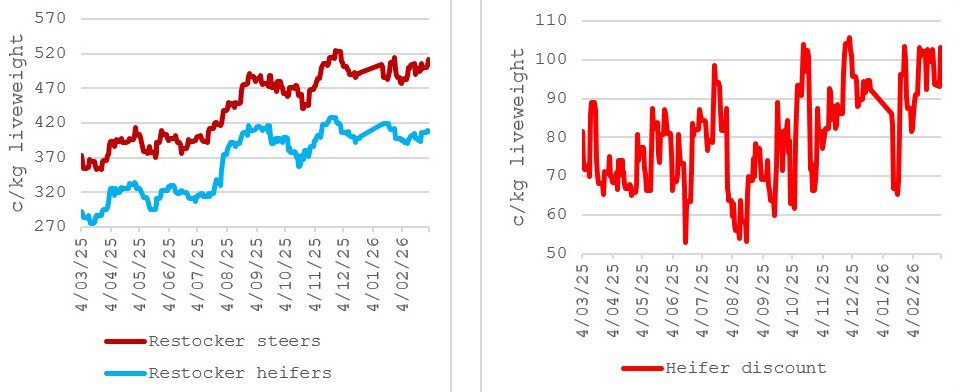
Data source: MLA
These charts show the national saleyard indicator for restocker steers and heifers and the discount between steer and heifer prices over the past year.
Record yardings of cattle were seen at Scone and Gunnedah this week, with heavy yardings also at Inverell, Tamworth and Roma (7500 head), with plenty of cows offered – highlighting the seasonal difference between these areas and those in the north.
NSW
Feeders through NSW are $4.80-$5/kg this week with a tight premium of only 10c/kg for Angus and EU cattle. Plenty of cattle are starting to move out of the New England north.
Lotfeeders seemed to be managing the possibility of Chinese import restrictions by shifting away from midfed programs to shortfed, which is supporting crossbred feeder prices.
 From 75-175mm of rain across the central tablelands and southern slopes on back of an early break mid-February has that region off to its best autumn since 2020. Similarly good widespread rain through southern NSW promises to dramatically improve sentiment across these markets.
With the rain across the south, as the season moves into autumn, supplies of southern Angus feeder steers will start tightening and widen the premium back out towards 50c/kg – about where it got to last winter.
Prime cattle prices are gently firming with international beef prices holding, despite returns being knocked around by the stronger $A. Bullocks $4.60c/kg and cows $3.70-4/kg with the rain expected to take a few cattle out of kill schedules in the lead-up to Easter.
SA, southern NSW
The big change though is in store markets across the south. February rain across western South Australia was the best since 1938 and extended right through the centre to north of Broken Hill and has filled in areas that were very dry through Pooncarie and Mildura and across to southwest NSW.
The impact was most apparent in the light cattle market with one buyer active at Naracoorte (SA) buying up well-bred light heifers anything sub 240kg. On one lot around 190kg they paid $1200/head which works out at $6.30/kg lw. These cattle will head west of Alice Springs for the autumn and winter.
Mountain calf sales, VIC
Continual rain and a shoulder-to-shoulder crowd saw a lift in sentiment convert to excellent results for vendors at the first Mountain Calf Sales this week.
Most of Victoria has received at least 50mm and up to 100mm for those under storms this week. The feature runs of calves went to returning buyers with feeders making above 500c/kg, while weaners made 500-550c/kg.
Lighter calves made $1500-$1900/head, 200kg calves made $1200-$1300/head or around 600c/kg lw. This compares favourably to last year when Hereford steers mostly sold between 420-460c/kg at Ensay. These results were welcome after very tough season and very poor Spring to the end of October. Rain in November got the cattle through and with up to 60-70mm recently, things are starting to look better.
Tasmania
Rainfall of 10mm last week plus more of the same in the forecast for this week has stabilised the Tassie market. Cattle prices have rebounded with the rain with heavy steers back up to 480-510c/kg lw.
Best rises have been in steers 300-350kg 520-540c/kg, with the lighter end sub-300kg 550-580c, up 20-30c/kg for the week.
Heifers are flatlining on the heavy end 400-420c/kg with the lighter end expected to find another 20-30c quickly to 420-460c, on the well-bred types this week.
The lift in market sentiment is timely with the calf sales getting underway across Tasmania this week.
Dry areas remain
The key message is that the net effect of the widespread rain will be to help keep markets through Southern and southeastern parts of Qld and northern NSW in a holding pattern – they are all quite dry and still offering large numbers.
But there are increasing numbers of restockers from areas that have received some rain willing to take these cattle. Elders agents as far away as Western Australia were fielding calls from buyers in Jamestown in SA looking for cattle to restock.
WA
While on WA, although northern pastoral areas have received rain, it has been very dry in the Pilbara, Gascoyne and mid-west with an early muster on the cards and cattle likely to be moved out of the region on agistment. Further north, Broome is still out of action with a stark contrast in conditions compared to pastoral regions further south.
The recent rain has dramatically altered market sentiment turning major livestock areas from being under significant seasonal duress to pondering if they have now had the best start to a season ever.
As mentioned, there remains significant areas across Southern QLD/Northern NSW that are tight, but if these areas get good rain as forecast in the next week, cattle could get expensive in the run up to Easter.
Southern feeder type cattle will be tight now right through until Spring but there will be an avalanche of Queensland feeders in May when it dries out and producers in the NT/Queensland pastoral regions start looking for a cheque to pay some bills. Many haven’t been able to sell cattle since late last year.