
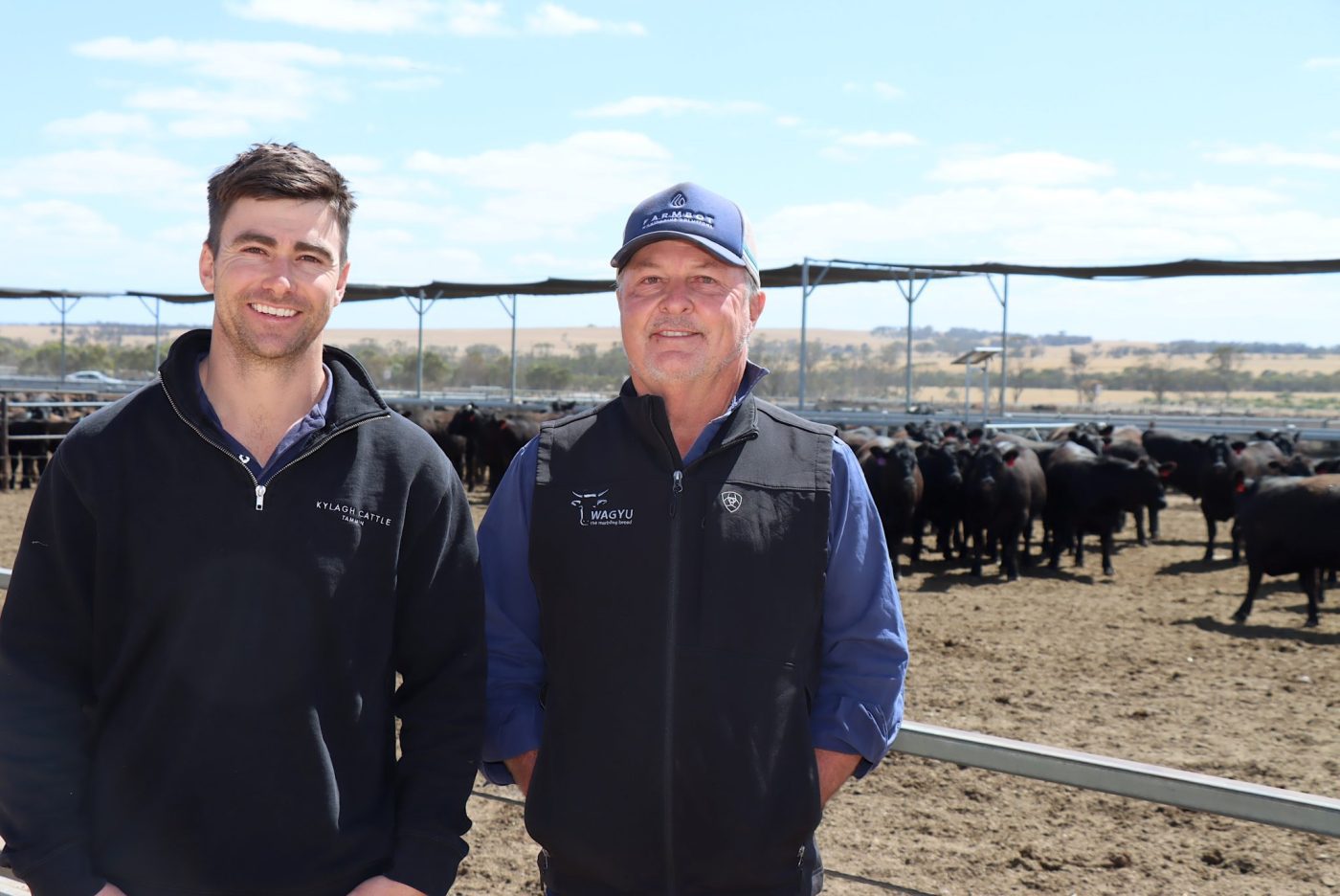
Nick and Ivan Rogers at Kylagh Feedlot, which is part of a diversified cattle breeding, feeding and grain growing operation.
This is the first of two profiles on lotfeeders in Western Australia, who are working to smooth out fluctuations in occupancy rates through the development of export markets and brand programs. The next article will be on Quartermain family from Ucarty.
IF YOU take the two-hour drive from Perth to Kylagh feedlot, you will pass paddock after paddock of dryland wheat and barley and it is easy to see why you would build a feedlot here.
But the challenge for feedlot operators in WA’s wheatbelt is not what you can see, it is the parts that are hard to see.
Cattle are not a huge presence in paddocks surrounding Kylagh and you can count the number of local processors on one hand.
With most yards traditionally hosting short fed programs for domestic supermarkets and cattle supply being based off an almost exclusively autumn calving herd, keeping feedlots pens full has been a challenge over the years.
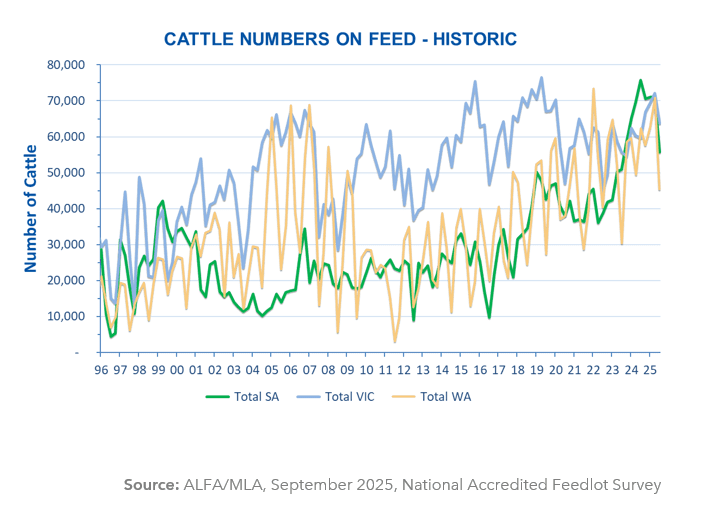
The National Feedlot Survey shows the big fluctuations in feedlot occupancy in WA over the years, an issue that is not as acute in other states. Click to enlarge
But over the past 10 years a coordinated effort between the production and processing sectors has been working to develop new markets and put strategies in place smooth out the fluctuations.
Kylagh Feedlot owner and former WA Lot Feeders’ Association president Ivan Rogers is one part of this effort. Along with his wife Jill and sons Nick and Alex, Ivan is navigating the changing industry by combining the benefits of being a generational family business with corporate disciplines.
The feedlot is run as part of a diversified company split into four businesses (breeding, cattle trading, cropping and lotfeeding) which all need to make profit on their own accord. Kylagh feedlot runs as a custom feeding yard, with the Rogers family’s trading company being the main customer, along with other clients.
They have also struck a deal to source cottonseed from the new cotton gin in the Kimerley.
Relationships key to success
Perth and the wheatbelt is one of the most isolated populations on the planet, with grain supply, cattle supply and processors concentrated in one part of the state.
Most of the cattle produced north of the wheatbelt go exclusively to live export and cattle for grainfed programs are sourced from areas to the south. The concentration of suppliers and customers means strong relationships are essential.
“Our main focus day-to-day is production, with our farming it’s canola, wheat and barley. Our breeding, it is Angus and Wagyu and again a big focus on production. With the feedlot it is cost of gain and production – but to have all of that you need good customer relations,” Ivan Rogers said.
“It is not always about looking for the cheapest, it is also about a whole value package, which is just as much about reliability and loyalty.”
While the strategies are in place and the ambitions are there, Mr Rogers is also honest about the limitations of the family business.
“CRM (customer relationship management) is just such a catchphrase in so many businesses and this business is the same. On a good day we are 7/10 and on a bad day we don’t even pass because we are so busy, but it is the ambitions that are important,” he said.
Longer-fed programs helping smooth fluctuations
Kylagh has had a long-term relationship with Coles, along with local processors who are now helping diversify the feeding programs.
Mr Rogers said processors had recently stepped up their development of brand programs, which given the opportunity to feed cattle for longer periods.
“If you look at things like the 100-day program, WA has been a bit late to the party. But it starting to grow strongly now and we are seeing that pull through to the production side.
“We have seen some pretty big investments into processing and that is going to be the big driver. If you look at the east coast, it was brands and processors that drove the development of the feedlot sector. We are pretty positive about that side of it over here.
“There has to be a purpose for running a feedlot, it is a value adding business. You cannot do it as a drought feeding operation or a reactive program because occupancy is everything. We are always aiming for 80pc occupancy and we normally exceed that.”
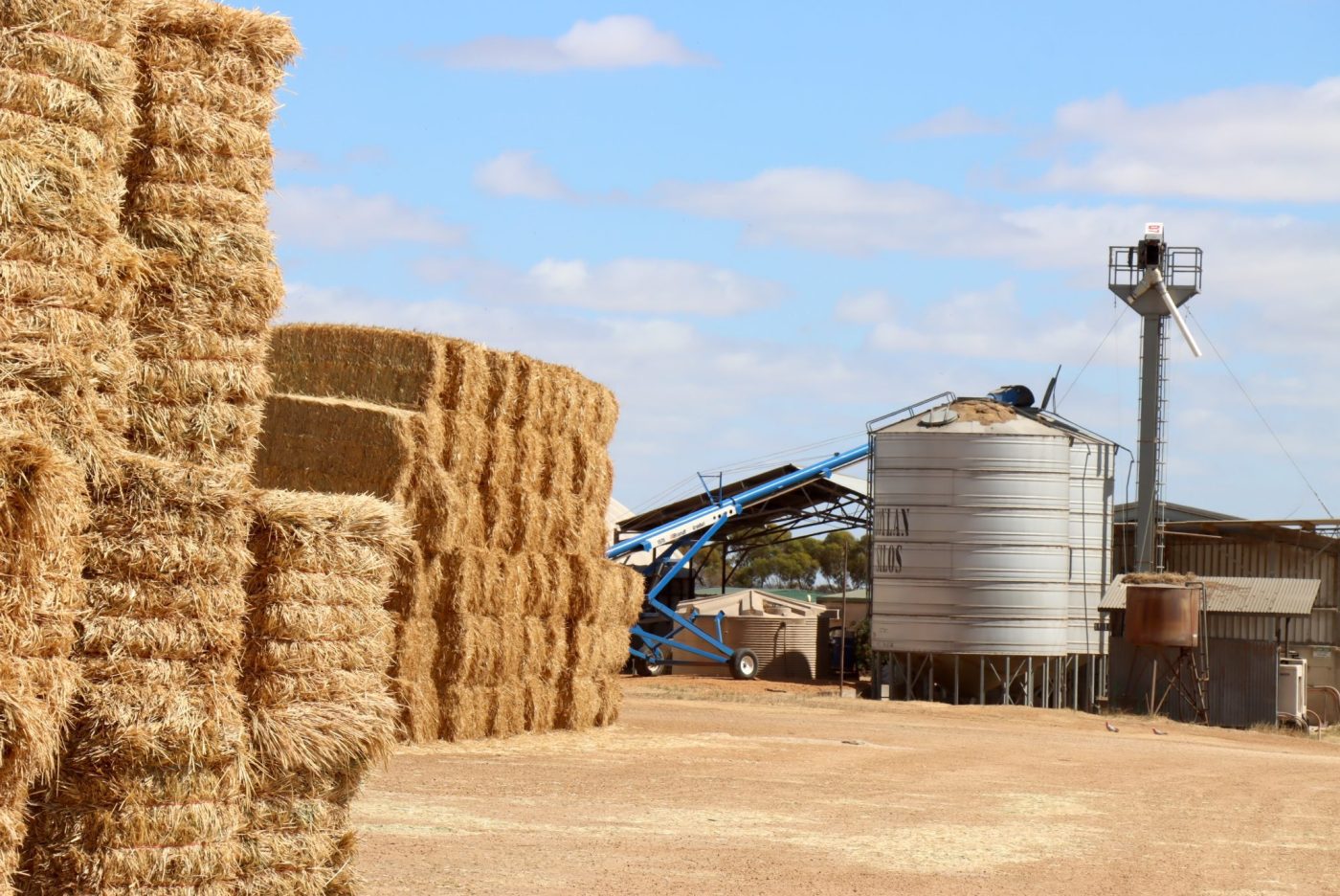 One of the big challenges to keeping up the occupancy rate is the autumn calving herd of Southern WA.
“That is a bit hard to manage and this is why some of the long-fed programs are becoming a bit more attractive, because the turnover is so much less,” Mr Rogers said.
“But it is different approaches for different businesses, ours is very much based on working closely with our suppliers and understanding when they are going to have cattle ready.”
Most of Kylagh Feedlot’s supply comes from the south-west corner of the state where the Rogers family also has its own breeding operations. It sources cattle from 20-30 rusted on suppliers.
“We don’t buy any cattle from the saleyards and we don’t socialise too far. We are not big enough to publish a price and take any cattle that come our way,” Mr Rogers said.
“On our breeding side, we have a collaborative program where we can work with other suppliers to share genetics through straws for AI programs.”
Give and take relationship with local grain growers
Grain supply is one of the most reliable parts of lotfeeding on the wheatbelt. While sheep are still a large part of the local agricultural industry, there has been a generational shift towards growing grain exclusively, with some properties even tearing fences down.
“Dryland cropping has been so successful in this area,” Mr Rogers said.
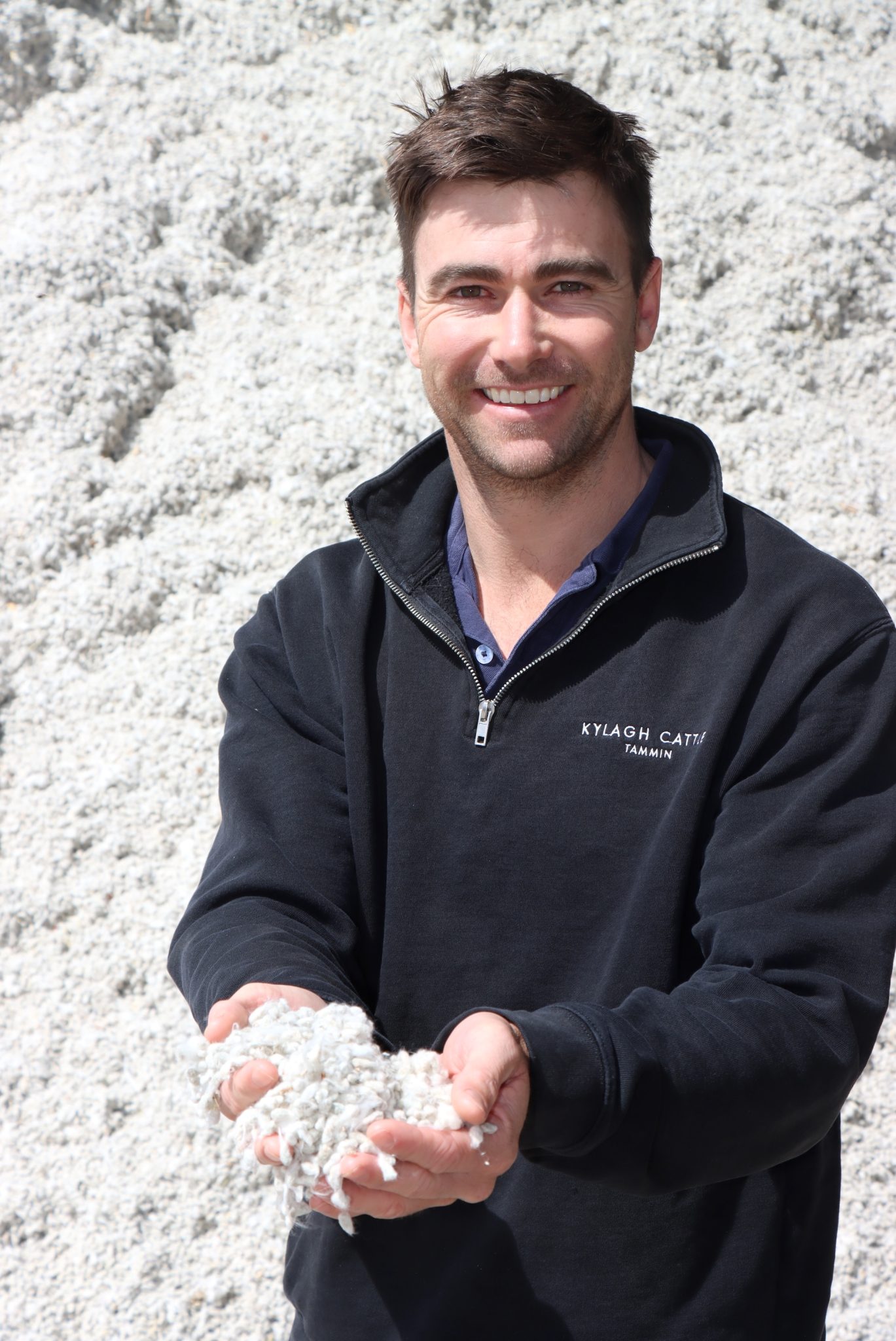
Nick Rogers with Kylagh Cattle’s new supply of cottonseed.
Alongside its own grain operations, the Rogers family has a close relationship with a group of grain growers on the Wheatbelt who supply the feedlot year-in year-out.
Mr Rogers said they were relationships that needed active management across the year and were based on each party being able to compensate for each other’s needs.
“Last year they supported us really well when the grain prices were relatively high. This year with prices being a bit depressed, we are offering them a very strong premium to keep that relationship going,” Mr Rogers said.
“We are never challenged by grain supply. There is 30m tonnes going out of the Wheatbelt this year because it is huge here.”
New relationships starting with cotton growers
Unlike the eastern states, cottonseed is not a regular part of feedlot rations in WA, with the area being too far away from cotton growing areas in NSW and Qld – where lotfeeders and producers already compete hard for the product.
But a new and growing cotton industry in the Kimberley region of WA has provided an opportunity for the Rogers to tap into the valuable source of energy and fibre that cottonseed provides.
They recently entered into a supply contract to bring cottonseed down from the Kimberley, which is still roughly 3000km away.
The deal has created some logistical challenges, with the intense wet seasons and a lack of infrastructure in the Kimberley making it difficult to store in the local area.
As a result, the Rogers family has had to transport a year’s supply of cottonseed down to Kylagh – with the product now taking up a big percentage of the commodities shed.