
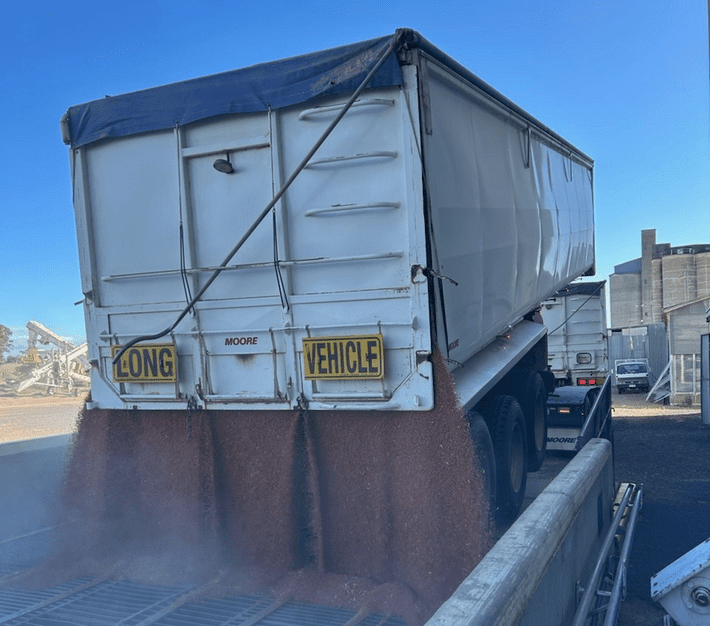
The first load of sorghum into GrainCorp for the 2026 harvest tipped at Millmerran last week. Photo: GrainCorp
PRICES for feed wheat and barley and sorghum have softened over the Christmas-New Year break, with growers showing little willingness to engage at current levels.
A big wheat and barley crop in Victoria has put pressure on southern markets, where consumers are comfortable with current coverage, and export demand for low-protein wheat is negligible.
The past week has seen extreme heat and fires to parts of Victoria, early new-crop sorghum from southern Queensland and northern New South Wales, and flooding in the Clermont district of Central Queensland.
For places that got it, the CQ rain will brighten prospects for soon-to-be-planted sorghum, and will also build the subsoil-moisture profile for wheat to be planted in autumn.
| Dec 11 | Today | |
| Downs barley | $320 | $315 |
| Downs SFW | $330 | $326 |
| Downs sorghum | $345 | $336 |
| Mel barley | $330 | $328 |
| Mel ASW | $365 | $347 |
Table 1: Indicative prices in Australian dollars per tonne.
Northern sorghum harvest starts
New-crop sorghum is filtering into container-packing sites and bulk storages now that harvest has started in parts of southern Qld, and in pockets of far northern NSW.
Early planted crops appear to be yielding well, but later crops that have suffered from moisture stress in recent weeks could well yield below average.
Sorghum is yet to appear on Qld shipping stems, but traders report some is being accumulated for bulk exports, and container business has also been written.
Recent strengthening of the Australian dollar has reduced the competitiveness of Australian sorghum, and wheat and barley too, when compared to other origins.
Ex-Tropical Cyclone Koji brought flooding rain to parts of CQ early this week, with Clermont receiving 246mm in the week to 9am today.
Other CQ registrations include: Emerald 136mm; Rolleston 114mm; Springsure 109mm; Winvic 201mm.
However, other CQ locations including Banana, Baralaba, Capella, and Monto received no rain.
CQ sorghum is normally planted from late January to late February and, notwithstanding flood damage in some paddocks, the rain is ideal for sorghum and mungbeans as summer crops, or for wheat and chickpeas as winter crops.
In the cash market, grower selling of cereals is thin, with chickpeas the stored commodity of choice to backload with fertiliser ahead of winter-crop planting in southern Qld and northern NSW.
“Growers are not selling wheat and barley, and the consumer is just starting to punch the price up,” one trader said.
On cottonseed, Woodside Commodities managing director Hamish Steele-Park said current-crop cottonseed continues to be hard to buy to reflect limited stocks.
Australia’s new-crop cotton is penciled in for 4.5 million bales, down around 10 percent from the crop picked this year, to reflect lower lint values and limited water availability from the Macquarie Valley south.
New-crop cottonseed values are sitting at around $460/t ex Gwydir Valley gin, $450/t ex Namoi Valley, $460/t ex Macquarie Valley, and $500/t ex Riverina gin.
“New-crop values are not export competitive at current levels, with US seed cheaper on a cost and freight basis,” Mr Steele-Park said.
“Our smaller crop will mean less needs to be exported in 2026, and any demand for new crop is all domestic as it stands.”
Barley moving in south
Feed barley is meeting solid export demand in the southern market, and is being sold in reasonable volume by those looking for a cash sell now that canola has mostly been sold.
Since Grain Central’s last Feedgrain Focus of 2025 published December 11, the quoted Melbourne ASW market has fallen $18/t, compared with a drop of only $2/t over the same period for feed barley.
“Red wheat seems to be everywhere,” one trader said of the Vic market.
Coming mostly from Vic’s Western District, it is in demand from local feedmills and dairies, but is attracting zero export demand.
“It’s WA that’s exporting the feed wheat.
“ASW on the east coast has come under harvest pressure.”
China and Saudi Arabia are buyers of bulk southern feed barley, and the export market has been active on Hard-type wheat of 11.5-12 percent protein.
Growers in southern NSW, where yields were generally below average, are expected to push some wheat or barley into the Geelong port zone as they look to backload with urea ahead of winter-crop planting.
The late harvest has meant a late holiday for many southern farming families.
“I think everyone is on the beach,” the trader said of the general quiet in the market typical at this time of year.
The exceptions are those who are dealing with the aftermath of fires in central, northern and western Vic in the past week.