
142nd Edition: November 2025
Key Points:
- Indonesia’s beef herd has collapsed by a third since 2022, reinforcing demand for Australian live cattle.
- Feeder prices in northern Australia surged to $4.50/kg, the fastest rise in years.
- Vietnam and Philippines steady, but typhoon season is causing disruption.
Regional Trends and Overview
Regional Price Graph
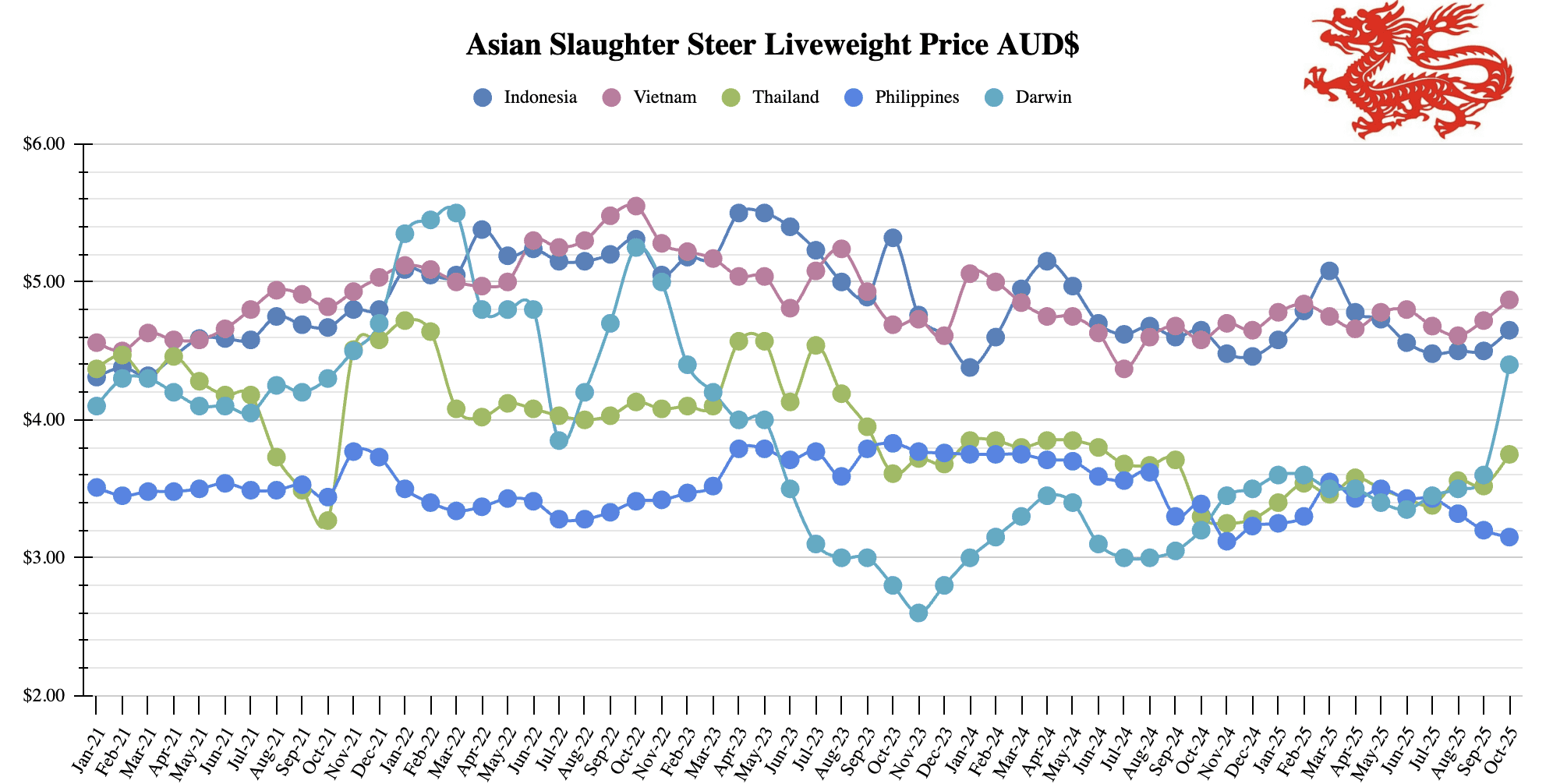
Indonesia: Slaughter Steers $4.65 AUD per kg live weight (IDR 10,900 = $1 AUD)

Dr Michael Patching
Prices
Prices in Indonesia continue to climb. In Lampung, slaughter bulls and steers are now trading at IDR 50,750 per kilogram, or around $4.62 AUD. Java remains more expensive, with prices up to IDR 52,000 ($4.85 AUD), reflecting the usual premium for central markets with stronger demand.
Retail prices tell the same story. Wet market beef is holding at IDR 135,000 per kilogram ($11.82 AUD), and supermarket cuts like beef knuckle are pushing IDR 179,500 ($15.09 AUD). Meanwhile, chicken remains far cheaper at around IDR 36,900 ($3.40 AUD), which helps explain why poultry is still the default protein for most households.
There’s every reason to expect this upward pressure on beef to continue. Australian cattle prices are running hot, and Indonesia’s market will have to adjust accordingly. If buyers want to secure volume, particularly for wet market supply, they’ll have to meet the rising cost of imports. That price pressure is now showing up across the chain.
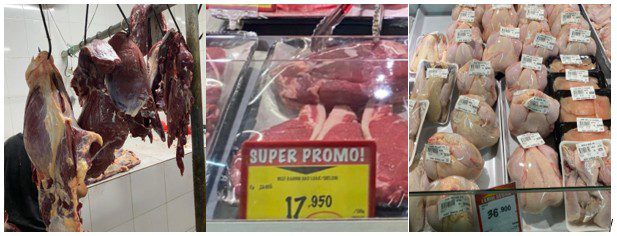
Photos: Local meat and livestock sales in Indonesia
Herd Collapse Reinforces Our Australian live cattle’s role in Indonesian Wet Markets
I’ve been watching Indonesia’s cattle numbers for a long time now, and while I always take the headline figures with a grain of salt, the trend this year is hard to ignore. According to the Ministry of Agriculture, the national beef herd has dropped to 11.75 million head in 2024, down from 17.6 million just two years ago. Even allowing for the usual caveats about data reliability, that’s a collapse of around 6 million head, or a third of the herd.
We all know counting cattle across 17,000 islands is a logistical nightmare, and I don’t put too much faith in the absolute numbers. But the methodology has stayed largely the same over the years, so when we see this kind of shift, it tells us something real has happened. In this case, I think it’s clear that LSD and FMD have decimated the herd, not just in terms of direct mortality, but through distress selling, movement restrictions, and farmers pulling back from restocking.
This has big implications for Australian exporters. Indonesia doesn’t have a beef export industry to speak of. Every local animal goes into domestic consumption, mostly hot meat sold through wet markets. That’s exactly where our live cattle end up too. So if these herd numbers are even close to right it only reinforces just how central Australian live exports remain to Indonesia’s beef supply. I don’t expect Jakarta to say that out loud, but the numbers tell their own story.
Vietnam: Slaughter Steers $4.87 AUD per kg live weight (VND 17,147 = $1 AUD)
Vietnam’s Small Abattoirs Face Regulatory Squeeze
Regulatory pressure is building on small-scale abattoirs in Vietnam, particularly those operating in or near urban areas. In Hà Nội, officials have announced plans to shut all unlicensed and unhygienic slaughterhouses by 2030. This threatens many facilities currently processing cattle, including Australian cattle, which are low in sophistication and often struggle to meet anything above basic hygiene requirements.
These abattoirs are typically uninsulated sheds with concrete floors. Many are not fully enclosed and lack waste treatment systems. Blood and wastewater are often hosed into open drains or nearby paddocks. While this is common practice across the region, it is becoming harder to ignore as national standards and ambitions catch up.
The challenge is that many of these facilities are located close to wet markets and customer bases. Pushing them out of urban centres adds transport costs, increases logistical complexity and breaks the link between slaughter and same-day meat distribution, a key feature of the wet market trade. For operators on thin margins, these changes threaten the viability of the entire model. For Australian exporters, this could create friction in the short term, particularly if it reduces slaughter capacity for imported cattle but may also lead to longer-term improvements in processing standards and cold chain reliability.
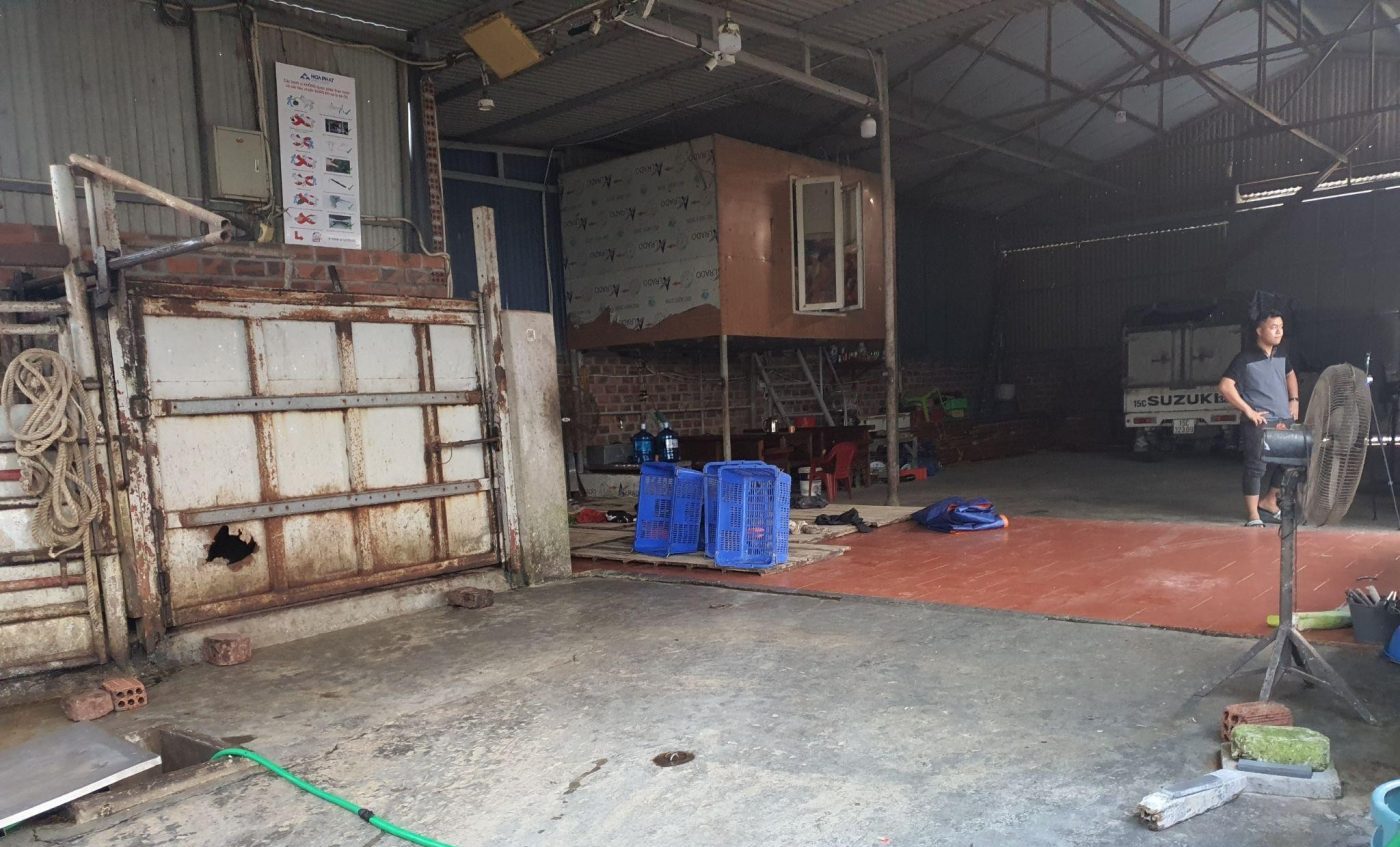
Picture: Abattoir in Haiphong showing construction styles and materials typical of many facilities that process Australian live cattle.
Philippines: Slaughter Steers $3.15 AUD per kg Live weight (₱39 = $1 AUD)
Prices
Livestock prices in the Philippines remain broadly stable. Wet market beef is unchanged at ₱380/kg ($9.82 AUD), with supermarket prices steady at ₱415/kg ($10.72 AUD). Slaughter steer prices have eased slightly to ₱122/kg ($3.15 AUD), though pork carcass remains firm at ₱240/kg ($6.20 AUD).
Poultry is also holding its ground. Supermarket broilers are up a touch to ₱165/kg ($4.26 AUD), while branded product like Magnolia is still at ₱185/kg ($4.78 AUD). All up, the market looks well-balanced, with enough supply to meet steady consumer demand. No real signals of pressure or shift yet.
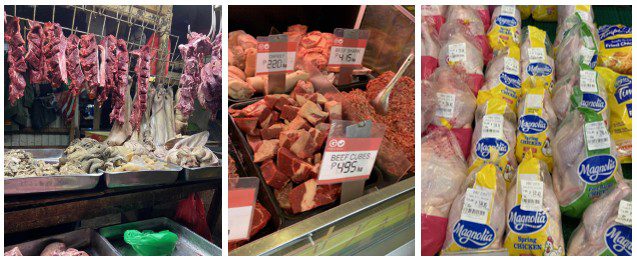
Photos: Local meat and livestock sales in Mindanao.
New Livestock Law to Transform Philippine Animal Protein Industry
The Philippines has passed Republic Act 12308, a livestock reform law backed by a budget of USD 3.45 billion over ten years. It aims to modernise the livestock, poultry and dairy sectors by upgrading the Bureau of Animal Industry and launching a new fund to support herd rebuilding, animal health and infrastructure.
It’s a bold move on paper. Whether the funding reaches the ground is another question. The Philippines has a patchy track record on delivery, but if even part of this gets traction, it could lift local capacity and improve the long-term outlook for what remains a valuable secondary market for Australian cattle and beef.
Typhoon Season Causes Large Scale Disruption
In the Philippines, Typhoon Kalmaegi (locally “Tino”) left a catastrophic trail when it struck in early November 2025, killing at least 188 people and displacing hundreds of thousands as floodwaters and landslides swept through provinces such as Cebu and Negros.
Shortly after, Typhoon Fung‑wong slammed into northern Luzon, forcing the evacuation of over 1.4 million people, damaging infrastructure, knocking out power for millions, and prompting the declaration of a year-long state of national calamity.
In Vietnam, Kalmaegi made landfall along the central coast, uprooting trees, destroying homes and cutting off power in low-lying provinces—officially at least five deaths were reported as the storm arrived, though the full damage is still being tallied.
Together, these back-to-back storms highlight the extreme vulnerability of both nations to powerful tropical cyclones, as well as the escalating impact as heavier rainfall, storm surges and flash floods increasingly accompany these events.
Australia: Feeder Steers Darwin $4.50
Northern Feeder Price Surges, Raising Questions for 2026 Export Outlook
The northern feeder steer price has surged from $3.60 in September to $4.50 in October. That’s a 90 cent jump in just one month, the sharpest move we’ve seen on the chart in several years. Prices usually lift at this time of year as supply tightens with the end of the dry, so the direction isn’t surprising. What caught many off guard was the speed.
Plenty of analysts have already been forecasting a strong couple of seasons ahead for Australian cattle prices, but this move came quicker than most expected. For live exporters, the question is whether we’ve already hit peak volume for this cycle. If prices stay at these levels, or push higher, we may see 2026 volumes come off, especially into price-sensitive markets like Vietnam and the Philippines.
Year 2025 cattle exports – comparison across SE Asian markets
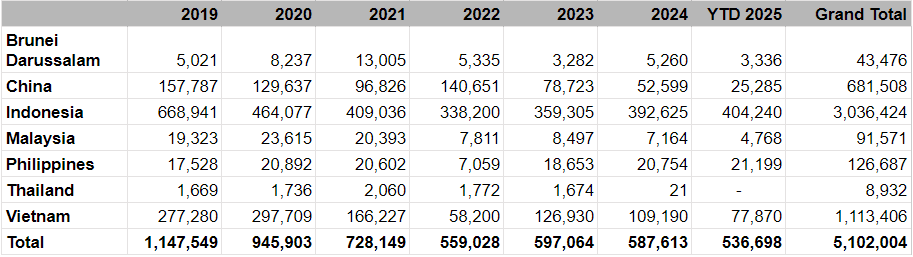
Source: DAFF website