
TWO recent scientific studies have shown the potential to build soil carbon through certain agricultural management – with the results being taken as a positive by Australia’s soil carbon industry.
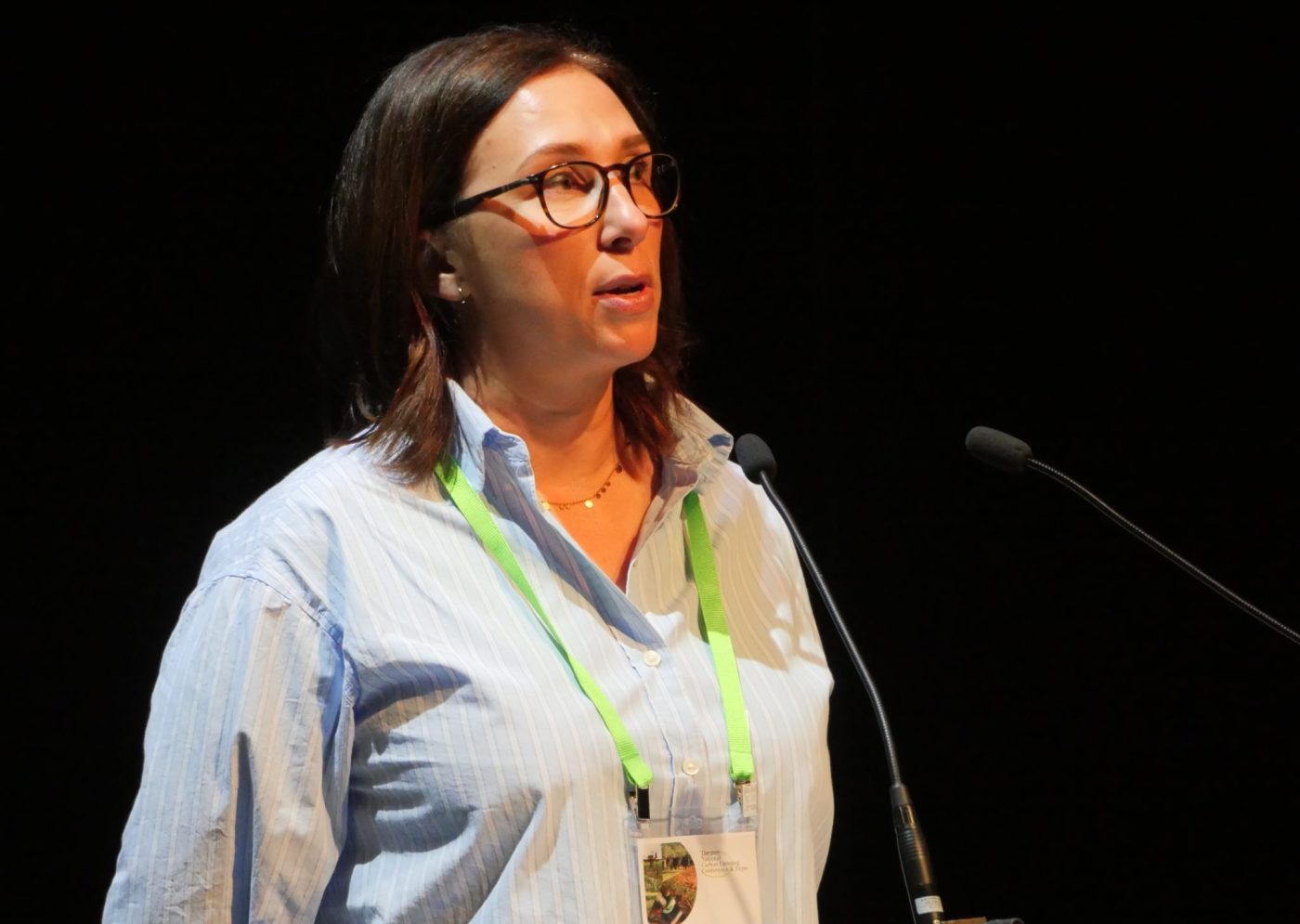
QUT researcher Dr Elaine Mitchell presenting to the National Carbon Farming conference.
Australia’s soil carbon scheme has been around for a decade now, with more than 700 projects signed up and at least 34 receiving Australian Carbon Credit Units.
The soil carbon scheme was designed to give producers an incentive to change practices and get a financial reward if they could demonstrate an increase in carbon in their soil.
However, the scheme has drawn extensive debate about how much soil carbon levels are determined by rainfall and how much is determined by management. Many involved have agreed that more long-term research is needed to answer that question.
New research by Queensland University of Technology, funded by Meat & Livestock Australia, has shown some positive results for the role of time-controlled-grazing and legumes in building soil carbon. The results, which are yet to be published, were presented to the recent National Carbon Farming conference in Albury.
The study was done over five properties in the Brigalow Belt of Queensland that were matched for soil type, land use history and other criteria. They then compared it to other conventionally managed properties.
“We were very careful in selecting our continuously grazed properties, we did not want to compare time-controlled grazing to completely flogged out properties,” said Dr Elaine Mitchell who presented the study to the conference.
“So, we had to pick conventional managers who were still good managers. In some cases, they were managing some kind of rotation, just not at the intensity of the operations we were looking at.”
Dr Mitchell said the QUT team tried to eliminate the limitations of previous studies into the role of time controlled or cell grazing in soil carbon. Including:
- Studying at commercial scale rather than on a small plot.
- Using more farms to ensure there was sufficient replication. Dr Mitchell said some previous studies had only used one farm.
- Making sure land types were matching, with previous studies going across soil types or climatic factors.
- Measuring down to one metre, as opposed to 10-30cm.
The study found that the properties under time-controlled-grazing had 15t of carbon/ha more than the properties under conventional grazing. It also found the time-controlled grazing properties were increasing carbon by an average of 0.67t/ha/year.
“We also saw greater amount of stable carbon in the soil. That is the stuff we hope will stick around in the soil for long periods of time,” Dr Mitchell said.
Southern study finds continuous rest builds soil carbon
Another study conducted by the New South Wales Department of Primary Industries at the Orange Agricultural Institute found that rotationally grazed paddocks had significantly higher levels of carbon than continuously grazed.
It found that systems with rest periods of 56 days across 15 paddocks had significantly higher soil organic carbon stocks than continuous grazing, but doubling rest or paddock numbers did not further enhance sequestration.
Treatments with low initial soil carbon levels proved highly responsive, capturing an average of 0.77t/ha/year annually, with rates reaching 1.22t in optimal conditions. Promisingly, carbon sequestration continued even during drought, at 0.13 tonnes per hectare per year.
Improved grazing management directly contributed 0.1t/ha/year, while environmental factors and land use change accounted for the remainder.
NSW DPIRD Pastures Research Leader, Dr Warwick Badgery said the findings provided valuable insights for producers looking to understand the potential for soil carbon change in their grazing business.
“This research reinforces what many landholders are already observing, well-managed grazing systems can contribute to soil carbon sequestration,” Dr Badgery said.
“High stocking rates did not influence soil carbon compared to low stocking rates, which is consistent with previous Australian studies but at odds with overseas studies.
“Bare ground was one of the strongest predictors of SOC change, with more bare ground associated with lower SOC stocks, highlighting the importance of maintaining groundcover.”