
148th Edition: June 2026
Key Points:
- Vietnam’s all but stalled live cattle trade is drawing fresh interest, with importers hopeful it could reopen if Australian prices keep easing toward a workable level
- China has declared the whole of Brazil free of foot-and-mouth disease, widening access for Brazilian beef and offal across Asia
- Vietnam’s new 2030 dairy strategy keeping it reliant on imported breeding stock
Regional Trends and Overview

Dr Michael Patching
Of course the big news this month came from outside the region, China recognising the whole of Brazil as free of foot-and-mouth disease and opening the world’s largest beef market fully to the world’s largest beef exporter. The reason it matters here is twofold.
First, a fully accredited Brazil can now chase the premium Asian markets that demand the higher health status, which frees its lower cost product to keep pushing into Indonesia, Vietnam and the Philippines. Second, and more immediately, the Brazilian industry body Abiec has said both Indonesia and the Philippines have already expressed interest in Brazilian beef offal on the back of the new status. Offal is exactly the kind of affordable product that competes hardest with Australian frozen beef and offal here.
Vanuatu points to opportunities off the beaten track
One smaller story caught my eye this month, worth flagging less for what it is than for what it points to. Vanuatu has restarted its national cattle rebuild, scaling a fanciful old target of 500,000 head back to a more realistic 150,000 over five years and concentrating the effort on a handful of islands, buying breeding cattle and placing them with a small number of capable farmers to build from. The rebuild sits under a European Union funded program worth around EUR 24 million, close to AUD 40 million, spanning beef and other local value chains, which is serious backing for a country that size.
Now, Vanuatu is not a known market for Australian live cattle, certainly not at the moment. But it is the sort of place the industry may need to start watching. With the feeder trade squeezed in Indonesia and the live trade into Vietnam all but stopped, the comfortable old markets are carrying less of the load than they used to. Funded herd rebuilding programs in smaller economies, the kind we would not normally give a second thought, are worth keeping on the radar, because over the next few years the openings for Australian cattle and genetics may increasingly come from outside the usual places.
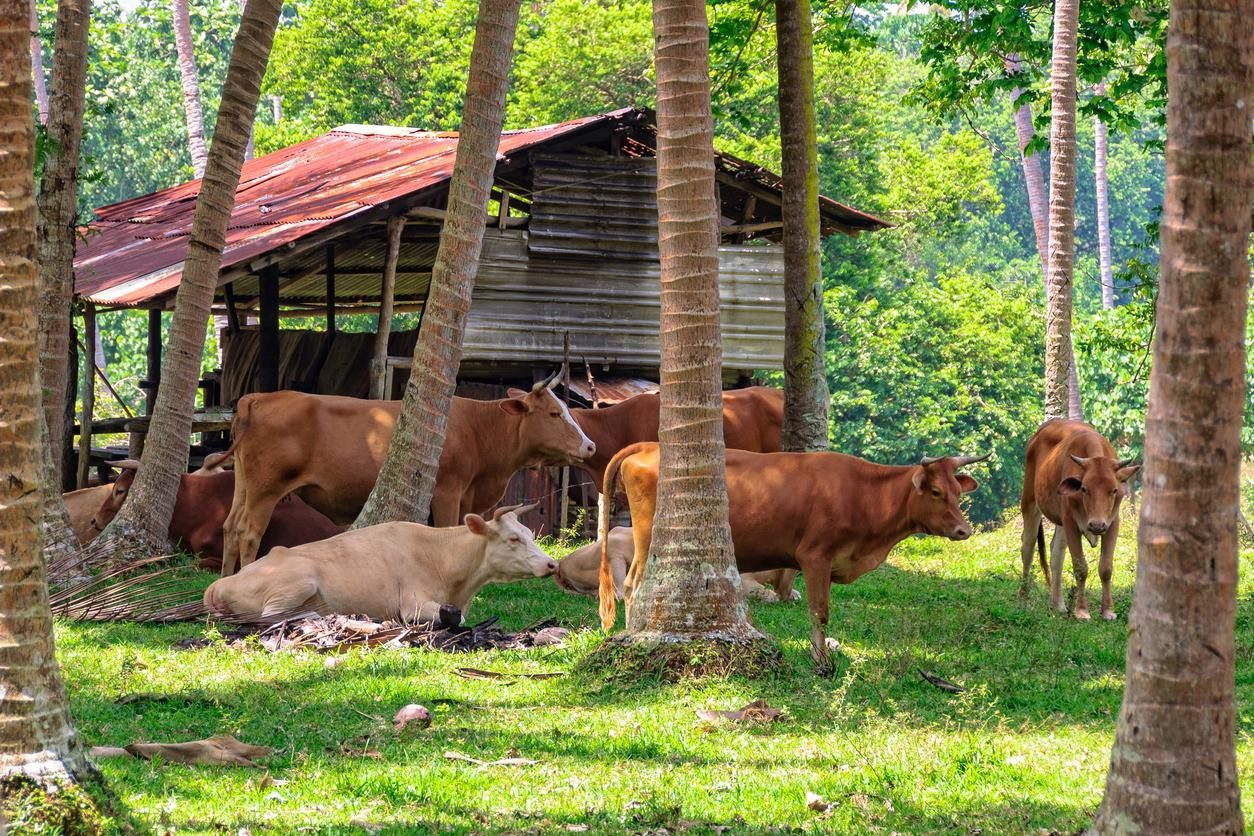
Photos: Typical small-holder production in Vanuatu
Regional Price Graph
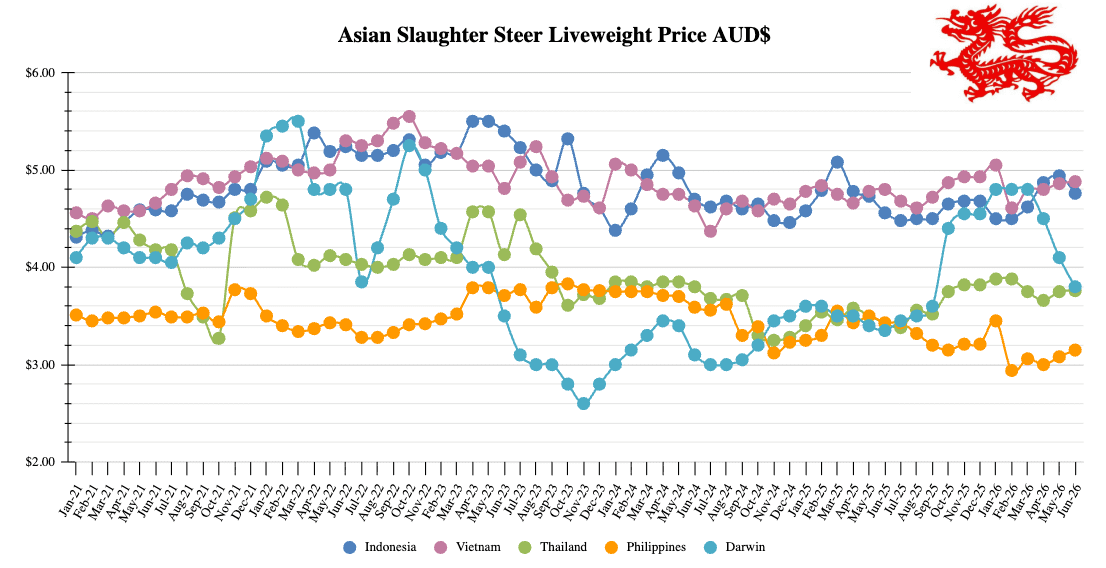
Indonesia: Slaughter Steers $4.73 AUD per kg live weight (IDR 12,900 = $1 AUD)
Prices
Lampung slaughter steers are around IDR 61,000 per kg (AUD 4.73), with Java steers a touch higher near IDR 62,500 (AUD 4.84). Wet market beef knuckle is running around IDR 145,000 per kg (AUD 11.24), with supermarket knuckle near IDR 160,000 (AUD 12.40). Chicken sits around IDR 38,000 per kg (AUD 2.95) and the gap against beef stays wide. Annual inflation came in at 3.08 per cent in May, with beef again named among the contributors, a reminder of why the government keeps such a close watch on the price.
Free-meals dairy push keeps the import door open
 Makan Bergizi Gratis, Prabowo’s signature scheme now feeding around 62 million people, is being built out into dairy through the new Indonesian Milk Kitchen, or Dasi, and the numbers explain why Indonesia leans on imported cattle, with domestic milk covering only about a quarter of demand, a herd of just 540,000 head mostly in smallholder hands, and a stated aim to bring in something like one million dairy cattle over five years. The catch is that the program has wobbled, with food-safety scares, mismanagement claims and an anti-graft complaint prompting Jakarta to trim its 2026 funding from Rp 335 trillion to Rp 268 trillion, close to AUD 5 billion off, and Prabowo himself conceding it comes with many problems. For Australia, dairy and breeder cattle are still an opportunity, outside the reference-price squeeze that hems in the feeder trade and on better margins. But the funding cut only confirms what the trade has long assumed, that the one-million-head figure was always aspirational and what actually arrives over the next five years will fall well short of it.
Vietnam: Slaughter Steers $4.88 AUD per kg live weight (VND 18,800 = $1 AUD)
Prices
Vietnamese slaughter steers are around AUD 4.88 per kg liveweight, with the dong still much weaker against the Australian dollar than early in the year, despite firming slightly thing month, around VND 18,800 now against about VND 17,200 in the first quarter, which makes cattle bought in Australian dollars dearer again in local terms before anything else is added.
The live trade into Vietnam is still effectively stalled as Australian cattle are priced beyond what an importer there can make work. What is new this month is a flicker of optimism. The tone of my conversations has lifted, and the feeling among contacts is that Vietnam could come back online over the next few months if the Australian price keeps easing toward a workable level.
There is also talk of a shortage of Thai cattle in the market, which matters more than it sounds, because Thai cattle crossing the border have long undercut Australian cattle on price there, or at least competed for price. It may well be the tighter border controls I flagged earlier in the year starting to bite, with Vietnam clamping down on informal cross border movement to keep the new SAT-1 strain of foot-and-mouth out. If so, a disease threat that reads as a regional worry is quietly working in Australia’s favour, limiting some of the cheap competition.
Hanoi’s dairy strategy rhymes with Jakarta’s
The Vietnamese story this month looks very much like Indonesia. Hanoi has approved a dairy industry development strategy running to 2030, with a target of around 2.6 billion litres of domestic fresh milk a year by then, enough to cover perhaps 60 to 65 per cent of what the processing sector needs. Industry estimates put the dairy herd required to get there at something like 700,000 head. As with Indonesia, the gap between ambition and the current base is important. Even with their large dairy companies Vinamilk and TH Milk, Vietnam will not breed its way there quickly, which keeps the door open for imported breeding stock and genetics. With the feeder/slaughter trade into Vietnam having all but stalled, the dairy and breeder channel is one of the few opportunities left in that market for Australian exporters.
Australia: Feeder Steers Darwin $3.90
On the home front the cattle market has split into two speeds. In the south and east prices have come roaring back, helped by autumn and winter rain that has restored both feed and confidence, with Queensland feeder steers up something like 20 per cent in a couple of months and the saleyards back in what traders are calling bull-market territory after the forced turnoff of March and April. The north has gone the other way. Darwin feeder steers have eased to around $3.90 per kg liveweight, down from $4.10 a month ago, weighed less by the season than by soft demand out of Indonesia, where the reference price and a record-weak rupiah have taken the urgency out of buying.
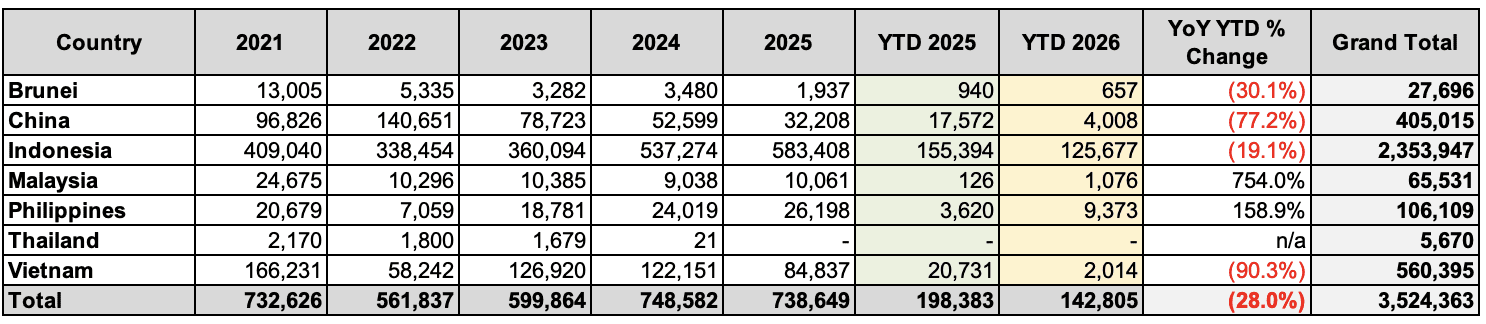
Year 2026 cattle exports up to end of April – comparison across SE Asean markets
Source: DAFF website