
IS IT time to review, adjust or even shelve the industry’s widely-publicised Female Slaughter Ratio metric – one of the beef sector’s key performance indicators used to judge whether the national herd is expanding or contracting?
Female Slaughter Ratio, or FSR, is a measure of the proportion of females (cows and heifers) in the overall national (or state) adult cattle slaughter. A national figure of 47pc is regarded as the ‘tipping point’ between beef herd expansion and contraction.
Our inquiries suggest the 47pc benchmark (averaged across a 20-year cycle) has never been adjusted since the advent of the FSR, way back in 1989. Some say the metric may simply have been adopted from the US beef industry, using US herd data.
Industry commentary article headlines like “National cattle herd enters destocking phase” have been abundant over the past 15 years, often primarily justified by FSR numbers.
However there’s a growing industry view that it’s now time to take a serious look at the FSR calculation, how closely it reflects modern cattle production systems, and indeed whether it still has any relevance at all.
Background
First, some background.
The FSR is published weekly as part of the NLRS weekly slaughter report, and is widely quoted by analysts and others across industry dialogue as an indication of producer intentions and herd size direction.
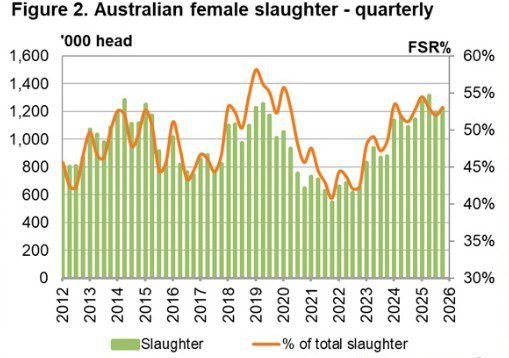
Source: ABS, Mecardo
As can be seen in this graph, covering the 2012-2026 period, the FSR has sat well above 50 percent since the June quarter 2024 – usually an indication or a contracting breeding herd – and indeed has not dipped below the 47pc tipping-point since 2021-23 herd rebuilding when producers were retaining heifers and cows to re-establish breeding herds after the 2019-20 drought.
While it has dipped sharply following recent rain, the FSR this week still sits at 50.6pc – well above the long-term technical equilibrium level of 47pc.
While an FSR consistently above 47pc has historically indicated herd contraction, a lot has happened in the beef industry (both short and longer-term) to suggest the current situation is different.
Conversations with respected industry stakeholders on this topic (see their comments below) made the point that the industry does not need as many breeders these days to deliver the same calf population each year; or conversely, it can produce a larger calf population with the same number of breeders. That in turn potentially delivers more spare heifers into feedlot programs, or older cows into manufacturing, both of which impact the FSR.
Here’s some ways that circumstances have changed, that may be impacting the value of the FSR:
Productive use, booming meat demand
Compared with a decade or two ago, there are now fewer unproductive cows in the Australian herd. Strong global demand for lean grassfed beef, driven in part by low US herd numbers, has driven very strong prices for female cattle. Slaughter cows servicing this unsatiable demand for grinding meat are today worth around 390c/kg liveweight. Those same cows a decade ago were worth little more than half that.
That has pushed big numbers of cows to market in the past couple of years, for reasons other than dry conditions.
In large extensive northern beef herds, it was not that uncommon in the past for aged cows to simply die in the paddock, with prices insufficient to justify the freight cost to market. It would be neigh on impossible to find breeding cows anywhere in northern Australia now that do not end up in the red meat supply chain somewhere. All that is reflected in the FSR.
Genetics, nutrition lifting fertility
In northern Australia, particularly, significant investment in genetics, nutrition and herd management, fencing and water infrastructure have lifted reproductive performance and overall herd productivity.
 As this recent Beef Central article highlighted, the expansion in use of Wagyu in some northern production systems – specifically to increase calving percentages – is a clear example of this structural shift toward higher productivity and more specialised production systems.
Add to that greater nutritional and vaccine support, and northern herds are now much more productive than what they once were – which directly impacts female slaughter.
While the impact is perhaps less in the southern half of the continent, the same principles apply.
Favourable seasons
Over the past four years, large areas of cattle country in Australia (New England and Northern Tablelands excluded) have had above average to excellent seasonal conditions, producing abundant pasture. That’s lead to a gradual build-up in herd sizes, some observers suggest – to the point where some managers have been comfortable in letting their breeding herds ‘creep out’ to say, 110-115pc of their normal long-term capacity.
So female reductions through slaughter that have occurred recently (reflected in the FSR) are in some cases simply ‘getting back closer to 100pc of long-term capacity,’ one regular cattle market contact suggested.
As a result of the above factors, many older and less productive cows have been drawn into the slaughter market. This elevated female turn-off is not necessarily indicative of herd liquidation, but instead reflects the clearing-out of those older or less productive surplus breeding animals that accumulated during the 2022–24 rebuild.
Despite the relatively stable herd size, the high rates of female slaughter can also be explained by the increase in surplus heifers (those above the required replacement breeder numbers) due to the higher calf population from subsequent good seasons and more fertile genetics.
Northern NSW breeders being sold earlier this year due to drought also contributed to the higher FSR, highlighted by the fact that for the first time in history, more females were processed in Victoria than Queensland in two quarters during 2025.
At a regional level, large interstate transfers of Queensland cows heading south to slaughter over the past two years, and southern feeder steers heading north into Queensland feedlots also impacts FSRs at a state by state level. For example last week’s Queensland FSR was only 37.5pc (12-month average = 39.4pc), while Victoria’s (boosted also by dairy kill) last week hit a spectacular FSR of 79.2pc.
Blunt instrument
Taking the above points into account, there’s a view emerging in industry circles that its time to apply some scrutiny to the FSR, and either look to make adjustments or put it on the shelf.
“In it’s current form, it’s pretty blunt instrument,” one well informed stakeholder told Beef Central.
“There’s just so many nuances that impact the result, that simply suggesting that having an FSR that sits above or below a long-term average to indicate herd growth or contraction is no longer reliable. Even broader industry directional changes like greater adoption of lotfeeding is having an impact. The use of sexed semen can have an impact. There are just so many other variables,” he said.
“Female kills above or below a long-term average no longer cuts it.”
There needed to be a ‘full-on study’ done by MLA or appropriate economists to look into it, to better understand what female slaughter means, and what’s now driving it, he suggested.
“But until it is looked into, in some detail, we simply don’t know,” he said.
Elders economist Richard Koch is one who questions the value of the FSR in today’s industry context.
“I think a simple heifer versus steer price comparison (premium) provides a better indication of whether we are rebuilding or not,” he said.
Industry concerns
Two prominent beef industry stakeholders who have watched the FSR closely are Consolidated Pastoral Co’s Troy Setter and former MLA and AA Co managing director Jason Strong, now a beef producer and industry consultant.
Troy Setter
Mr Setter said he had had concerns about the FSR’s reliability for some time.
“In northern Australia, the improvements in productivity alone, through feeding more phosphorus, more yearling heifers, more British (and Wagyu) genetics lifting fertility and lower mortality, mean that maybe the FSR, especially at a regional level need to be reviewed,” he said.
“But when I talk to good producers in southern Australia, they, too, are turning their cattle off younger, and with greater fertility and productivity – it’s not just in the north. And we’re all a lot better at managing drought.”
“When I first started at CPC we were producing weaning rates of around 50pc. Today we’re in the 80s. We didn’t calve a cow down until she was three years of age. Now a big chunk of them are two or two-and-a-half at first calf, and we regularly have surplus heifers to sell.”
“I just look at our own herd, and conclude that our own female slaughter ratio is totally different from what it used to be.”
The state-level FSR numbers could be misleading, Mr Setter said. “Victoria’s FSRs above 70pc are being driven hard by the huge numbers of Queensland and northern cattle being trucked south for processing,” he said.
“I have a different view to MLA and ABARES over the size of the herd in Australia, but if you go off some of those assumptions, then we should have run out of cattle already. We clearly have not.”
“We should be looking at the FSR in detail, because there’s a whole lot of things that have changed since it was implemented that affect the outcome. And in fact it should be looked at every ten years or so, to keep up with industry change.”
“Turnoff age has changed; puberty has changed; and a lot of people aren’t growing out bullock any longer. It all impacts female productivity and the numbers represented by the FSR. Even ten years ago, when we were only getting $400-$500 for a northern cull cow, people just hung onto aged cows, and tried and get an extra calf out of them. That no longer happens.”
“I’d think it would be good for a panel of industry people – along with a serious economist or two – to be appointed to go through the data and modelling.”
Rusted-on
The fact that the FSR formula was devised back in the ‘dim dark ages’ was part of the problem, Jason Strong told Beef Central.
“It’s one of those things that has just become rusted-on as an industry number,” Mr Strong said.

Jason Strong
“Simply saying we’re in herd liquidation when we hit this level, or expansion when we hit that level fails to overlay changes in the real drivers behind the herd numbers.
Twenty or 30 years when Australia was still large producing a commodity product, and before live export, the industry built capacity simply by adding more cattle, Mr Strong said, and reduced numbers by killing them.
“Largely, they were commodity drivers, whereas now, we have these much more strategic and structured livestock sales channels – even in the north, with live export. The drivers behind that aren’t necessarily that we have more cattle or less cattle, but demand from the south; demand from importing countries; seasonal conditions and other factors. It’s more than just the herd numbers.”
“The national herd today can be growing or reducing, quite separate from an FSR number pointing to how many cows we have.”
Within the total number of cattle in the population, the proportion has also changed. That 47pc FSR figure relies on a proportion of aged breeding cows, and the sorts of questions that would have to be considered in order to do a good assessment of the value of the FSR would include: What is the average age of the cow herd?”
“I would argue that it is younger than it has been for a long time, which then, you would expect, would make it more productive. And even if we are in a static state, we could have more females than what we otherwise might have expected, without having a huge impact on the total herd.”
There was also the overlay of what has happened within the feedlot sector, Mr Strong suggested, with supply options for steers and heifers as a dedicated sale item, rather than a cull or unused item.
“We now have females coming through the system that are being bred not for calf production, but to be fed and killed,” he said. “That’s largely because the cows in the system are more productive.”
“There’s a whole range of different drivers that are influencing herd movements today. And all of this connects with the more sophisticated supply chain we’re seeing, where we have a more deliberate set of actions and structured outcomes, rather than simply being reactive.”
“It falls into the same category as the old saying that the only reasons that beef producers sell cattle is because they have no grass, or no money.”
And with the more sophisticated supply chain and preferential access that Australia has to global markets, the differential in price between a cow and a heifer isn’t like it used to be, he said.
If it got dry or got tight, one of the ways to increase return was to sell a heifer, because they were worth so much more than a cull cow. But quite often, today, a cull cow is worth more than a heifer. That’s partly because of better genetics and management, and cows kept in better condition. Today she weighs 550kg liveweight, and is worth 390c/kg.
“And these days, because of the markets we service, the value of a cull cow isn’t that much different than a steer coming out of a feedlot.”
That’s absolutely changing decision-making around female sale cattle, and the impacts on tools like the FSR.”
Does it still have a role?
So why does the industry today still need an FSR? Beef Central asked.
“I actually don’t think it is anywhere near as important as it once was,” Mr Strong said.
“Historically, when beef was a commodity market, when supply was going up, prices would come down. But today, prices have remained very high, despite near record production,” he said.
“That simple supply and demand story is not as big as it used to be. We’re in a different environment, and the drivers are different, making it hard for the FSR to stay relevant.”
“It (the FSR) probably gets more airplay today than it deserves, but it happens because it is an ‘easily digestible, recognisable instrument.’
“People have been listening to the reports that ‘the FSR is at 51pc’ for years, because its an easy, approachable metric.”
“It may be interesting information, but I don’t know how much that drives decision-making any more. It might be insightful to do a study to determine what the drivers and potential levers are today, but as a tool, I don’t think FSR any longer plays any significant role.”
Maybe the data is not correct? Who checks? Maybe ‘phantom’ cows are being slaughtered? Maybe steer slaughter is underreported, or live export is mostly steers….that is an interesting thought to pursue! Cow ‘productivity’ can’t change much, no one has bred a cow that calves twice a year yet! A stressed herd produces more females than males also. My bet is on flawed data tho.
At the property level, I think that 47% is not a bad starting point for most of our better managed breeder herds in northern Australia. A well managed breeding herd in the Katherine region that averages a 3% mortality rate, sells most of it steers to live export between two and three years old and has a normal heifer culling strategy will have an average FSR of 47.21%. A central Queensland breeder property with a similar mortality rate, an average weaning rate of about 78% to 80% and typical herd management will have an average FSR of between 46% and 48% depending upon the age of turnoff of the steers. Steers turned off at younger ages generate an FSR closer to 46%, older steers generate closer to 48%.
For both of these properties, achieving an FSR in any year greater than 48% would probably indicate a relative increase in female sales above that number required to maintain the breeder herd size.
I don’t think the relative increase in the proportion of the northern herd going into feedlots would impact the calculation significantly.
However I have not done calculations for a national herd. That situation is a lot more dynamic, but if 50% of calves continue to be born female and 50% male, an average FSR of 47% seems likely to indicate the size of the national breeder herd will be stable over time.