
Emissions discussions must move beyond isolated accounting measures toward a broader understanding of food production systems, ag industry stakeholders speaking at Protein 2026 in Dalby noted, while also advising that farmers still need to understand their own emissions profiles.
A common theme emerging from a panel discussion was frustration with what some panellists saw as an often “reductionist” approach to agricultural emissions in public debate.
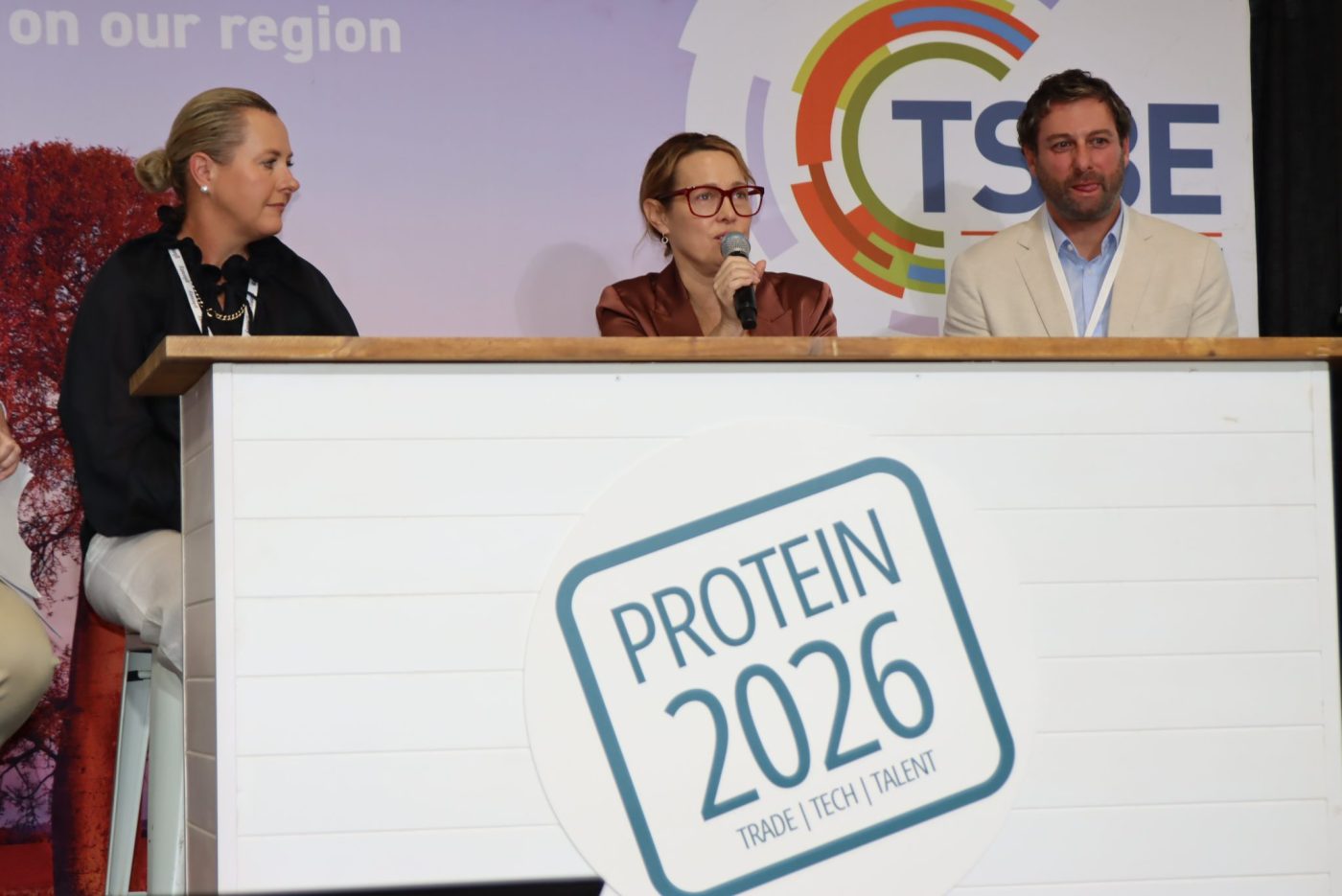
Rachel Chambers and Brad Tressider.
Queensland Food Farmers’ Commissioner Rachel Chambers said food production should be viewed as an interconnected system rather than a series of isolated emissions sources.
“It does my head in,” she said in response to the emissions question.
“It does my head in, because there’s the offsets, there’s the emissions, there’s the carbon conversation, there’s overseas targets, there’s Australian targets, and the farmer is trying to navigate all of it, and saying, ‘I drive a tractor here and here, I grow three different crops, I have two different animals here, and you’re trying to ask me how many emissions for this one crop?
“And that’s not the land in which I live. And until we work out that it’s a food production system, and that if you want food, you have to look at the whole system and work out how we work together in that space, and I think we are so far away from at the moment.”
She said her fear was that farmers would continue to be “lumped with things being forced down the supply chain”.
“What I want us all to get better at is pushing back up the supply chain and saying no, actually, this is what I do, and if you want food, and this is how we can work together.”
Other panellists agreed the debate needed to move beyond a discussion focused solely on where emissions are generated, toward a broader systems-based view encompassing the entire supply chain.
Gallagher Insurance’s Brad Tressider said the broader context around emissions appeared to be shifting, amid growing global uncertainty over climate commitments, geopolitics and food security pressures.
“We’ve still got to get food produced and we’ve still got to feed people, and that’s what came out with the previous speakers in the previous years of this conference, where the priority is still about getting food to people.”
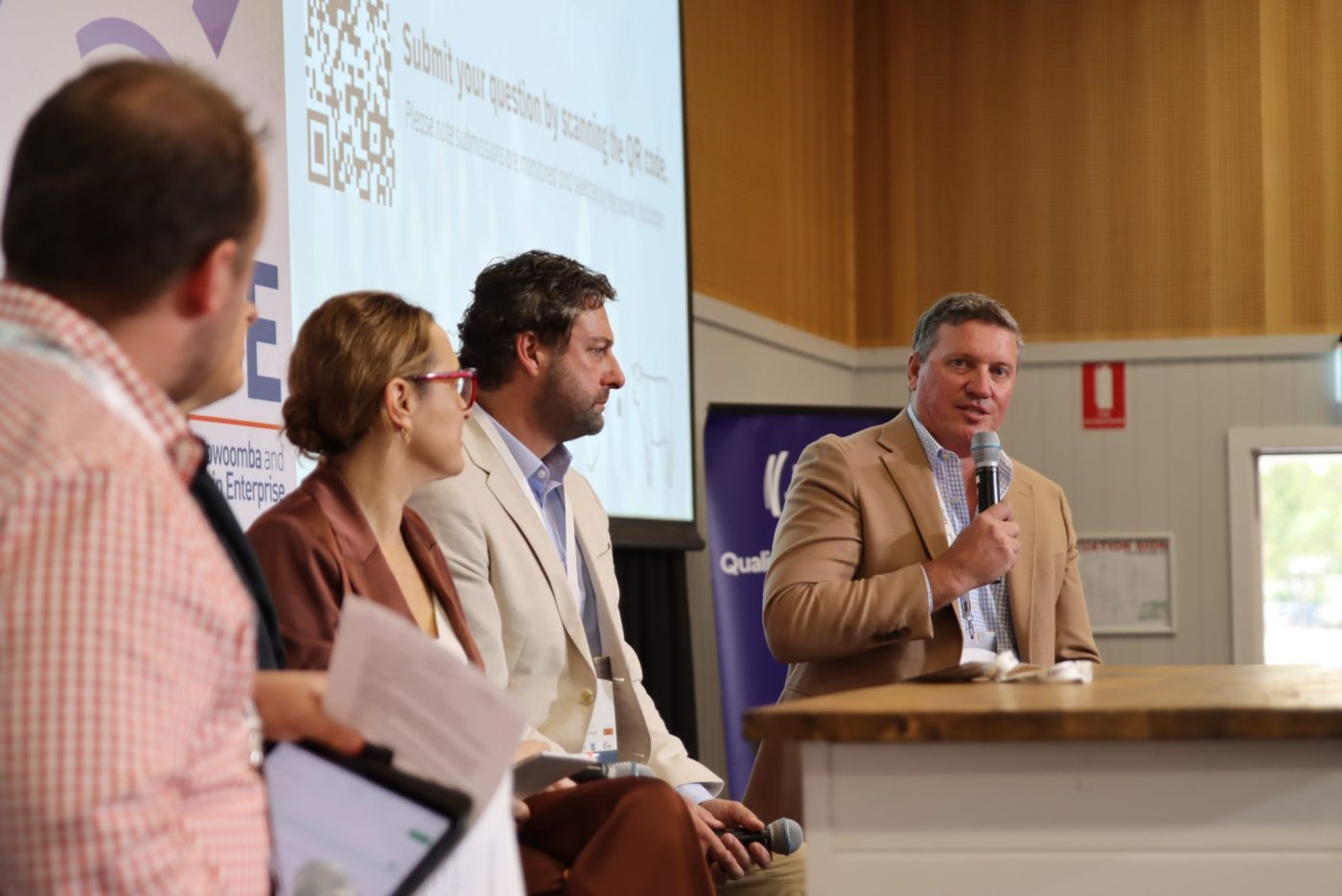
Brendan Tatt (right)
JBS Australia’s Brendan Tatt said ESG and emissions considerations would not disappear and that it remained important for businesses to understand their emissions profile.
But he said the world was also beginning to understand the cost associated with some previously announced aspirational targets.
“People are walking back very quickly, either publicly or privately, from some of those targets, and we’ve seen some very big organizations globally reframing or resetting of targets in the last three years.”
All over the world, he said, most consumers used a similar decision-making hierarchy when choosing products on supermarket shelves, which he summarised as: ‘What would I like to buy? What can I afford to buy? Is it going to keep my family safe?’
“You can go anywhere around the world, any demographic, any culture, they’ll pretty much use that decision-making hierarchy,” he said.
It was only after those questions were answered that other considerations – such as whether a product was good for the planet – tended to come into play.
“Now that said, we can’t keep using energy, all those things, we can’t degradate our farms, we can’t degradate our water supplies, we need to be smarter.
“We’ve got lots of technology that’s either here or coming really quickly. We need to be much better at managing our resources, just to be competitive and to run good businesses, for our kids and their kids.
‘Every business in this room should know their numbers’
His advice to businesses was to “hurry slowly”.
“Every business in this room should know their numbers,” he said.
“I don’t disagree with Rachel – how do you put a tonne of carbon on your oats crop that might be fed for cattle production or grain, or the tractor did six jobs today – where do you put that diesel emission?
“But you should know on your farm level what your emissions are.
“It’s going to have a value put on it, so you might as well know what it is, whether you want to use it or not.
“We all should know that sort of detail in our business if we’re running a good operation.
“But I wouldn’t get too messed up in trying to make investment decisions on what’s happening today, because it will be different tomorrow.”
More Climate-Related Financial Disclosure deadlines approaching
Under Australia’s Climate-Related Financial Disclosure regime, Group 2 entities must begin formally tracking and reporting climate risks, emissions and transition plans for financial years commencing on or after 1 July 2026.
A business qualifies as a Group 2 entity if it meets at least two of the following criteria:
• Revenue of $200 million or more
• Consolidated gross assets of $500 million or more
• 250 or more employees
• Asset owners, including registered schemes or superannuation funds, with $5 billion or more in assets under management.
Mandatory reporting will extend to Group 3 entities from 1 July 2027.
Group 3 status applies to businesses meeting at least two of the following criteria:
• Revenue of $50 million or more
• Consolidated gross assets of $25 million or more
• 100 or more employees.
Reporting entities will be required to report Scope 3 emissions in their second year of reporting.
Guidance from the Department of Agriculture, Fisheries and Forestry states that most Australian farmers will not have a direct legal obligation to report emissions under the new Climate-Related Financial Disclosure rules, even when Scope 3 reporting becomes mandatory for large companies.
Large reporting entities – including supermarkets, processors, banks and food companies – can estimate Scope 3 emissions using industry averages or secondary data, and are not required to collect farm-level emissions data from suppliers.
However, the guidance notes commercial pressures or incentives to provide emissions data may still emerge through supply chain programs, certification schemes, finance requirements or market access arrangements.
For more information about Climate Related Financial Disclosures and potential implications for Australian farmers, see the Department of Agriculture, Fisheries and Forestry guidance on climate-related financial disclosures on the DAFF website.
HAVE YOUR SAY