
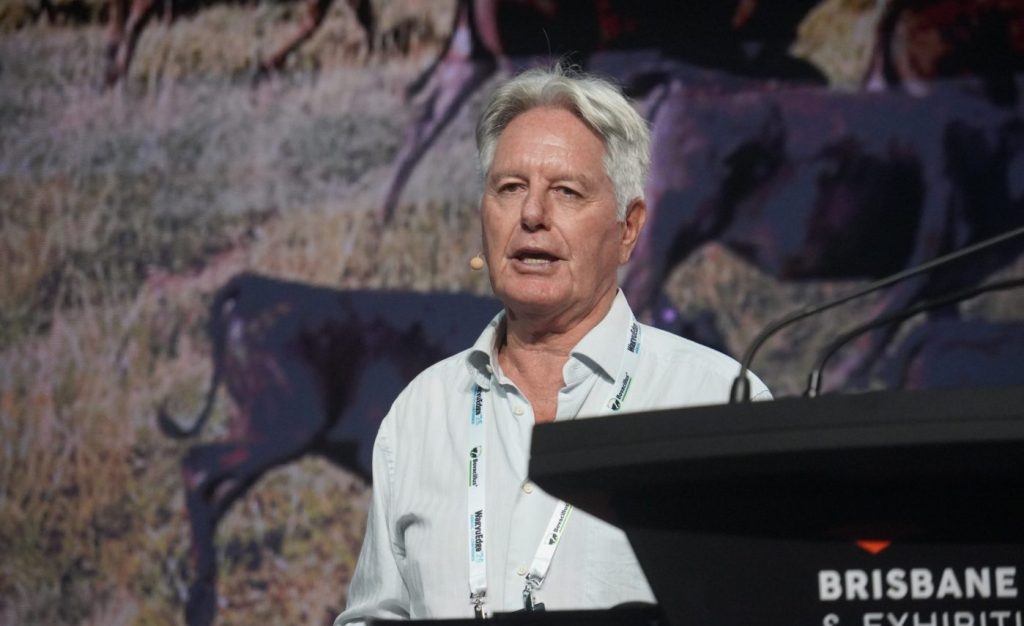
Ross Ainsworth
BEEF producers could need up to two years of income reserves in the bank to survive a major exotic disease incursion in Australia, veterinarian Ross Ainsworth warned delegates at last week’s WagyuEdge conference in Brisbane.
Dr Ainsworth provided a sobering account of the potential damage a breakout of Lumpy Skin Disease or Foot & Mouth Disease could have on Australia’s heavily export-exposed beef industry.
While industry attention is currently focussed elsewhere on topics like fuel and fertiliser access, global conflicts impacting logistics, trade access and other matters, exotic disease risk still represents a clear and present danger.
Dr Ainsworth has practised as a cattle veterinarian, animal health advisor and live export administrator across Northern Australia and Southeast Asia for 50 years. He has written extensively for Beef Central for the past 15 years.
“While most of what you delegates have heard at this conference has been pretty positive stuff, this exotic disease risk that the Australian industry faces is very serious indeed,” he warned. “I hope I don’t depress you too much.”
Dr Ainsworth claimed that Australia’s exotic disease risk profile was “just so much worse than any other country.”
“We have the world’s highest disease-free status, therefore we have the most to lose,” he said.
“And with 70 percent of our beef destined for export markets, if that is unable to be shipped because markets close after a disease outbreak, then our industry is dead overnight.”
The extensive nature of Australian cattle management systems meant that if there was any sort of outbreak, it would take longer to detect, and longer to resolve than in smaller, more intensively managed countries.
“If we do have a disease problem, our importing countries are going to be very careful, and may be very slow to re-open the trade and let Australian beef back in,” he said.
 Right now, Australian was very close to two recent outbreaks of very serious exotic diseases in cattle. Both Lumpy Skin Disease and FMD arrived coincidentally in our nearest neighbour, Indonesia, in early 2022.
FMD was the most serious animal disease in the world, he said. “It’s a 9 on a 10-point scale as an animal disease, and a 10/10 in terms of commercial impact,” he said.
“If this disease comes to Australia, you are all broke,” he said, in the bluntest possible terms. “Beef markets could be closed for some years.”
However history was on Australia’s side, with no detection of FMD in this country for 150 years. Initially, that freedom was based on ‘luck’ – the fact that cattle had to come from the other side of the world. In the last 50-odd years, that luck had combined with some very good biosecurity controls.
“Now, with good biosecurity and a fair measure of luck, I’m pretty confident that we will remain FMD-free,” Dr Ainsworth said.
Currently, southern Africa and China are battling new FMD outbreaks, in China’s case, a particularly virulent version.
Lumpy Skin Disease
The second disease risk, Lumpy Skin Disease, was a much different kettle of fish.
In terms of an animal disease impact, it was only 2 or 3/10 Dr Ainsworth suggested, but it was the main short-to-medium term threat that the industry needed to understand and prepare for.
However LSDs impact would be much greater in commerce terms for Australia – because never before had the disease spread to a country with a major beef export focus, like Australia.
“So the threat to your cash flow is a 9.9/10, if not a 10/10,” Dr Ainsworth said.
“The irony is that the threat is not from the disease impact on livestock, but a nasty imbalance of supply and demand, driven by politics rather than science or logic.”
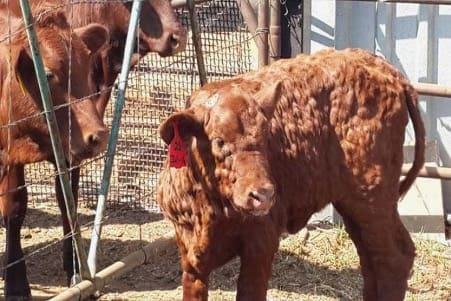 As background, LSD is a pox virus causing skin lesions in cattle, buffalo, and as more recently discovered, camels.
Infected animals lose weight, and there are some mortalities. This is because the lesions also occur in the respiratory tract and the gut, creating risk of secondary infection. Lesions on udders could make it too painful for a nursing cow to allow the calf to suckle, causing calf loss.
The virus is spread by biting inspects, taking blood along with the virus itself from an infected animal and flying off to the next host, injecting the virus.
There were a number of biting inspects involved – biting flies, stable flies, midges and even ticks can transmit – but what was not known was which ones were the main culprits, should it arrive in Australia.
“So much about this disease, we simply don’t know a lot about,” Dr Ainsworth said.
Most concerning for Australia is the fact that some of these inspects can travel long distances on the wind.
“With FMD, the disease cannot travel too far, but for LSD, it’s a different story.”
A positive feature of LSD was its low morbidity – in any given herd, only a small number of animals become infected – 5-20pc. Of that small infected group, only 1-10pc die, according to the literature.
“But that would be different in Australia, because everywhere it has been in the world so far, animals have been cared-for in close contact with their owners. If animals get sick with this disease in the broad pastoral zone of northern Australia, then there are going to be a lot more problems.”
Dr Ainsworth said there were still so many puzzling factors about LSD and its transmission that were not yet understood.
“The good news is it can’t infect humans, and processed meat is safe to both eat, and to export,” he said.
Part of the challenge with LSD was that it was so difficult to predict what the spread of the disease would look like. Sometimes its spread across the world slowed to a crawl, while at other times it spread like wildfire.
“It took 80 years for LSD to leave Africa, where it originated,” Dr Ainsworth said. “Then it only took one year to travel from northwest China to Hanoi in Vietnam, going from minus-40 degree winters to tropical areas, causing terrible trouble all the way.”
“Certainly nobody took a truckload of infected animals all the way from Jinchang to Hanoi. Equally, it is hard to image that insects flew all that way. We simply don’t know – it makes no sense at all.”
Even more puzzling was its rapid move through Southeast Asia, during the Covid period. The disease took only six months to travel from North Sumatra all the way to the east end of Java, but then took another three years to arrive in Bali early this year. The only time those borders have ever been truly shut was during the Covid period, especially given that the direction in livestock trade is from south to north, against the flow of the infection.
One of the problems with measuring risk of infection in Australia from areas further north was the lack of knowledge about how many virus organisms needed to infect an insect, how far that insect can fly, and how many of those infected insects are required to infect a beast in Australia.
While LSD was current located in Bali, Dr Ainsworth said there was absolutely no doubt whatsoever that it would work its way through the Eastern Indonesia islands and arrive in Timor – just 450km from the nearest point on Australia’s north coast.
“If it can’t get across that stretch of water, then it can easily island-hop around through the northern eastern islands into Papua New Guinea, and it is then only a short distance across the Torres Strait into Cape York.”
“Those examples lead me to believe that LSD will arrive in Australia at some time in the future,” Dr Ainsworth said. “But there is absolutely no way to guess when that might be.”
“My hunch is it will arrive somewhere along the Kimberley Coast over the wet season, and we won’t detect it for quite a while, because it’s impossible for managers to get out due to flooding and wet weather. This year, for example, some of those Kimberley cattle won’t be seen until May or June, or possibly even later.”
“But what can be guaranteed, through Murphy’s Law, is that bad things happen at the worst possible moment – and LSD is in that category,” he said.
What happens if/when LSD is detected in Australia?
Should LSD be detected in Australia, cattle movement restrictions would be immediately imposed, and advice issued to international export markets leading to inevitable closure, Dr Ainsworth said.
Authorities (a broad group was listed) would quickly seek to establish where the outbreak was, and how many zones were affected, where it could be blocked, and what else could be done.
“The first thought will be, can we eradicate it? But if it has been here for the past two or three weeks, with insects biting infected cattle and then flying off to a neighbouring property, that may not make a lot of sense.”
The good news is that there are pretty good vaccines for the disease, and the Australian Government had wisely gone out and bought 300,000 doses, stored overseas. Permits have also been gained to being that material in, should we have an emergency.
“But I don’t think that is nearly enough doses, if the disease hits the Kimberley or Top End region,” Dr Ainsworth said.
Re-opening for exports
Addressing the key point of how long it takes Australia to re-open export trade after an LSD incursion , he said our export customer base could be divided in two: those that already had LSD themselves, and those that had not.
“Already, the Australian Government has done a great job, negotiating in advance with trading partners – just in case.”
He suggested there were import customers (most logically those already harbouring LSD themselves, like Korea, Japan, China and Indonesia) which represented around 700,000t of current Australian exports, that had agreed to take Australian product, should we suffer an infection.
However that figure represents only about half of current annual exports.
“The important fact is that the risk of LSD transmission through chilled or frozen beef is extremely low – not necessarily zero, but near enough to it,” Dr Ainsworth said.
“As we know, the Australian Government (given our existing low disease status) would be among the most paranoid in the world when it comes to disease threats. Yet we import small quantities of beef from Japan, which suffered an outbreak. Japan voluntarily shut its borders for export after the detection, but literally within a matter of weeks a new protocol was generated and Australia continues to take Japanese Wagyu beef today.”
“Fingers crossed our other trading partners will treat us the same.”
However, did Australia think it would get a “fair, rational and science-based assessment of the situation” from US president Donald Trump? Dr Ainsworth asked.
“The problem we face is that we only need one of Australia’s major export customers to stop taking our beef after an LSD outbreak, to have a major affect,” he said.
“There would be such a massive over-supply of beef, that all product in Australia would be worthless. Prices would collapse, if there is 450,000t of product on the market that does not have a home to go to.”
“I graduated in vet science in 1975, so I remember the Beef Slump era,” he said. “Cattle were worth less than the price of transport to get them to market. I know how this works, and it’s pretty gruesome.”
So what can producers do to prepare?
“I think the first thing is to review your capacity to financially survive, up to two years of negative income. It might not be quite that long, but it’s going to be a while. Unless the US comes straight back in, the cattle market will crash,” he said.
“Secondly, if you have some elite genetics (particularly relevant given the Wagyu producer audience he was speaking to) I’d be storing some genetic material to make sure that if it does happen in your area (and cattle are destroyed or removed as part of control measures) those genetics survive.”
“Thirdly, I’d also encourage the government to increase to emergency store of LSD vaccine – I don’t think 300,000 doses is nearly enough.”
A new vaccine was also in development, but testing and approvals could take years and years, he said.
Dr Ainsworth made the point that never before had LSD spread to a country with a major beef export focus, like Australia.
“Everywhere it has infected so far, they just vaccinate, and the problem is solved, because they are not heavily reliant in export, and eat most of their production themselves. They are not concerned about being blocked.”
- Ross Ainsworth chat’s with Weekly Grill podcast host Kerry Lonergan in an upcoming episode.
Does it ever occur to Dr Ainsworth and all ag health professionals that these diseases may be purposefully spread? He says himself the way LSD spread seems illogical. Like pig hunters seeding new areas with pigs, a glazier breaking windows or fireman starting fires. Think of the motivations behind a disease outbreak in Australia – either as bio-terror extortion, or simply good business by pharma giants and the ensuing disease control actions (power and money) . I’m sure people can think of more beneficiaries and scenarios. In this day and age of false news and false flags, plus the openly broadcast intentions to reduce beef consumption, it seems negligently naive to not consider and take precautions against ‘bad actors’. I rate this as a much greater probability of infection in Oz than ‘natural’ happenstance spread.
Thanks Grant. Yes. Intentional spread is always a consideration. In the case of LSD I conclude that its spread has been so random and seemingly untargeted that I give this option a very low chance of being the explanation. I would be interested to hear what type of precautions you would suggest to prevent bad actors from getting involved in intentional disease spread.
100% Agree Grant