
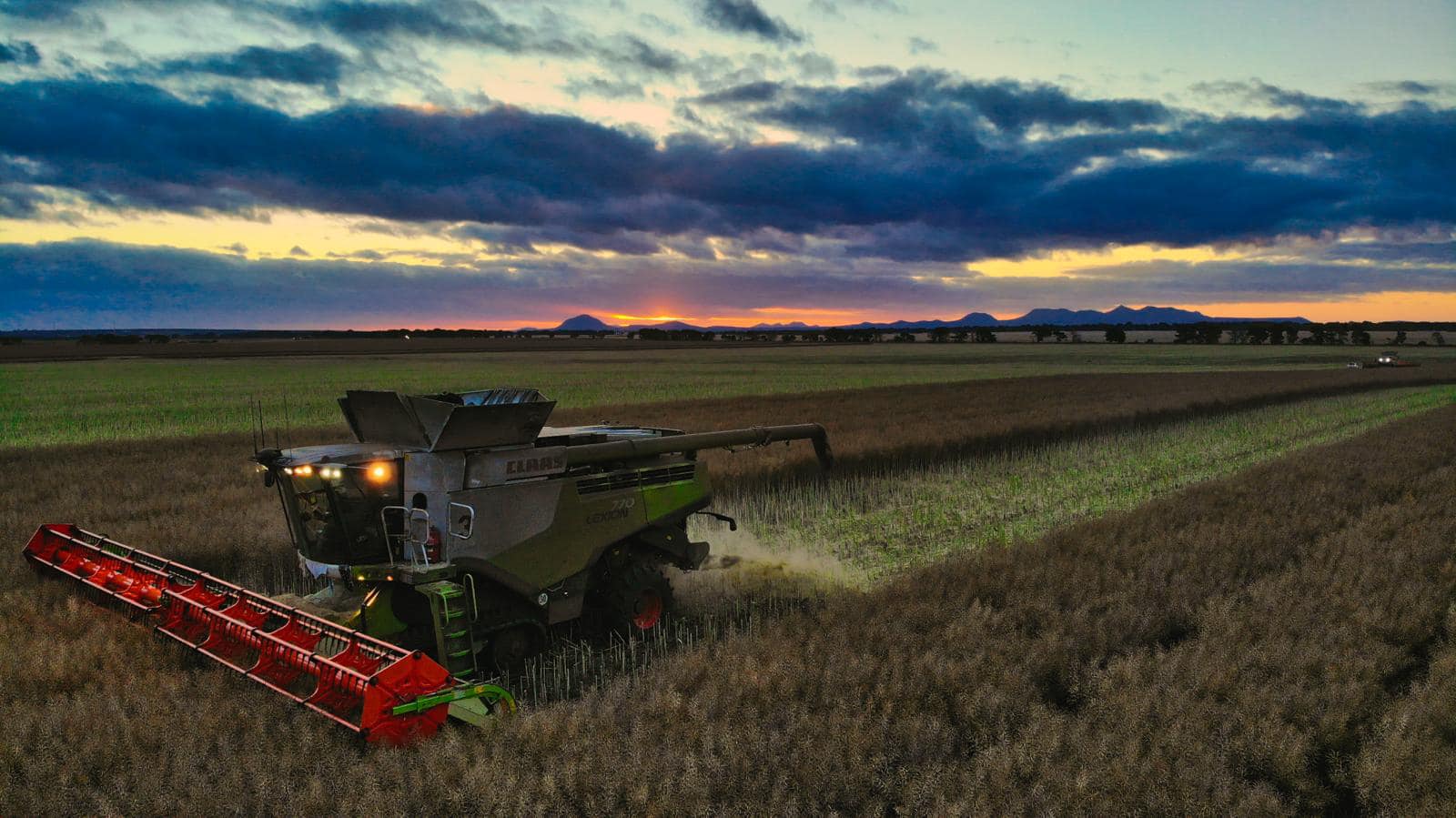
Harvesting canola in January 2022 on Redman Farms, Hopetoun, on WA’s south coast, where sheep numbers have fallen dramatically and cropping has increased over recent years. Photo: Redman Farms
A REPORT just released by tech company Digital Agriculture Services shows 900,000ha of Australian agricultural land has shifted from pasture to cropping in the past two years alone to give Australia a record cropping area of 23 million hectares.
Entitled From Pastures to Crops: Quantifying Australia’s Land-use Shift from 2020 Onwards, the report fleshes out the trend detected by DAS’ satellite-based digital imaging that shows “a sustained and measurable shift” from long-term pasture into cropping.
Improved crop varieties, the impending ban on exporting live sheep, and generational change are among the reasons DAS gives for the shift, which has been most pronounced in Western Australia and New South Wales.
Following is an edited version of the report:
Because agriculture is one of Australia’s largest asset classes and agricultural land use spans around 55 percent of the continent, or roughly 426Mha when excluding timber production, even small shifts in land use carry national significance.
The pattern DAS has observed is evident across mixed farming landscapes, high rainfall zones, and irrigation areas.
While the live sheep export ban is accelerating change in WA, DAS analysis shows the broader land-use transition is being shaped by a mix of structural, technological and agronomic forces that pre-date the policy decision.
This shift spans high-rainfall zones, mixed-farming belts, irrigation areas and traditionally low-rainfall marginal areas, signalling a more fundamental reconfiguration of Australian agricultural land use.
Land use change is now material, and monitoring this change sits on the critical path for governments, banks, insurers, commodity markets and climate policy.
Global food systems are highly sensitive to land and production shocks.
Grain supply depends on where crops are planted and how much area is in production, shaping export capacity, price dynamics and policy responses.
For this reason, measuring actual land-use change, including pasture-to-cropping conversion, is increasingly central to understanding market adaptation.
Quantifying the shift
DAS has calculated that 528,000ha in 2024, followed by 405,000 hectares in 2025, have shifted from pasture to cropping.
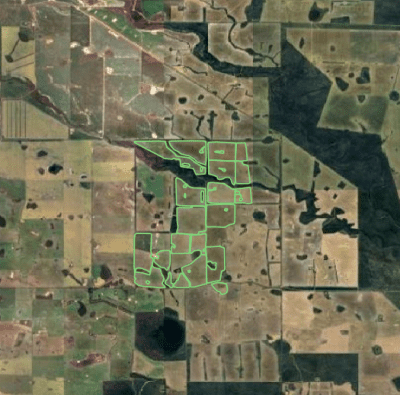
These WA Wheatbelt paddocks outlined in green switched from pasture to cropping in 2025. Image: DAS
WA and NSW together account for more than two-thirds of the 900,000ha total, with WA alone adding 120,000ha of newly cropped land last year, and contributing to WA’s largest winter crop area on record.
Across Australia, the total winter crop area now exceeds 23Mha, underpinning record cereal, oilseed and pulse production.
In WA, wheat yields are averaging 2.98 tonnes/ha, barley 3.67t/ha, and canola 1.92t/ha, all supported by improved crop water-use efficiency, subsoil drainage, and mechanisation.
These productivity gains have made cropping a competitive alternative to livestock enterprises.
Cropping appeal grows on stronger margins
The economics underpinning this transition are compelling.
DAS’s spatial models show that gross margins for cropping have outperformed sheep production for three consecutive seasons, reflecting stronger international grain prices and efficiency gains from scale.
While live export returns have remained flat or negative due to policy uncertainty, broadacre cropping has benefited from sustained demand in the Asia-Pacific feed and oilseed markets.
For many producers, the conversion of pasture to cropping is a risk-management move, mostly due to the market’s predictable export pathways and lower labour intensity.
However, it is important to note that cropping margins are sensitive to fertiliser, fuel and logistics costs, which have risen sharply since 2022.
Yield variability also introduces exposure to climatic volatility, particularly in low-rainfall zones where cropping has recently expanded.
Even so, with record barley production in WA of 7.13Mt, and WA’s second-largest canola crop on record at 3.84Mt, the data suggests that, in aggregate, the pivot is strengthening the economic position of many mixed farms, at least in the medium term.
Wide-ranging reasons for change
In addition to the impending ban on live sheep exports, expected to impact WA most heavily, DAS has identified the following factors as contributing to the national transition from pasture to cropping:
Land sales and new ownership reshaping enterprise types: DAS has observed that shifts from grazing to cropping occur because properties are sold to new owners who bring different capital, methods and production systems, more so than existing graziers changing their business model;
Broad decline in the sheep industry: Across multiple states, a long-term downturn in sheep numbers, labour availability, and enterprise confidence has pushed landholders out of grazing;
Improved margins supporting a general trend away from grazing: Stronger cropping margins in several key years since 2020 have supported a broader trend toward cropping in mixed-farming landscapes;
High rainfall zones becoming viable for cropping: Parts of WA’s south-west, Victoria’s Western District, and the southern tablelands of NSW have long struggled with waterlogged paddocks that limit cropping opportunities. Sub-surface drainage and tile drainage technologies are now enabling high-rainfall paddocks to support productive and reliable crop rotations for the first time;
Low rainfall zones achieving more consistent yields: In low-rainfall parts of the eastern WA Wheatbelt and similar environments, advances in plant breeding, agronomy, and soil amelioration have significantly improved water-use efficiency;
Shifts within irrigation regions: In regions like the Murray Irrigation Area, former dairy and intensive grazing properties are transitioning to cropping, thanks to more fertile soils, reliable irrigation access, consistent rainfall, and more favourable conditions for broadacre production. These characteristics are making cereals and oilseeds a strong alternative enterprise where cattle once dominated.
Land use change become more dynamic
DAS’ observations are based on mapped boundaries for fallowed and pasture paddocks, as well as those growing: canola, barley, chickpeas, faba beans, field peas, lentils, lupins, oats, wheat, and vetch over winter, and cotton, rice, corn, and sorghum over summer.
DAS can also estimate yield and production for each wheat, barley and canola paddock, and can track hay cuts and harvest.
As cropping expands and contracts across seasons and regions, the baseline assumptions used in market outlooks, export planning, infrastructure investment and risk settings will need to be refreshed more often.
DAS expects verified land-use data to move from “context” to “input” across government, banking, insurance, commodity markets and climate policy.
DAS predicts that decision-makers will rely less on static land-use snapshots and more on observed movement.
Land-use change will become a more visible and more consequential feature of Australian agriculture over the next decade.
DAS was established in 2017 in partnership with CSIRO, which remains as a partner.
Source: DAS