
BRAZIL has officially filled its tariff-free beef quota access into the United States for the 2026 calendar year – and done it in record time.
The latest weekly US Customs and Border Protection Service report issued overnight confirms that Brazil, which services the US market under the modest ‘Other Country’ MBN quota, has completely filled the entitlement, as of 6 January.
It means for the rest of the year Brazilian beef into the US is exposed to a 26.4pc out-of-quota tariff, making it less competitive against Australia, New Zealand and other exporters.
The ‘Other Country’ quota was already small at just 65,000 tonnes, but last week US President Trump took the surprise step of taking 13,000t from the quota and granting it specifically to the United Kingdom, in exchange for a reciprocal access for US beef into the UK.
Effectively, that has reduced the ‘Other Country’ quota used by Brazil and others this year to just 52,000t, hastening the quota triggering by Brazil even faster (see table).
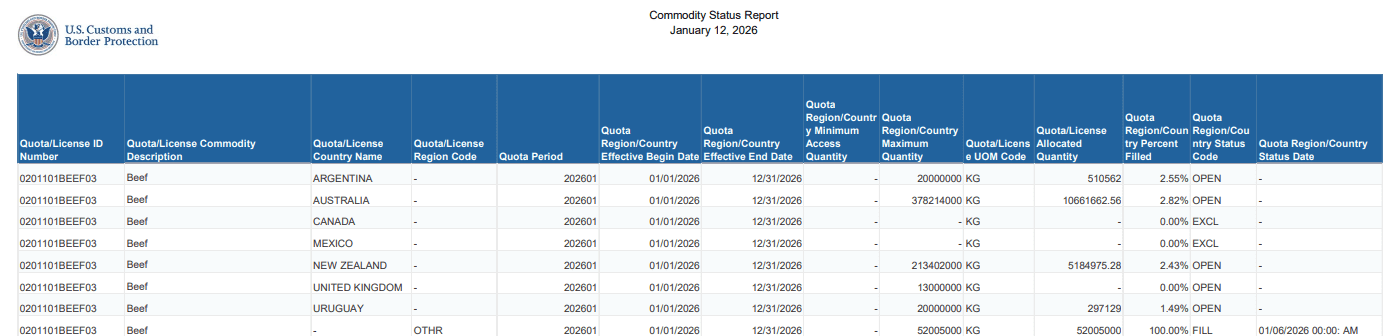
Click on table for a larger view
Carry-over Brazilian beef held in US bonded cold storage for release in the new calendar year was also a factor this year, as exporters and importers sought to escape the impact of the tariff – albeit briefly.
The 2026 international beef trading year has barely started, and already quotas and tariffs are exerting considerable influence on global meat trade – and are likely to do so throughout the next 11 months.
Without any Free Trade Agreement in place with the US, Brazil’s access is greatly limited, while Australia’s bilateral FTA quota into the US this year is 378,214t – of which we had filled only 10,660t (2.82pc) by 12 January.
As described yesterday, last year, Brazil filled its 2025 quota by 17 January. In 2024 the trigger was hit in March, and the year before that, in May.
The US remains desperately short of domestic beef in the opening stages of 2026.
Just prior to Christmas break, US meat and livestock markets commentor Derrell Peel from Oklahoma State University said the USDA’s December Cattle on Feed report showed a US feedlot inventory of 11.727 million head, down 2.1pc year-over-year, and the smallest December feedlot inventory since 2017.
Feedlot inventories declined year-over-year for 13 consecutive months, Dr Peel said, leading to a 12-month moving average total the lowest since October 2018.
The rather slow decline in feedlot inventories masked a sharper drop in feedlot placements and marketings, he said.
Feedlot placements in November were down 11.2pc year-on-year, and decreased 8.6pc in the last six months ended December.
Finished cattle marketings in November were down 11.8pc from a year ago and have decreased 7.9pc in the last six months compared to last year.
As of November, the average of US feedlot placements the past year were at the lowest level since April 2016, and average marketings were the lowest since August 2016, Dr Peel said.
Average feedlot placements and marketings have decreased more dramatically in 2025 as tightening feeder supplies were exacerbated by the lack of Mexican cattle imports, he said.