
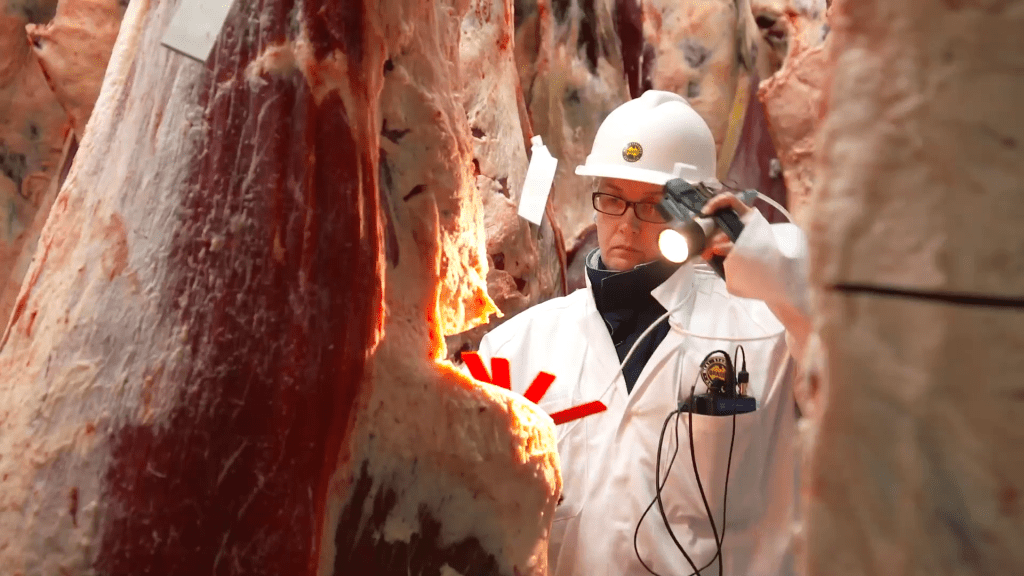
WHILE there are now about 1.6 million head of cattle on feed in Australia at any given time, it is impossible to tell for how many of those animals that carcase feedback gets back to the breeder involved.
One well-informed stakeholder attending Wednesday night’s Meat Standards Australia annual producer awards in Adelaide speculated that the figure – covering both vendor-bred feeders and those transacted before they enter the feedlot – might be considerably less than 50 percent.
With changes of ownership along the way in the cattle supply chain, clearly many cattle being MSA-graded do not see their performance data transferred back to the original breeder – where the greatest impact can occur through genetic decision-making.
Data collection and distribution, how that data is used, and the possibilities presented through technology and inter-connected industry systems became the central talking-point during an industry panel session held at this week’s MSA national awards dinner in Adelaide.
And the performance data transfer ‘problem’ is certainly not all from the feedlot or grass processor end of the supply chain.
Former ALFA president and southern NSW lotfeeder Tess Herbert, from Gundamain feedlot, said her business was ‘happy to share MSA performance data with anybody along the chain’, but in fact rarely got such requests from breeders.
Part of move to VBM
MLA managing director Mick Crowley told the gathering that better provision of carcase feedback to the original breeder was an important component in the industry’s objective of moving to a Value-Based Marketing model.
“We need producers all along the supply chain to have better access to all available data – particularly when we think about the starting point to driving progress on over-the-hooks outcomes from grading data – not just back to the last owner, but back to the breeder,” he said.
Those making the genetics decisions (ie the calf breeders) have a big impact on the profitability of the supply chain, from then on, Mr Crowley said.
And the principal applied equally in the grain and grassfed sectors, where ownership changes took place.
“We’re seeing things changing in the industry, where producers are specialising more – specialising in producing weaners, backgrounding or finishing – where trading of livestock occurs before slaughter. And others, depending on the season, may flex between finish steers or heifers on grass, or sell them lighter into a feedlot.
“It would be beneficial to understand that feedlot and chiller performance – because they are the beneficiaries of that progress – especially as lotfeeding continues to expand,” he said.
“If we can get that feedback data being used to inform more genetic decisions, we will only see the benefits for the broader supply chain.”
Mr Crowley said some data was clearly being transferred back to some breeders through participating supply chains, via the MyFeedback platform, “but given the feedback we heard last night (at the MSA dinner), and more broadly from livestock producers, there’s definitely demand for that information to go back to more breeders.”
“And in fact some people (breeders) are not aware of the willingness of participants in the supply chain to share information. We need to make it more seamless than that. The Australian industry has such good traceability systems through data connected to individual NLIS tags, better than any other beef-producing nation we should be able to link that data sharing together better. That’s the opportunity.”
“The culture is right, and there’s definitely a willingness to drive change in areas like this. It’s a people business, and we need that willingness to be involved in where we go next as an industry, and I think we’re poised to do that,” he said.
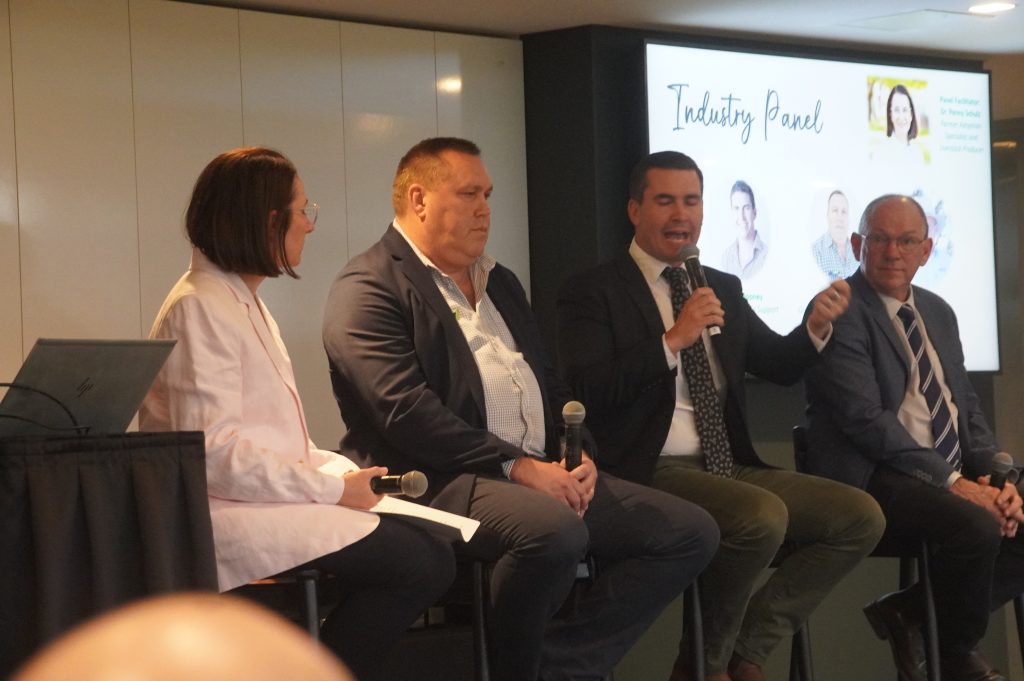
Teys Australia’s Ethan Mooney; Thomas Foods International’s Kevin Himmelberg; and veteran agent, RMA Network CEO and Beef Central columnist Chris Howie, facilitated by Penny Schultz
A panel session involving Teys Australia’s Ethan Mooney; Thomas Foods International’s Kevin Himmelberg; and veteran agent, RMA Network CEO and Beef Central columnist Chris Howie, facilitated by Penny Schultz explored a range of topics surrounding MSA. The power of data and feedback, and the adoption of new technologies to support that became a central theme.
Teys’ Ethan Mooney said MSA data was available to all cattle vendors (note his comments related to ‘vendors’, not ‘breeders’) supplying slaughter or feeder cattle to the company’s plants and feedlots, however it might not be coincidental that it tended to be vendors with consistently high performing cattle that requested it.
He said his company supported MLA’s aspiration to get more carcase data back to breeder-level, in cases where ownership changes along the way, and was interested to see how that might be executed.
Data access
Asked what Teys’ top livestock suppliers were doing differently that set them apart in MSA performance, Mr Mooney said data access and the use of that data was a ‘huge tool’ for better producers.
“Our top performers are those who are consistently looking at their data, and they are acting on it,” he said.
“It’s one thing to look at a set of carcase data, and another thing to act on it. We’re seeing producers making very informed decisions based on this information.”
“We provide as much data as a producer (specifically, vendor) can handle, and I hope we do a good job at that. We’re open to people asking for, and requesting more, and we work with quite a number of third-party providers who provide data analytics, at the request of vendors.”
“They take that on-farm data and link it with their kill data or induction feedback data from the feedlots Teys owns, to try to work out what they can do in terms of dam lines, sire lines, particular paddocks’ performance – all the way back to any of the tools on My MLA on feedback.”
“For a producer supplying feeder cattle to a Teys feedlot, not only can they get the feedback at induction, but also when they are killed as well, to look at marbling, ADG, feed conversion ratio and other data.”
TFI’s Kevin Himmelberg had a similar story.
“Using that data more effectively is going to be the fastest moving change, and how we incorporate that with AI and other emerging predictive tools,” he said.
“For me, it’s simply about delivering consistency and predictability in performance.”
Asked how important communication and feedback back to producers was in the Teys business, Mr Mooney said data and how it was used was now extremely important in the processor/cattle producer relationship.
“It’s central to the decisions that we make, with our suppliers. As that relationship gets closer with people – whether that’s direct or through an agent – the key is to allow people to make the informed decisions with the data they have, and being able to give them the data.
“We provide vendors with the opportunities that we may see, but it is up to them to make the decisions about which data best fits their particular business, and which opportunities around things like raising claims, HGP use or whatever to pursue – but its up to the producer to run with those, where they best see fit.”
Benchmarking gamechanger
Chris Howie said the analytics that MLA’s My Feedback platform had developed meant agents and their clients could now go in and benchmark the client’s processor cattle against next-door neighbours’, others in the region or across the state.
“From my perspective, that’s absolutely the next point of difference for the next generation agency or advisor in helping producers,” he said.
Mr Howie said base-line carcase performance information now available provided producers with a direct correlation with their investment.
“If you top-dress a certain paddock, you can actually look back next year and see whether it produced an extra 10,000kg of beef. The same applies to monitoring results from changing genetics.
“This is a game changer. Producers can now invest in their business, and if they pick up another 10,000kg of production as a result, they can monitor it – and it’s a great day.”
“These are the bits and pieces that we used to try to do using pencils and serviettes, to try to work out, but now we have data, and new tools like Optiweigh in field weighing units, to support this.”
Moving towards VBM
Moderator Penny Schultz said with carcase yield, offal value, animal health traits, it was now feeling like the industry was truly moving towards a value-based marketing model, underpinned by MSA.
She asked what VBM looked like for the processors on the panel.
“From a Teys perspective, were are absolutely committed to VBM, and making it work – in whatever that journey may look like,” Mr Mooney said.
“But the main point to make with VBM is it’s not a flick of the switch: It’s a complicated journey, but it’s a journey, nonetheless, that we as an industry need to take.”
“A group of industry representatives were in Rockhampton recently looking at the forerunner to some of that yield-based work, and we’re committed to that process, with a number of technologies along the way, whether that be CT scanning, yield-based measurement tools, or even back to live animal assessment for yield. We’re trying to do as much as we can to move that needle, but it will take time to complete that VBM journey, because we have to make sure it is right.”
“What we are looking at, effectively, is a new pricing mechanism for livestock, having used the current pricing mechanism for a very long time.
“As well as price signalling, the current system has been trusted for a long time, but we are getting to a stage now where we may have a new pricing mechanism. As long as we make that journey in a measured fashion, I think we’re heading in the right direction.”
Kevin Himmelberg said the biggest factor for change in his business was tools to deliver consistency and reliability.
“Being able to harvest that carcase and feedlot feedback, and also educate on Value-Based Marketing is going to be the hard thing,” he said.
Chris Howie’s parting words of advice to cattle vendors were to work out what they wanted the data for, first, before they started accessing and analysing it.